The CLCN7 Antibody (CAB6886) is a high-quality antibody developed for reliable detection and analysis of target proteins. This antibody, produced in rabbits, exhibits high reactivity with human samples and has been validated for use in Western blot applications. By binding specifically to the CLCN7 protein, this antibody allows for precise detection and analysis in a variety of cell types, making it an essential reagent for studies in osteoporosis, lysosomal storage disorders, and other bone-related diseases.CLCN7, also known as chloride channel 7, plays a crucial role in maintaining bone homeostasis and acidification of lysosomes.
This antibody is validated for use in WB, ELISA applications and has demonstrated reactivity against Human, Mouse, Rat samples.
Product Name:
CLCN7 Antibody
SKU:
CAB6886
Size:
20μL, 100μL
Reactivity:
Human, Mouse, Rat
Conjugate:
Unconjugated
Immunogen:
Recombinant protein (or fragment).This information is considered to be commercially sensitive.
Recommended starting concentration is 1 μg/mL. Please optimize the concentration based on your specific assay requirements.
Synonyms:
HOD, CLC7, CLC-7, OPTA2, OPTB4, PPP1R63, CLCN7
Positive Sample:
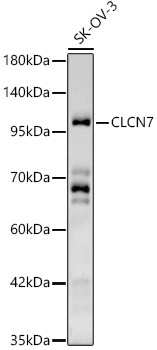
SK-OV-3
Cellular Localization:
Lysosome Membrane, Multi-Pass Membrane Protein.
Calculated MW:
89kDa
Observed MW:
110kDa
The product of this gene belongs to the CLC chloride channel family of proteins. Chloride channels play important roles in the plasma membrane and in intracellular organelles. This gene encodes chloride channel 7. Defects in this gene are the cause of osteopetrosis autosomal recessive type 4 (OPTB4), also called infantile malignant osteopetrosis type 2 as well as the cause of autosomal dominant osteopetrosis type 2 (OPTA2), also called autosomal dominant Albers-Schonberg disease or marble disease autosoml dominant. Osteopetrosis is a rare genetic disease characterized by abnormally dense bone, due to defective resorption of immature bone. OPTA2 is the most common form of osteopetrosis, occurring in adolescence or adulthood.
Purification Method
Affinity purification
Gene ID
1186
RRID
AB_2767446
Buffer Information
Store at -20℃. Avoid freeze / thaw cycles. Buffer: PBS containing 50% glycerol, preserved with proclin300 or sodium azide, pH 7.3.
Western blot analysis of lysates from SK-OV-3 cells, using CLCN7 Rabbit pAb (CAB6886) at 1:500 dilution. Secondary antibody: HRP-conjugated Goat anti-Rabbit IgG (H+L) (CABS014) at 1:10000 dilution. Lysates/proteins: 25μg per lane. Blocking buffer: 3% nonfat dry milk in TBST. Detection: ECL Basic Kit (AbGn00020). Exposure time: 180s.