C-Reactive Protein (CRP) Monoclonal Antibody (CAB19003)
The C-Reactive Protein (CRP) Monoclonal Antibody (CAB19003) is a high-quality antibody developed for reliable detection and analysis of target proteins. This highly specific antibody, derived from rabbit monoclonal sources, is optimized for detecting and quantifying CRP in human samples using Western blot techniques.CRP is an acute-phase reactant produced by the liver in response to inflammation, infection, or tissue damage. Elevated levels of CRP are associated with a wide range of inflammatory conditions, making it a valuable biomarker for monitoring disease progression and treatment response.
This antibody is validated for use in WB, IHC-P, ELISA applications and has demonstrated reactivity against Human, Mouse samples.
Product Name:
C-Reactive Protein (CRP) Monoclonal Antibody
SKU:
CAB19003
Size:
20μL, 100μL
Reactivity:
Human, Mouse
Clone Number:
ARC0341
Conjugate:
Unconjugated
Immunogen:
Synthetic peptide. This information is considered to be commercially sensitive.
Recommended starting concentration is 1 μg/mL. Please optimize the concentration based on your specific assay requirements.
Synonyms:
PTX1, C-Reactive Protein (CRP)
Positive Sample:
Human serum, Mouse serum
Cellular Localization:
Secreted.
Calculated MW:
23kDa
Observed MW:
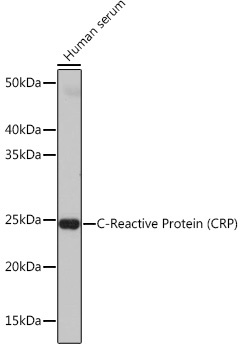
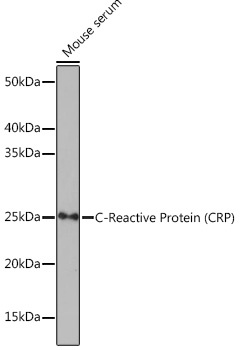
25kDa
The protein encoded by this gene belongs to the pentraxin family which also includes serum amyloid P component protein and pentraxin 3. Pentraxins are involved in complement activation and amplification via communication with complement initiation pattern recognition molecules, but also complement regulation via recruitment of complement regulators. The encoded protein has a calcium dependent ligand binding domain with a distinctive flattened beta-jellyroll structure. It exists in two forms as either a pentamer in circulation or as a nonsoluble monomer in tissues. It is involved in several host defense related functions based on its ability to recognize foreign pathogens and damaged cells of the host and to initiate their elimination by interacting with humoral and cellular effector systems in the blood. Consequently, the level of this protein in plasma increases greatly during acute phase response to tissue injury, infection, or other inflammatory stimuli. Elevated expression of the encoded protein is associated with severe acute respiratory syndrome coronavirus 2 (SARS‐CoV‐2) infection.
Purification Method
Affinity purification
Gene ID
1401
RRID
AB_2862495
Buffer Information
Store at -20℃. Avoid freeze / thaw cycles. Buffer: PBS containing 50% glycerol and 0.05% BSA, preserved with proclin300 or sodium azide, pH 7.3.
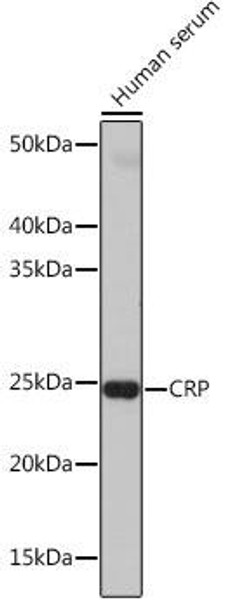
Western blot analysis of lysates from Human serum, using C-Reactive Protein (CRP) Rabbit mAb (CAB19003) at 1:1000 dilution. Secondary antibody: HRP-conjugated Goat anti-Rabbit IgG (H+L) (CABS014) at 1:10000 dilution. Lysates/proteins: 25μg per lane. Blocking buffer: 3% nonfat dry milk in TBST. Detection: ECL Basic Kit (AbGn00020). Exposure time: 5s.
Western blot analysis of lysates from Mouse serum, using C-Reactive Protein (CRP) Rabbit mAb (CAB19003) at 1:1000 dilution. Secondary antibody: HRP-conjugated Goat anti-Rabbit IgG (H+L) (CABS014) at 1:10000 dilution. Lysates/proteins: 25μg per lane. Blocking buffer: 3% nonfat dry milk in TBST. Detection: ECL Enhanced Kit (AbGn00021). Exposure time: 3min.