Description
CRYBB1 Antibody (CAB2590)
The CRYBB1 Antibody (CAB2590) is a high-quality antibody developed for reliable detection and analysis of target proteins. This antibody, produced in rabbits, is highly specific to human samples and has been validated for use in Western blot applications. By binding to the Crybb1 protein, researchers can detect and analyze its expression in various cell types, making it an ideal tool for studies related to eye development and diseases affecting the lens.
This antibody is validated for use in WB, ELISA applications and has demonstrated reactivity against Human, Mouse samples.
| Product Name: | CRYBB1 Antibody |
| SKU: | CAB2590 |
| Size: | 20μL, 100μL |
| Reactivity: | Human, Mouse |
| Conjugate: | Unconjugated |
| Immunogen: | Recombinant protein (or fragment).This information is considered to be commercially sensitive. | ||||
| Sequence: | MSQA AKAS ASAT VAVN PGPD TKGK GAPP AGTS PSPG TTLA PTTV PITS AKAA ELPP GNYR LVVF ELEN FQGR RAEF SGEC SNLA DRGF DRVR SIIV SAGP WVAF EQSN FRGE MFIL EKGE YPRW NTWS SSYR SDRL MSFR PIKM DAQE HKIS LFEG ANFK GNTI EIQG DDAP SLWV YGFS DRVG SVKV SSGT WVGY QYPG YRGY QYLL EPGD FRHW NEWG AFQP QMQS LRRL RDKQ WHLE GSFP VLAT EPPK | ||||
| Tested Applications: | WB ELISA | ||||
| Recommended Dilution: |
| ||||
| Synonyms: | CATCN3, CTRCT17, CRYBB1 |
| Positive Sample: | Mouse eye |
| Calculated MW: | 28kDa |
| Observed MW: | 28kDa |
Crystallins are separated into two classes: taxon-specific, or enzyme, and ubiquitous. The latter class constitutes the major proteins of vertebrate eye lens and maintains the transparency and refractive index of the lens. Since lens central fiber cells lose their nuclei during development, these crystallins are made and then retained throughout life, making them extremely stable proteins. Mammalian lens crystallins are divided into alpha, beta, and gamma families; beta and gamma crystallins are also considered as a superfamily. Alpha and beta families are further divided into acidic and basic groups. Seven protein regions exist in crystallins: four homologous motifs, a connecting peptide, and N- and C-terminal extensions. Beta-crystallins, the most heterogeneous, differ by the presence of the C-terminal extension (present in the basic group, none in the acidic group). Beta-crystallins form aggregates of different sizes and are able to self-associate to form dimers or to form heterodimers with other beta-crystallins. This gene, a beta basic group member, undergoes extensive cleavage at its N-terminal extension during lens maturation. It is also a member of a gene cluster with beta-A4, beta-B2, and beta-B3.
| Purification Method | Affinity purification |
| Gene ID | 1414 |
| RRID | AB_2764475 |
| Buffer Information | Store at -20℃. Avoid freeze / thaw cycles. Buffer: PBS containing 50% glycerol, preserved with proclin300 or sodium azide, pH 7.3. |
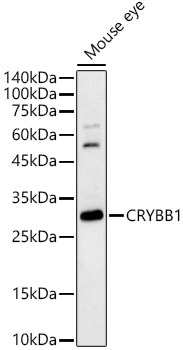 | Western blot analysis of various lysates, using CRYBB1 Rabbit pAb (CAB2590) at 1:1000 dilution. Secondary antibody: HRP-conjugated Goat anti-Rabbit IgG (H+L) (CABS014) at 1:10000 dilution. Lysates/proteins: 25μg per lane. Blocking buffer: 3% nonfat dry milk in TBST. Detection: ECL Basic Kit (AbGn00020). Exposure time: 180s. |