The DMP1 Antibody (CAB16832) is a high-quality antibody developed for reliable detection and analysis of target proteins. This antibody, produced in rabbits, is highly specific to human samples and is validated for use in Western blot applications.DMP1 is a key regulator of mineralization and is essential for proper bone formation and maintenance. Dysregulation of DMP1 has been implicated in various bone disorders, making it a target of interest in the field of skeletal biology research.
This antibody is validated for use in WB, ELISA applications and has demonstrated reactivity against Human, Mouse, Rat samples.
Product Name:
DMP1 Antibody
SKU:
CAB16832
Size:
20μL, 100μL
Reactivity:
Human, Mouse, Rat
Immunogen:
Synthetic peptide. This information is considered to be commercially sensitive.
Sequence:
MKIS ILLM FLWG LSCA LPVT RYQN NESE DSEE WKGH LAQA PTPP LESS ESSE GSKV SSEE QANE DPSD STQS EEGL GSDD HQYI YRLA GGFS RSTG KGGD
Tested Applications:
WBELISA
Recommended Dilution:
WB
1:100 - 1:500
ELISA
Recommended starting concentration is 1 μg/mL. Please optimize the concentration based on your specific assay requirements.
Dentin matrix acidic phosphoprotein is an extracellular matrix protein and a member of the small integrin binding ligand N-linked glycoprotein family. This protein, which is critical for proper mineralization of bone and dentin, is present in diverse cells of bone and tooth tissues. The protein contains a large number of acidic domains, multiple phosphorylation sites, a functional arg-gly-asp cell attachment sequence, and a DNA binding domain. In undifferentiated osteoblasts it is primarily a nuclear protein that regulates the expression of osteoblast-specific genes. During osteoblast maturation the protein becomes phosphorylated and is exported to the extracellular matrix, where it orchestrates mineralized matrix formation. Mutations in the gene are known to cause autosomal recessive hypophosphatemia, a disease that manifests as rickets and osteomalacia. The gene structure is conserved in mammals. Two transcript variants encoding different isoforms have been described for this gene.
Purification Method
Affinity purification
Gene ID
1758
RRID
AB_2769185
Buffer Information
Store at -20℃. Avoid freeze / thaw cycles. Buffer: PBS containing 50% glycerol, preserved with proclin300 or sodium azide, pH 7.3.
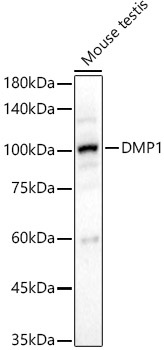
Western blot analysis of lysates from Mouse testis, using DMP1 Rabbit pAb (CAB16832) at 1:500 dilution. Secondary antibody: HRP-conjugated Goat anti-Rabbit IgG (H+L) (CABS014) at 1:10000 dilution. Lysates/proteins: 25μg per lane. Blocking buffer: 3% nonfat dry milk in TBST. Detection: ECL Basic Kit (AbGn00020). Exposure time: 90s.
Hinton P et al.
Development of In Vitro Models of Bone-Cartilage Crosstalk