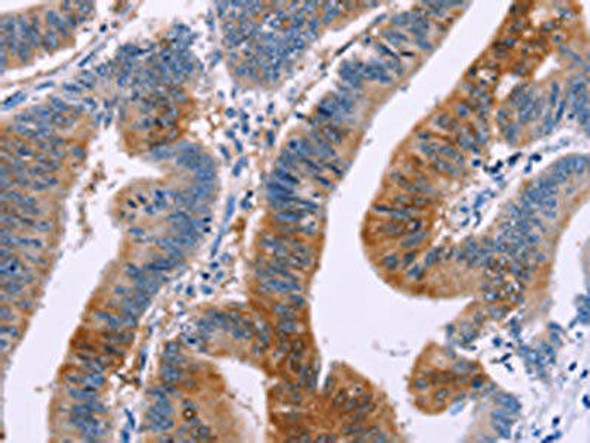
The DUSP13 Antibody (CAB6464) is a high-quality antibody developed for reliable detection and analysis of target proteins. This antibody, specifically raised in rabbits, exhibits high reactivity with human samples and has been validated for use in Western blot applications.DUSP13 is a key player in the modulation of cellular processes such as cell proliferation, differentiation, and survival by dephosphorylating specific target proteins. By targeting DUSP13 with this antibody, researchers can gain valuable insights into its function and regulatory mechanisms in different cell types.
This antibody is validated for use in WB, ELISA applications and has demonstrated reactivity against Mouse, Rat samples.
Product Name:
DUSP13 Antibody
SKU:
CAB6464
Size:
20μL, 100μL
Reactivity:
Mouse, Rat
Conjugate:
Unconjugated
Immunogen:
Recombinant protein (or fragment).This information is considered to be commercially sensitive.
Recommended starting concentration is 1 μg/mL. Please optimize the concentration based on your specific assay requirements.
Synonyms:
MDSP, TMDP, SKRP4, DUSP13
Positive Sample:
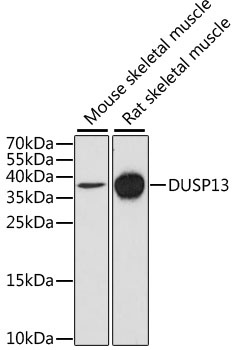
Mouse skeletal muscle, Rat skeletal muscle
Cellular Localization:
Cytoplasm.
Calculated MW:
6kDa/7kDa/9kDa/17kDa/20kDa/22kDa/27kDa
Observed MW:
36kDa
Members of the protein-tyrosine phosphatase superfamily cooperate with protein kinases to regulate cell proliferation and differentiation. This gene encodes a dual specificity phosphatase that acts on both phosphotyrosine and phosphoserine/threonine residues. The encoded protein is expressed in testis.
Purification Method
Affinity purification
Gene ID
51207
RRID
AB_2767066
Buffer Information
Store at -20℃. Avoid freeze / thaw cycles. Buffer: PBS with 0.01% thimerosal,50% glycerol,pH7.3.
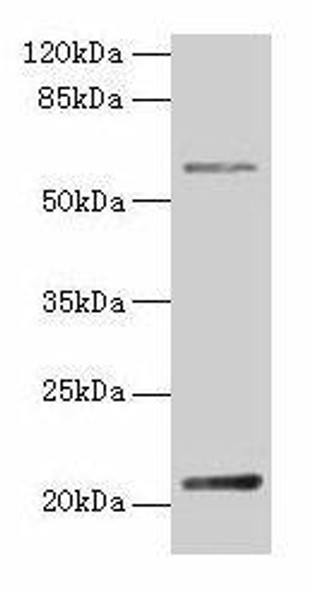
Western blot analysis of various lysates using DUSP13 Rabbit pAb (CAB6464) at 1:1000 dilution. Secondary antibody: HRP-conjugated Goat anti-Rabbit IgG (H+L) (CABS014) at 1:10000 dilution. Lysates/proteins: 25μg per lane. Blocking buffer: 3% nonfat dry milk in TBST. Detection: ECL Basic Kit (AbGn00020). Exposure time: 90s.