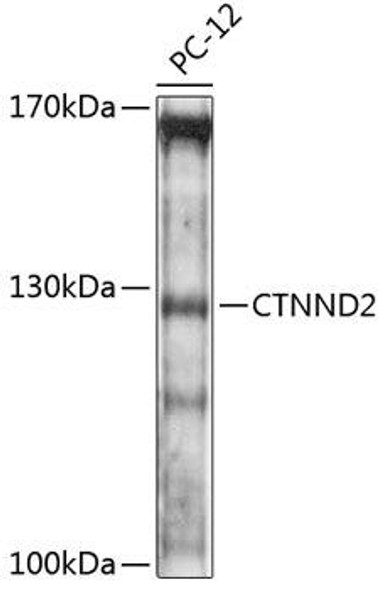
The ERCC6 Antibody (CAB18211) is a high-quality antibody developed for reliable detection and analysis of target proteins. This antibody, produced in rabbits, exhibits high reactivity with human samples and is suitable for Western blot applications. By binding to the ERCC6 protein, this antibody enables the detection and analysis of ERCC6 expression in various cell types, making it ideal for research in molecular biology and genomics.ERCC6, also known as Cockayne syndrome protein B (CSB), plays a crucial role in maintaining genomic stability by repairing DNA damage and promoting accurate transcription.
This antibody is validated for use in WB, IHC-P, ELISA applications and has demonstrated reactivity against Human, Mouse, Rat samples.
Product Name:
ERCC6 Antibody
SKU:
CAB18211
Size:
20μL, 100μL
Reactivity:
Human, Mouse, Rat
Immunogen:
Synthetic peptide. This information is considered to be commercially sensitive.
This gene encodes a DNA-binding protein that is important in transcription-coupled excision repair. The encoded protein has ATP-stimulated ATPase activity, interacts with several transcription and excision repair proteins, and may promote complex formation at DNA repair sites. Mutations in this gene are associated with Cockayne syndrome type B and cerebrooculofacioskeletal syndrome 1. Alternative splicing occurs between a splice site from exon 5 of this gene to the 3' splice site upstream of the open reading frame (ORF) of the adjacent gene, piggyback-derived-3 (GeneID:267004), which activates the alternative polyadenylation site downstream of the piggyback-derived-3 ORF. The resulting transcripts encode a fusion protein that shares sequence with the product of each individual gene.
Purification Method
Affinity purification
Gene ID
2074
RRID
AB_2861987
Buffer Information
Store at -20℃. Avoid freeze / thaw cycles. Buffer: Buffer: PBS containing 50% glycerol, preserved with proclin300 or sodium azide, pH 7.3.
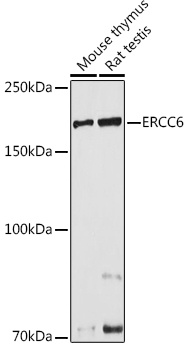
Western blot analysis of various lysates using ERCC6 Rabbit pAb (CAB18211) at 1:1000 dilution. Secondary antibody: HRP-conjugated Goat anti-Rabbit IgG (H+L) (CABS014) at 1:10000 dilution. Lysates/proteins: 25μg per lane. Blocking buffer: 3% nonfat dry milk in TBST. Detection: ECL Basic Kit (AbGn00020). Exposure time: 30s.
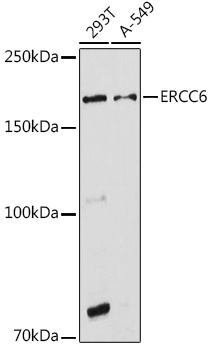
Western blot analysis of various lysates using ERCC6 Rabbit pAb (CAB18211) at 1:1000 dilution. Secondary antibody: HRP-conjugated Goat anti-Rabbit IgG (H+L) (CABS014) at 1:10000 dilution. Lysates/proteins: 25μg per lane. Blocking buffer: 3% nonfat dry milk in TBST. Detection: ECL Basic Kit (AbGn00020). Exposure time: 180s.
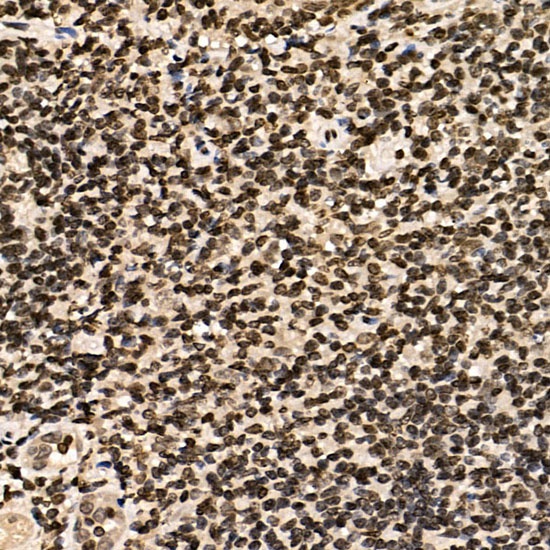
Immunohistochemistry analysis of paraffin-embedded Human tonsil using ERCC6 Rabbit pAb (CAB18211) at dilution of 1:100 (40x lens). Microwave antigen retrieval performed with 0.01M PBS Buffer (pH 7.2) prior to IHC staining.