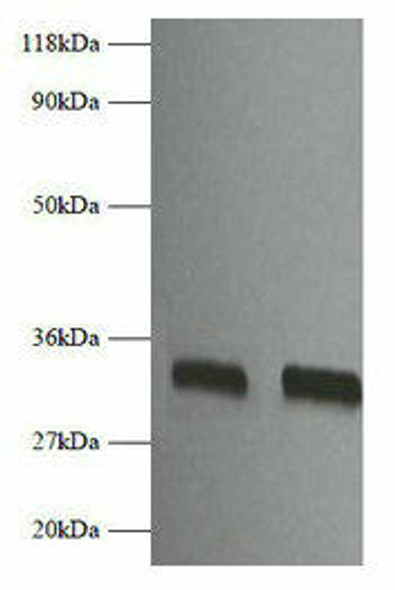
The FGF2 Monoclonal Antibody (CAB22330) is a high-quality antibody developed for reliable detection and analysis of target proteins. This antibody, produced using advanced monoclonal technology, is validated for use in various applications, including immunohistochemistry, immunoprecipitation, and flow cytometry.FGF2 is a potent growth factor that plays a crucial role in angiogenesis, tissue repair, and embryonic development. Dysregulation of FGF2 signaling is associated with various diseases, including cancer, cardiovascular disorders, and neurological conditions. The FGF2 Monoclonal Antibody allows researchers to investigate the expression and function of FGF2 in different cell types and tissues, providing insights into its role in disease pathogenesis and potential therapeutic interventions.
This antibody is validated for use in WB, ELISA applications and has demonstrated reactivity against Human, Mouse, Rat samples.
Product Name:
FGF2 Monoclonal Antibody
SKU:
CAB22330
Size:
20μL, 100μL
Reactivity:
Human, Mouse, Rat
Clone Number:
ARC51110
Conjugate:
Unconjugated
Immunogen:
Synthetic peptide. This information is considered to be commercially sensitive.
Recommended starting concentration is 1 μg/mL. Please optimize the concentration based on your specific assay requirements.
Synonyms:
BFGF, FGFB, FGF-2, HBGF-2, FGF2
Positive Sample:
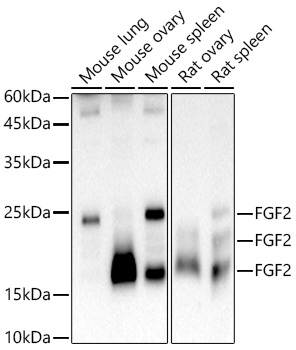
SKOV3, Mouse lung, Mouse ovary, Mouse spleen, Rat ovary, Rat spleen
Cellular Localization:
Nucleus, Secreted.
Calculated MW:
17kDa/21kDa/22kDa/30kDa
Observed MW:
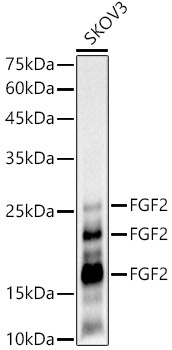
18kDa/22kDa/26kDa
The protein encoded by this gene is a member of the fibroblast growth factor (FGF) family. FGF family members bind heparin and possess broad mitogenic and angiogenic activities. This protein has been implicated in diverse biological processes, such as limb and nervous system development, wound healing, and tumor growth. The mRNA for this gene contains multiple polyadenylation sites, and is alternatively translated from non-AUG (CUG) and AUG initiation codons, resulting in five different isoforms with distinct properties. The CUG-initiated isoforms are localized in the nucleus and are responsible for the intracrine effect, whereas, the AUG-initiated form is mostly cytosolic and is responsible for the paracrine and autocrine effects of this FGF.
Purification Method
Affinity purification
Gene ID
2247
Buffer Information
Store at -20℃. Avoid freeze / thaw cycles. Buffer: PBS containing 50% glycerol and 0.05% BSA, preserved with proclin300 or sodium azide, pH 7.3.
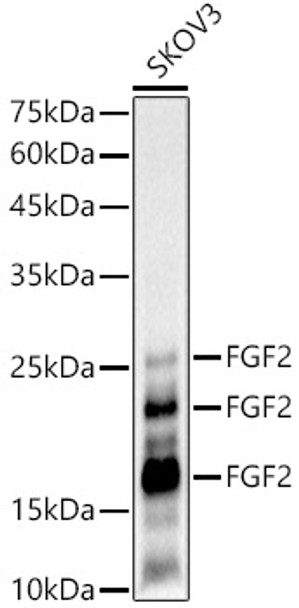
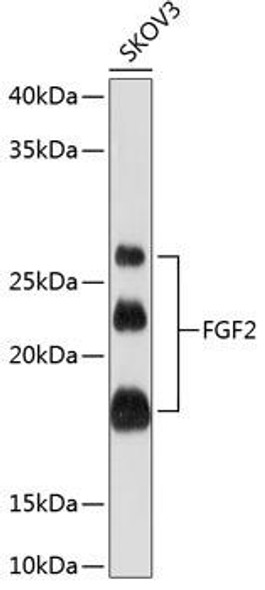
Western blot analysis of lysates from SKOV3 cells, using FGF2 Rabbit mAb (CAB22330) at 1:1000 dilution. Secondary antibody: HRP-conjugated Goat anti-Rabbit IgG (H+L) (CABS014) at 1:10000 dilution. Lysates/proteins: 25μg per lane. Blocking buffer: 3% nonfat dry milk in TBST. Detection: ECL Basic Kit (AbGn00020). Exposure time: 1s.
Western blot analysis of various lysates, using FGF2 Rabbit mAb (CAB22330) at 1:1000 dilution. Secondary antibody: HRP-conjugated Goat anti-Rabbit IgG (H+L) (CABS014) at 1:10000 dilution. Lysates/proteins: 25μg per lane. Blocking buffer: 3% nonfat dry milk in TBST. Detection: ECL Basic Kit (AbGn00020). Exposure time: 30s.