Description
FGFR2 Monoclonal Antibody (CAB19051)
The FGFR2 Monoclonal Antibody (CAB19051) is a high-quality antibody developed for reliable detection and analysis of target proteins. This antibody, produced using rabbit monoclonal technology, offers high specificity and sensitivity for detection of FGFR2 in human samples, making it an ideal choice for experiments in cancer biology and developmental biology.FGFR2 is a transmembrane receptor tyrosine kinase that plays a crucial role in cell proliferation and tissue repair. Dysregulation of FGFR2 has been implicated in various cancers, making it a promising therapeutic target for cancer treatment.
This antibody is validated for use in WB, ELISA applications and has demonstrated reactivity against Human, Mouse, Rat samples.
| Product Name: | FGFR2 Monoclonal Antibody |
| SKU: | CAB19051 |
| Size: | 20μL, 100μL |
| Reactivity: | Human, Mouse, Rat |
| Clone Number: | ARC0480 |
| Conjugate: | Unconjugated |
| Immunogen: | Synthetic peptide. This information is considered to be commercially sensitive. | ||||
| Sequence: | MVSW GRFI CLVV VTMA TLSL ARPS FSLV EDTT LEPE EPPT KYQI SQPE VYVA APGE SLEV RCLL KDAA VISW TKDG VHLG PNNR TVLI GEYL QIKG ATPR | ||||
| Tested Applications: | WB ELISA | ||||
| Recommended Dilution: |
| ||||
| Synonyms: | BEK, JWS, BBDS, CEK3, CFD1, ECT1, KGFR, TK14, TK25, BFR-1, CD332, K-SAM, R2 |
| Positive Sample: | 293T, A-431, Mouse brain, Mouse lung, Rat brain, Rat lung |
| Cellular Localization: | Cell Membrane, Cytoplasmic Vesicle, Golgi Apparatus, Secreted, Single-Pass Type I Membrane Protein. |
| Calculated MW: | 92kDa |
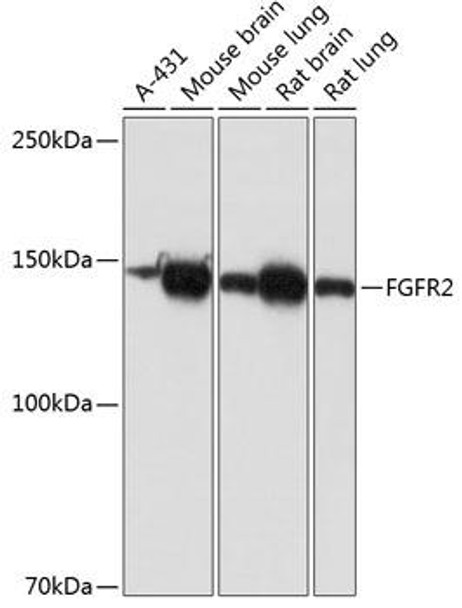
| Observed MW: | 145kDa |
The protein encoded by this gene is a member of the fibroblast growth factor receptor family, where amino acid sequence is highly conserved between members and throughout evolution. FGFR family members differ from one another in their ligand affinities and tissue distribution. A full-length representative protein consists of an extracellular region, composed of three immunoglobulin-like domains, a single hydrophobic membrane-spanning segment and a cytoplasmic tyrosine kinase domain. The extracellular portion of the protein interacts with fibroblast growth factors, setting in motion a cascade of downstream signals, ultimately influencing mitogenesis and differentiation. This particular family member is a high-affinity receptor for acidic, basic and/or keratinocyte growth factor, depending on the isoform. Mutations in this gene are associated with Crouzon syndrome, Pfeiffer syndrome, Craniosynostosis, Apert syndrome, Jackson-Weiss syndrome, Beare-Stevenson cutis gyrata syndrome, Saethre-Chotzen syndrome, and syndromic craniosynostosis. Multiple alternatively spliced transcript variants encoding different isoforms have been noted for this gene.
| Purification Method | Affinity purification |
| Gene ID | 2263 |
| RRID | AB_2862544 |
| Buffer Information | Store at -20℃. Avoid freeze / thaw cycles. Buffer: PBS containing 50% glycerol and 0.05% BSA, preserved with proclin300 or sodium azide, pH 7.3. |
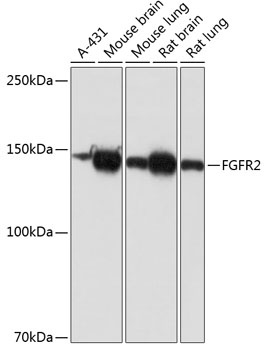 | Western blot analysis of various lysates using [KO Validated] FGFR2 Rabbit mAb (CAB19051) at 1:1000 dilution. Secondary antibody: HRP-conjugated Goat anti-Rabbit IgG (H+L) (CABS014) at 1:10000 dilution. Lysates/proteins: 25μg per lane. Blocking buffer: 3% nonfat dry milk in TBST. Detection: ECL Basic Kit (AbGn00020). Exposure time: 3min. |
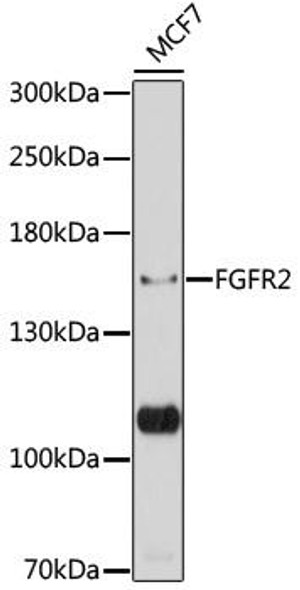
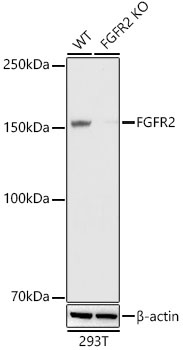 | Western blot analysis of lysates from wild type(WT) and FGFR2 knockout (KO) 293T cells, using [KO Validated] FGFR2 Rabbit mAb (CAB19051) at 1:1000 dilution. Secondary antibody: HRP-conjugated Goat anti-Rabbit IgG (H+L) (CABS014) at 1:10000 dilution. Lysates/proteins: 25μg per lane. Blocking buffer: 3% nonfat dry milk in TBST. Detection: ECL Basic Kit (AbGn00020). Exposure time: 1s. |