Description
FGFR4 Monoclonal Antibody (CAB9197)
The FGFR4 Monoclonal Antibody (CAB9197) is a high-quality antibody developed for reliable detection and analysis of target proteins. This antibody, raised in rabbits, offers high specificity and sensitivity in detecting FGFR4 in human samples, making it ideal for use in various research applications such as Western blotting.FGFR4 is a member of the FGFR family, known for its involvement in signal transduction pathways that regulate cell growth and development. Dysregulation of FGFR4 signaling has been linked to various diseases, including cancer, making it a promising target for therapeutic interventions.
This antibody is validated for use in WB, ELISA applications and has demonstrated reactivity against Human, Mouse, Rat samples.
| Product Name: | FGFR4 Monoclonal Antibody |
| SKU: | CAB9197 |
| Size: | 20μL, 100μL |
| Reactivity: | Human, Mouse, Rat |
| Clone Number: | ARC1474 |
| Conjugate: | Unconjugated |
| Immunogen: | Synthetic peptide. This information is considered to be commercially sensitive. | ||||
| Sequence: | SLLR EGHR MDRP PHCP PELY GLMR ECWH AAPS QRPT FKQL VEAL DKVL LAVS EEYL DLRL TFGP YSPS GGDA SSTC SSSD SVFS HDPL PLGS SSFP FGSG VQT | ||||
| Tested Applications: | WB ELISA | ||||
| Recommended Dilution: |
| ||||
| Synonyms: | TKF, JTK2, CD334, FGFR4 |
| Positive Sample: | Hep G2, HuH-7, Mouse liver, Rat liver |
| Cellular Localization: | Cell Membrane, Cytoplasm, Endoplasmic Reticulum, Endosome, Secreted, Single-Pass Type I Membrane Protein. |
| Calculated MW: | 88kDa |
| Observed MW: | 95kDa/125kDa |
The protein encoded by this gene is a tyrosine kinase and cell surface receptor for fibroblast growth factors. The encoded protein is involved in the regulation of several pathways, including cell proliferation, cell differentiation, cell migration, lipid metabolism, bile acid biosynthesis, vitamin D metabolism, glucose uptake, and phosphate homeostasis. This protein consists of an extracellular region, composed of three immunoglobulin-like domains, a single hydrophobic membrane-spanning segment, and a cytoplasmic tyrosine kinase domain. The extracellular portion interacts with fibroblast growth factors, setting in motion a cascade of downstream signals, ultimately influencing mitogenesis and differentiation.
| Purification Method | Affinity purification |
| Gene ID | 2264 |
| RRID | AB_2863686 |
| Buffer Information | Store at -20℃. Avoid freeze / thaw cycles. Buffer: PBS containing 50% glycerol and 0.05% BSA, preserved with proclin300 or sodium azide, pH 7.3. |
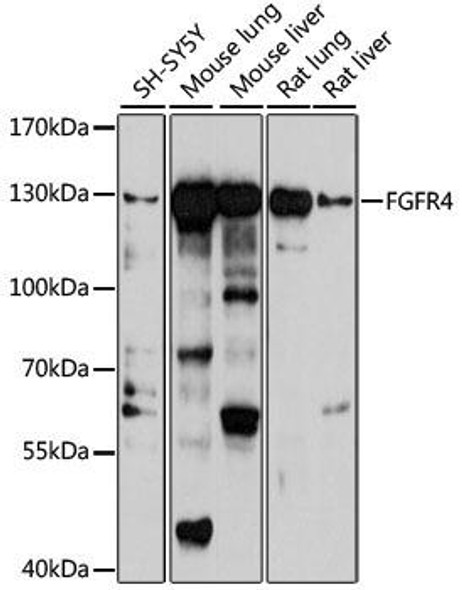
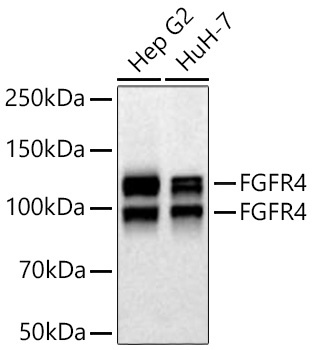 | Western blot analysis of various lysates using FGFR4 Rabbit mAb (CAB9197) at 1:1000 dilution incubated at room temperature for 1.5 hours. Secondary antibody: HRP-conjugated Goat anti-Rabbit IgG (H+L) (CABS014) at 1:10000 dilution. Lysates/proteins: 25 μg per lane. Blocking buffer: 3% nonfat dry milk in TBST. Detection: ECL Basic Kit (AbGn00020). Exposure time: 60 s. |
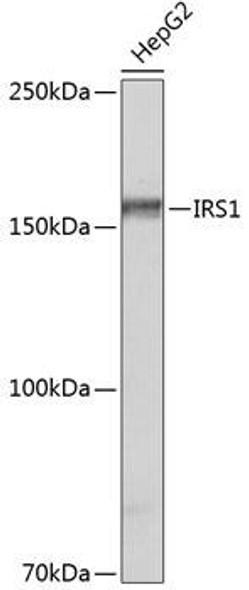
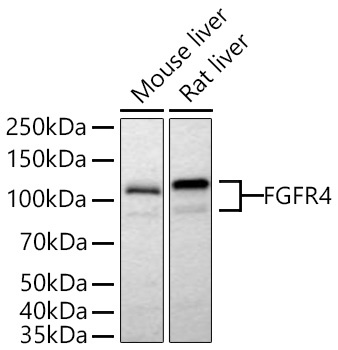 | Western blot analysis of various lysates using FGFR4 Rabbit mAb (CAB9197) at 1:1000 dilution incubated at room temperature for 1.5 hours. Secondary antibody: HRP-conjugated Goat anti-Rabbit IgG (H+L) (CABS014) at 1:10000 dilution. Lysates/proteins: 25 μg per lane. Blocking buffer: 3% nonfat dry milk in TBST. Detection: ECL Basic Kit (AbGn00020). Exposure time: 90 s. |