The Furin Monoclonal Antibody (CAB5043) is a high-quality antibody developed for reliable detection and analysis of target proteins. This gene encodes a member of the subtilisin-like proprotein convertase family, which includes proteases that process protein and peptide precursors trafficking through regulated or constitutive branches of the secretory pathway. It encodes a type 1 membrane bound protease that is expressed in many tissues, including neuroendocrine, liver, gut, and brain. The encoded protein undergoes an initial autocatalytic processing event in the ER and then sorts to the trans-Golgi network through endosomes where a second autocatalytic event takes place and the catalytic activity is acquired. Like other members of this convertase family, the product of this gene specifically cleaves substrates at single or paired basic residues. Some of its substrates include proparathyroid hormone, transforming growth factor beta 1 precursor, proalbumin, pro-beta-secretase, membrane type-1 matrix metalloproteinase, beta subunit of pro-nerve growth factor and von Willebrand factor. It is thought to be one of the proteases responsible for the activation of HIV envelope glycoproteins gp160 and gp140, and may play a role in tumor progression. Unlike SARS-CoV and other coronaviruses, the spike protein of SARS-CoV-2 is thought to be uniquely cleaved by this protease. Alternative splicing results in multiple transcript variants.
This antibody is validated for use in WB, ELISA applications and has demonstrated reactivity against Human, Mouse samples.
Product Name:
Furin Monoclonal Antibody
SKU:
CAB5043
Size:
100μL, 20μL
Reactivity:
Human, Mouse
Clone Number:
ARC1221
Conjugate:
Unconjugated
Immunogen:
Synthetic peptide. This information is considered to be commercially sensitive.
Tested Applications:
WBELISA
Recommended Dilution:
WB
1:500 - 1:2000
ELISA
Recommended starting concentration is 1 μg/mL. Please optimize the concentration based on your specific assay requirements.
Synonyms:
FUR, PACE, SPC1, PCSK3, Furin
Positive Sample:
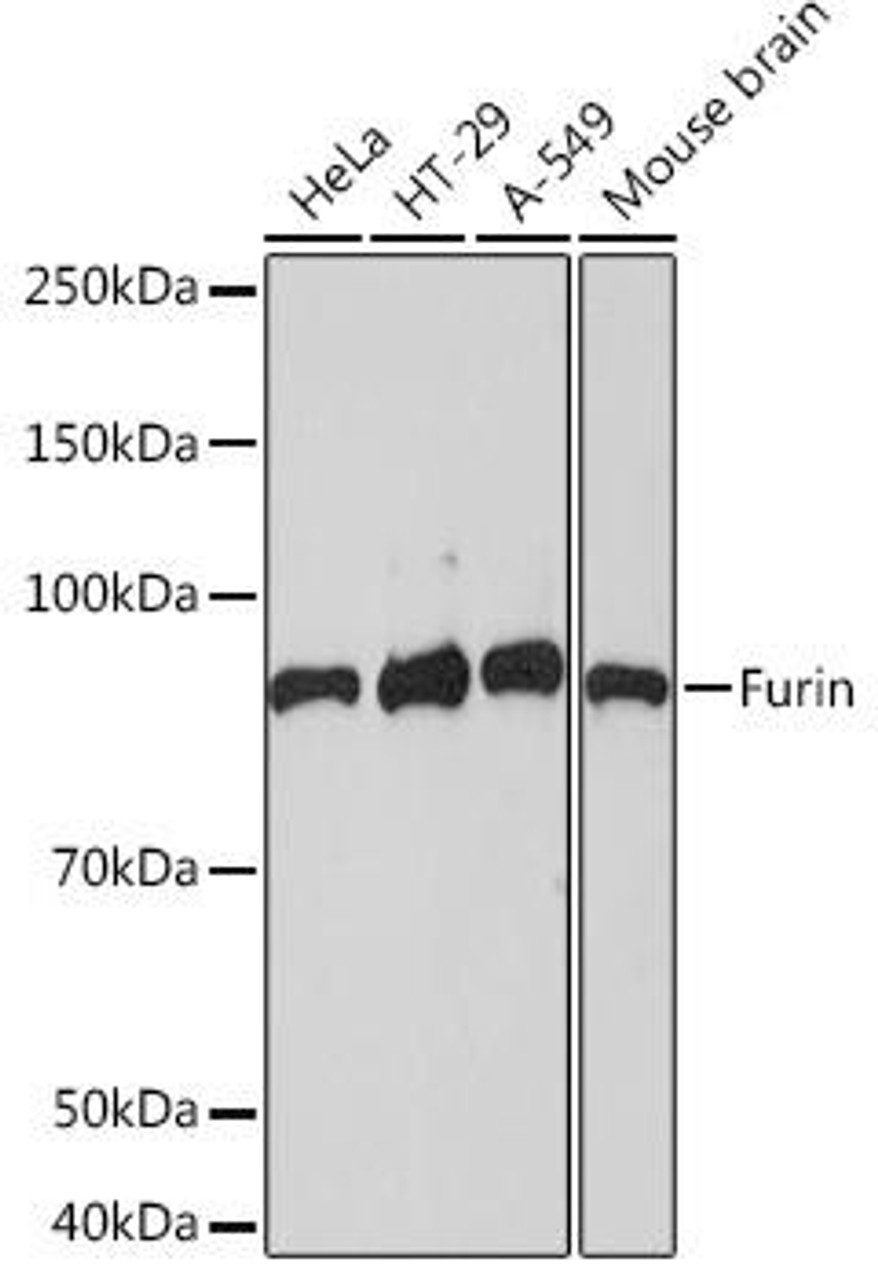
HeLa, HT-29, A-549, Mouse brain
Cellular Localization:
Cell Membrane, Golgi Apparatus, Single-Pass Type I Membrane Protein, Trans-Golgi Network Membrane, Secreted, Endosome Membrane .
Calculated MW:
87kDa
Observed MW:
90kDa
This gene encodes a member of the subtilisin-like proprotein convertase family, which includes proteases that process protein and peptide precursors trafficking through regulated or constitutive branches of the secretory pathway. It encodes a type 1 membrane bound protease that is expressed in many tissues, including neuroendocrine, liver, gut, and brain. The encoded protein undergoes an initial autocatalytic processing event in the ER and then sorts to the trans-Golgi network through endosomes where a second autocatalytic event takes place and the catalytic activity is acquired. Like other members of this convertase family, the product of this gene specifically cleaves substrates at single or paired basic residues. Some of its substrates include proparathyroid hormone, transforming growth factor beta 1 precursor, proalbumin, pro-beta-secretase, membrane type-1 matrix metalloproteinase, beta subunit of pro-nerve growth factor and von Willebrand factor. It is thought to be one of the proteases responsible for the activation of HIV envelope glycoproteins gp160 and gp140, and may play a role in tumor progression. Unlike SARS-CoV and other coronaviruses, the spike protein of SARS-CoV-2 is thought to be uniquely cleaved by this protease. Alternative splicing results in multiple transcript variants.
Purification Method
Affinity purification
Gene ID
5045
RRID
AB_2863423
Buffer Information
Store at -20℃. Avoid freeze / thaw cycles. Buffer: PBS containing 50% glycerol and 0.05% BSA, preserved with proclin300 or sodium azide, pH 7.3.
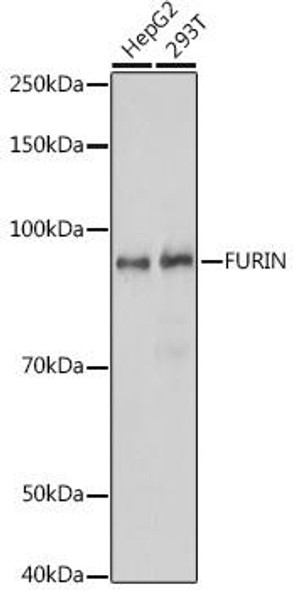
Western blot analysis of various lysates using Furin Rabbit mAb (CAB5043) at 1:1000 dilution. Secondary antibody: HRP-conjugated Goat anti-Rabbit IgG (H+L) (AS014) at 1:10000 dilution. Lysates/proteins: 25μg per lane. Blocking buffer: 3% nonfat dry milk in TBST. Detection: ECL Basic Kit (AbGn00020). Exposure time: 90s.