Description
GPX1 Monoclonal Antibody (CAB23519)
The GPX1 Monoclonal Antibody (CAB23519) is a high-quality antibody developed for reliable detection and analysis of target proteins. GPX1 is an essential antioxidant enzyme that plays a key role in protecting cells from oxidative damage. This antibody, produced through stringent monoclonal antibody development techniques, exhibits high specificity and sensitivity towards GPX1 in human samples, making it suitable for a wide range of applications including Western blotting and immunohistochemistry.
This antibody is validated for use in WB, IHC-P, ELISA applications and has demonstrated reactivity against Human, Mouse, Rat samples.
| Product Name: | GPX1 Monoclonal Antibody |
| SKU: | CAB23519 |
| Size: | 20μL, 100μL |
| Reactivity: | Human, Mouse, Rat |
| Clone Number: | ARC53251 |
| Conjugate: | Unconjugated |
| Immunogen: | Synthetic peptide. This information is considered to be commercially sensitive. | ||||||
| Sequence: | Email for sequence | ||||||
| Tested Applications: | WB IHC-P ELISA | ||||||
| Recommended Dilution: |
| ||||||
| Synonyms: | GPXD, GSHPX1, GPX1 |
| Positive Sample: | THP-1, Mouse kidney, Rat Liver |
| Cellular Localization: | Cytoplasm. |
| Calculated MW: | 22kDa |
| Observed MW: | 22kDa |
The protein encoded by this gene belongs to the glutathione peroxidase family, members of which catalyze the reduction of organic hydroperoxides and hydrogen peroxide (H2O2) by glutathione, and thereby protect cells against oxidative damage. Other studies indicate that H2O2 is also essential for growth-factor mediated signal transduction, mitochondrial function, and maintenance of thiol redox-balance; therefore, by limiting H2O2 accumulation, glutathione peroxidases are also involved in modulating these processes. Several isozymes of this gene family exist in vertebrates, which vary in cellular location and substrate specificity. This isozyme is the most abundant, is ubiquitously expressed and localized in the cytoplasm, and whose preferred substrate is hydrogen peroxide. It is also a selenoprotein, containing the rare amino acid selenocysteine (Sec) at its active site. Sec is encoded by the UGA codon, which normally signals translation termination. The 3' UTRs of selenoprotein mRNAs contain a conserved stem-loop structure, designated the Sec insertion sequence (SECIS) element, that is necessary for the recognition of UGA as a Sec codon, rather than as a stop signal. This gene contains an in-frame GCG trinucleotide repeat in the coding region, and three alleles with 4, 5 or 6 repeats have been found in the human population. The allele with 4 GCG repeats has been significantly associated with breast cancer risk in premenopausal women. Alternatively spliced transcript variants have been found for this gene. Pseudogenes of this locus have been identified on chromosomes X and 21.
| Purification Method | Affinity purification |
| Gene ID | 2876 |
| Buffer Information | Store at -20℃. Avoid freeze / thaw cycles. Buffer: PBS containing 50% glycerol and 0.05% BSA, preserved with proclin300 or sodium azide, pH 7.3. |
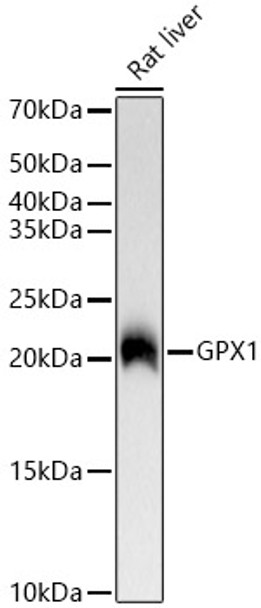
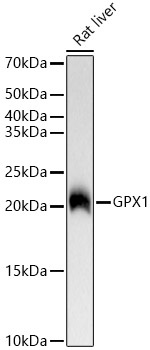 | Western blot analysis of lysates from Rat liver, using GPX1 Rabbit mAb (CAB23519) at 1:12000 dilution. Secondary antibody: HRP-conjugated Goat anti-Rabbit IgG (H+L) (CABS014) at 1:10000 dilution. Lysates/proteins: 25μg per lane. Blocking buffer: 3% nonfat dry milk in TBST. Detection: ECL Basic Kit (AbGn00020). Exposure time: 1s. |
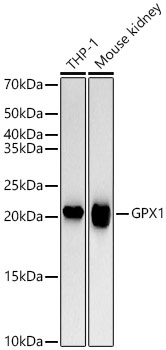 | Western blot analysis of various lysates, using GPX1 Rabbit mAb (CAB23519) at 1:12000 dilution. Secondary antibody: HRP-conjugated Goat anti-Rabbit IgG (H+L) (CABS014) at 1:10000 dilution. Lysates/proteins: 25μg per lane. Blocking buffer: 3% nonfat dry milk in TBST. Detection: ECL Basic Kit (AbGn00020). Exposure time: 10s. |
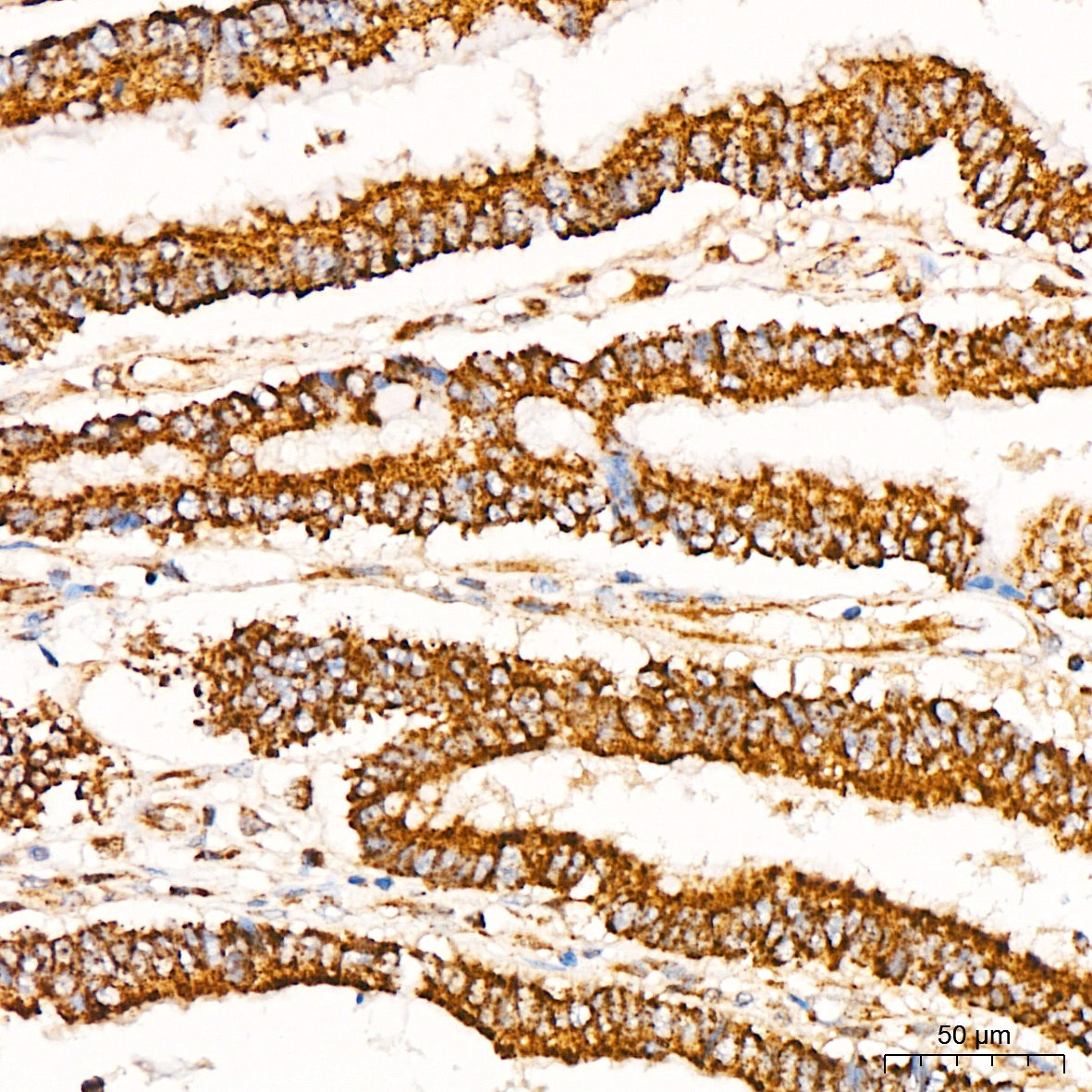 | Immunohistochemistry analysis of paraffin-embedded Human colon carcinoma tissue using GPX1 Rabbit mAb (CAB23519) at a dilution of 1:200 (40x lens). High pressure antigen retrieval performed with 0.01M Citrate buffer (pH 6.0) prior to IHC staining. |