Description
GPX3 Antibody (CAB12956)
The GPX3 Antibody (CAB12956) is a high-quality antibody developed for reliable detection and analysis of target proteins. This antibody, raised in rabbits, is highly specific for human samples and is validated for use in various applications including Western blotting.GPX3 is a crucial enzyme that helps detoxify harmful reactive oxygen species, making it a key player in maintaining cellular health and protecting against oxidative stress-related diseases. Research into GPX3 can provide insights into conditions such as cancer, cardiovascular disease, and neurodegenerative disorders where oxidative damage plays a significant role.
This antibody is validated for use in WB, ELISA applications and has demonstrated reactivity against Mouse, Rat samples.
| Product Name: | GPX3 Antibody |
| SKU: | CAB12956 |
| Size: | 20μL, 100μL |
| Reactivity: | Mouse, Rat |
| Conjugate: | Unconjugated |
| Immunogen: | Synthetic peptide. This information is considered to be commercially sensitive. | ||||
| Sequence: | QSRG QEKS KMDC HGGI SG | ||||
| Tested Applications: | WB ELISA | ||||
| Recommended Dilution: |
| ||||
| Synonyms: | GPx-P, GSHPx-3, GSHPx-P, GPX3 |
| Positive Sample: | Mouse kidney |
| Cellular Localization: | Secreted. |
| Calculated MW: | 26kDa |
| Observed MW: | 25kDa |
The protein encoded by this gene belongs to the glutathione peroxidase family, members of which catalyze the reduction of organic hydroperoxides and hydrogen peroxide (H2O2) by glutathione, and thereby protect cells against oxidative damage. Several isozymes of this gene family exist in vertebrates, which vary in cellular location and substrate specificity. This isozyme is secreted, and is abundantly found in plasma. Downregulation of expression of this gene by promoter hypermethylation has been observed in a wide spectrum of human malignancies, including thyroid cancer, hepatocellular carcinoma and chronic myeloid leukemia. This isozyme is also a selenoprotein, containing the rare amino acid selenocysteine (Sec) at its active site. Sec is encoded by the UGA codon, which normally signals translation termination. The 3' UTRs of selenoprotein mRNAs contain a conserved stem-loop structure, designated the Sec insertion sequence (SECIS) element, that is necessary for the recognition of UGA as a Sec codon, rather than as a stop signal. Alternatively spliced transcript variants have been found for this gene.
| Purification Method | Affinity purification |
| Gene ID | 2878 |
| RRID | AB_2759802 |
| Buffer Information | Store at -20℃. Avoid freeze / thaw cycles. Buffer: PBS containing 50% glycerol, preserved with proclin300 or sodium azide, pH 7.3. |
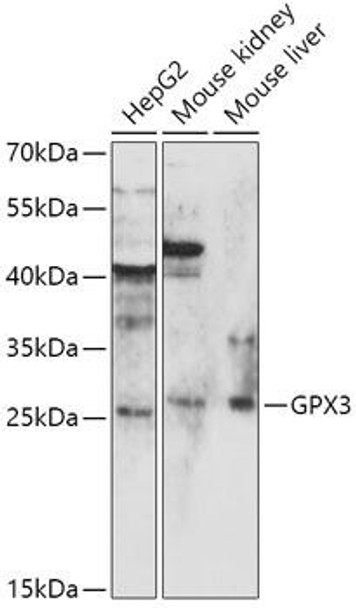
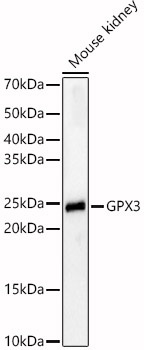 | Western blot analysis of lysates from Mouse kidney, using GPX3 Rabbit pAb (CAB12956) at 1:800 dilution. Secondary antibody: HRP-conjugated Goat anti-Rabbit IgG (H+L) (CABS014) at 1:10000 dilution. Lysates/proteins: 25μg per lane. Blocking buffer: 3% nonfat dry milk in TBST. Detection: ECL Basic Kit (AbGn00020). Exposure time: 60s. |