

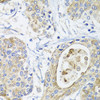
Description
GSTA2 Antibody (CAB7678)
The GSTA2 Antibody (CAB7678) is a high-quality antibody developed for reliable detection and analysis of target proteins. This antibody, raised in rabbits, is highly specific to human samples and has been validated for use in Western blot applications. By binding to the GSTA2 protein, this antibody allows for the detection and analysis of GSTA2 expression in various cell types, making it ideal for studies in toxicology, pharmacology, and cancer research.
This antibody is validated for use in WB, ELISA applications and has demonstrated reactivity against Human, Mouse, Rat samples.
| Product Name: | GSTA2 Antibody |
| SKU: | CAB7678 |
| Size: | 20μL, 100μL |
| Reactivity: | Human, Mouse, Rat |
| Conjugate: | Unconjugated |
| Immunogen: | Recombinant protein (or fragment).This information is considered to be commercially sensitive. | ||||
| Sequence: | MAEK PKLH YSNI RGRM ESIR WLLA AAGV EFEE KFIK SAED LDKL RNDG YLMF QQVP MVEI DGMK LVQT RAIL NYIA SKYN LYGK DIKE KALI DMYI EGIA DLGE MILL LPFS QPEE QDAK LALI QEKT KNRY FPAF EKVL KSHG QDYL VGNK LSRA DIHL VELL YYVE ELDS SLIS SFPL LKAL KTRI SNLP TVKK FLQP GSPR KPPM DEKS LEES RKIF RF | ||||
| Tested Applications: | WB ELISA | ||||
| Recommended Dilution: |
| ||||
| Synonyms: | GST2, GTA2, GTH2, GSTA2-2, GSTA2 |
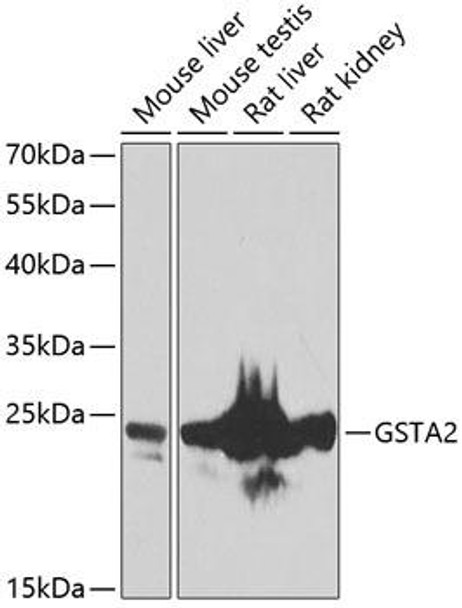
| Positive Sample: | Mouse liver, Mouse testis, Rat liver, Rat kidney |
| Cellular Localization: | Cytoplasm. |
| Calculated MW: | 26kDa |
| Observed MW: | 25kDa |
Cytosolic and membrane-bound forms of glutathione S-transferase are encoded by two distinct supergene families. These enzymes function in the detoxification of electrophilic compounds, including carcinogens, therapeutic drugs, environmental toxins and products of oxidative stress, by conjugation with glutathione. The genes encoding these enzymes are known to be highly polymorphic. These genetic variations can change an individual's susceptibility to carcinogens and toxins as well as affect the toxicity and efficacy of some drugs. At present, eight distinct classes of the soluble cytoplasmic mammalian glutathione S-transferases have been identified: alpha, kappa, mu, omega, pi, sigma, theta and zeta. This gene encodes a glutathione S-tranferase belonging to the alpha class. The alpha class genes, located in a cluster mapped to chromosome 6, are the most abundantly expressed glutathione S-transferases in liver. In addition to metabolizing bilirubin and certain anti-cancer drugs in the liver, the alpha class of these enzymes exhibit glutathione peroxidase activity thereby protecting the cells from reactive oxygen species and the products of peroxidation.
| Purification Method | Affinity purification |
| Gene ID | 2939 |
| RRID | AB_2769702 |
| Buffer Information | Store at -20℃. Avoid freeze / thaw cycles. Buffer: PBS containing 50% glycerol, preserved with proclin300 or sodium azide, pH 7.3. |
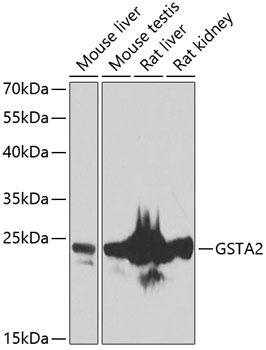 | Western blot analysis of various lysates using GSTA2 Rabbit pAb (CAB7678) at 1:1000 dilution. Secondary antibody: HRP-conjugated Goat anti-Rabbit IgG (H+L) (CABS014) at 1:10000 dilution. Lysates/proteins: 25μg per lane. Blocking buffer: 3% nonfat dry milk in TBST. Detection: ECL Basic Kit (AbGn00020). Exposure time: 90s. |