
Description
GSTM3 Antibody (CAB3905)
The GSTM3 Antibody (CAB3905) is a high-quality antibody developed for reliable detection and analysis of target proteins. This highly specific antibody, produced in rabbits, exhibits a strong reactivity with human samples and has been validated for use in Western blot applications. By binding specifically to the GSTM3 protein, this antibody enables precise detection and analysis in a variety of cell types, making it an ideal choice for investigations in areas such as toxicology, pharmacology, and cancer research.
This antibody is validated for use in WB, ELISA applications and has demonstrated reactivity against Human, Mouse samples.
| Product Name: | GSTM3 Antibody |
| SKU: | CAB3905 |
| Size: | 20μL, 100μL |
| Reactivity: | Human, Mouse |
| Conjugate: | Unconjugated |
| Immunogen: | Recombinant protein (or fragment).This information is considered to be commercially sensitive. | ||||
| Sequence: | VDII ENQV MDFR TQLI RLCY SSDH EKLK PQYL EELP GQLK QFSM FLGK FSWF AGEK LTFV DFLT YDIL DQNR IFDP KCLD EFPN LKAF MCRF EALE KIAA YLQS DQFC KMPI NNKM AQWG NKPV C | ||||
| Tested Applications: | WB ELISA | ||||
| Recommended Dilution: |
| ||||
| Synonyms: | GST5, GSTB, GTM3, GSTM3-3, GSTM3TV2, hGSTM3-3, GSTM3 |
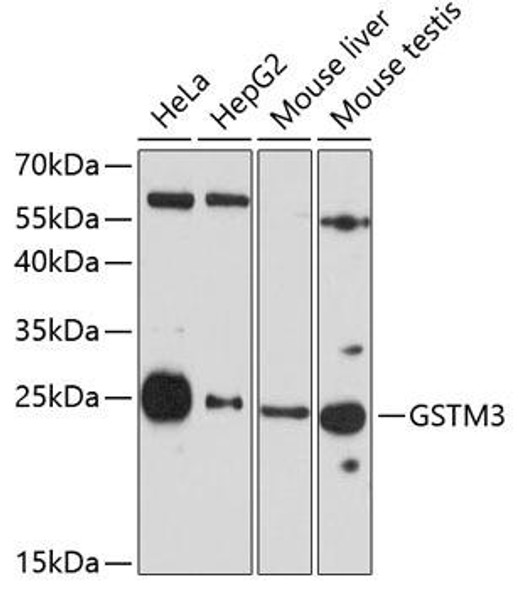
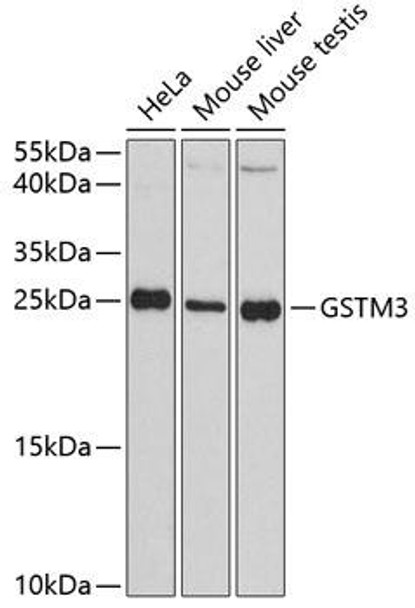
| Positive Sample: | HeLa, Mouse liver, Mouse testis |
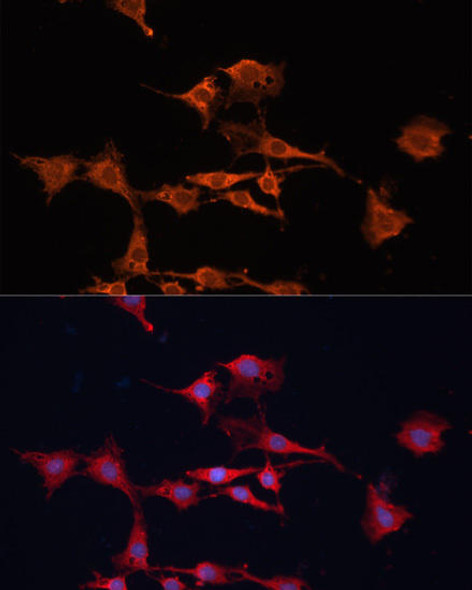
| Cellular Localization: | Cytoplasm. |
| Calculated MW: | 27kDa |
| Observed MW: | 25kDa |
Cytosolic and membrane-bound forms of glutathione S-transferase are encoded by two distinct supergene families. At present, eight distinct classes of the soluble cytoplasmic mammalian glutathione S-transferases have been identified: alpha, kappa, mu, omega, pi, sigma, theta and zeta. This gene encodes a glutathione S-transferase that belongs to the mu class. The mu class of enzymes functions in the detoxification of electrophilic compounds, including carcinogens, therapeutic drugs, environmental toxins and products of oxidative stress, by conjugation with glutathione. The genes encoding the mu class of enzymes are organized in a gene cluster on chromosome 1p13.3 and are known to be highly polymorphic. These genetic variations can change an individual's susceptibility to carcinogens and toxins as well as affect the toxicity and efficacy of certain drugs. Mutations of this class mu gene have been linked with a slight increase in a number of cancers, likely due to exposure with environmental toxins. Alternative splicing results in multiple transcript variants.
| Purification Method | Affinity purification |
| Gene ID | 2947 |
| RRID | AB_2765373 |
| Buffer Information | Store at -20℃. Avoid freeze / thaw cycles. Buffer: PBS with 0.01% thimerosal,50% glycerol,pH7.3. |
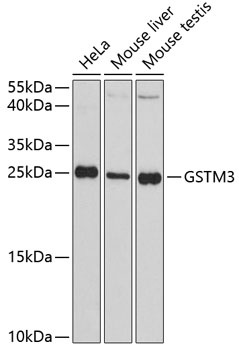 | Western blot analysis of various lysates using GSTM3 Rabbit pAb (CAB3905) at 1:3000 dilution. Secondary antibody: HRP-conjugated Goat anti-Rabbit IgG (H+L) (CABS014) at 1:10000 dilution. Lysates/proteins: 25μg per lane. Blocking buffer: 3% nonfat dry milk in TBST. Detection: ECL Basic Kit (AbGn00020). Exposure time: 90s. |