Description
GSTM4 Antibody (CAB7434)
The GSTM4 Antibody (CAB7434) is a high-quality antibody developed for reliable detection and analysis of target proteins. This antibody, produced in rabbits, exhibits high reactivity with human samples and has been validated for use in Western blot applications. By specifically binding to the GSTM4 protein, this antibody enables precise detection and analysis in various experimental settings.GSTM4, a crucial enzyme in cellular defense mechanisms against toxic compounds and oxidative stress, plays a significant role in regulating intracellular processes related to metabolism and protection from environmental insults.
This antibody is validated for use in WB, ELISA applications and has demonstrated reactivity against Human, Mouse samples.
| Product Name: | GSTM4 Antibody |
| SKU: | CAB7434 |
| Size: | 20μL, 100μL |
| Reactivity: | Human, Mouse |
| Conjugate: | Unconjugated |
| Immunogen: | Recombinant protein (or fragment).This information is considered to be commercially sensitive. | ||||
| Sequence: | MSMT LGYW DIRG LAHA IRLL LEYT DSSY EEKK YTMG DAPD YDRS QWLN EKFK LGLD FPNL PYLI DGAH KITQ SNAI LCYI ARKH NLCG ETEE EKIR VDIL ENQA MDVS NQLA RVCY SPDF EKLK PEYL EELP TMMQ HFSQ FLGK RPWF VGDK ITFV DFLA YDVL DLHR IFEP NCLD AFPN LKDF ISRF EGLE KISA YMKS SRFL PKPL YTRV AVWG NK | ||||
| Tested Applications: | WB ELISA | ||||
| Recommended Dilution: |
| ||||
| Synonyms: | GTM4, GSTM4-4, GSTM4 |
| Positive Sample: | SW480, NCI-H460, Mouse liver, Mouse lung |
| Cellular Localization: | Cytoplasm. |
| Calculated MW: | 26kDa |
| Observed MW: | 26-34kDa |
Cytosolic and membrane-bound forms of glutathione S-transferase are encoded by two distinct supergene families. At present, eight distinct classes of the soluble cytoplasmic mammalian glutathione S-transferases have been identified: alpha, kappa, mu, omega, pi, sigma, theta and zeta. This gene encodes a glutathione S-transferase that belongs to the mu class. The mu class of enzymes functions in the detoxification of electrophilic compounds, including carcinogens, therapeutic drugs, environmental toxins and products of oxidative stress, by conjugation with glutathione. The genes encoding the mu class of enzymes are organized in a gene cluster on chromosome 1p13.3 and are known to be highly polymorphic. These genetic variations can change an individual's susceptibility to carcinogens and toxins as well as affect the toxicity and efficacy of certain drugs. Diversification of these genes has occurred in regions encoding substrate-binding domains, as well as in tissue expression patterns, to accommodate an increasing number of foreign compounds. Multiple transcript variants, each encoding a distinct protein isoform, have been identified.
| Purification Method | Affinity purification |
| Gene ID | 2948 |
| RRID | AB_2767962 |
| Buffer Information | Store at -20℃. Avoid freeze / thaw cycles. Buffer: PBS containing 50% glycerol, preserved with proclin300 or sodium azide, pH 7.3. |
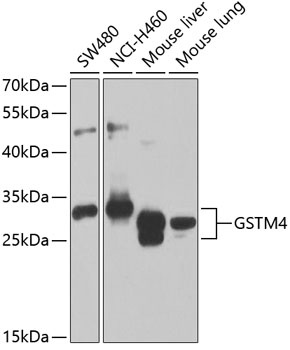 | Western blot analysis of various lysates using GSTM4 Rabbit pAb (CAB7434) at 1:1000 dilution._Secondary antibody: HRP-conjugated Goat anti-Rabbit IgG (H+L) (CABS014) at 1:10000 dilution._Lysates/proteins: 25μg per lane._Blocking buffer: 3% nonfat dry milk in TBST._Detection: ECL Enhanced Kit (AbGn00021)._Exposure time: 30s. |