Description
HRAS Monoclonal Antibody (CAB19619)
The HRAS Monoclonal Antibody (CAB19619) is a high-quality antibody developed for reliable detection and analysis of target proteins. This antibody, generated in rabbits, is highly specific and reactive with human samples, making it ideal for use in Western blot applications. It binds specifically to the HRAS protein, allowing for accurate detection and analysis in a variety of cell types.The HRAS protein, a member of the RAS family of small GTPases, plays a crucial role in signaling pathways that regulate cell growth and proliferation. Dysregulation of HRAS is associated with various diseases, including cancer, making it a promising target for therapeutic interventions.
This antibody is validated for use in WB, ELISA applications and has demonstrated reactivity against Mouse, Rat samples.
| Product Name: | HRAS Monoclonal Antibody |
| SKU: | CAB19619 |
| Size: | 20μL, 100μL |
| Reactivity: | Mouse, Rat |
| Clone Number: | ARC0098 |
| Conjugate: | Unconjugated |
| Immunogen: | Synthetic peptide. This information is considered to be commercially sensitive. | ||||
| Sequence: | FEDI HQYR EQIK RVKD SDDV PMVL VGNK CDLA ARTV ESRQ AQDL ARSY GIPY IETS AKTR QGVE DAFY TLVR EIRQ HKLR KLNP PDES GPGC MSCK CVLS | ||||
| Tested Applications: | WB ELISA | ||||
| Recommended Dilution: |
| ||||
| Synonyms: | CTLO, HAMSV, HRAS1, RASH1, p21ras, C-H-RAS, H-RASIDX, C-BAS/HAS, C-HA-RAS1, HRAS |
| Positive Sample: | Mouse brain, Rat brain |
| Cellular Localization: | Cell Membrane, Cytoplasm, Cytoplasmic Side, Golgi Apparatus, Golgi Apparatus Membrane, Lipid-Anchor, Lipid-Anchor, Nucleus, Perinuclear Region. |
| Calculated MW: | 21kDa |
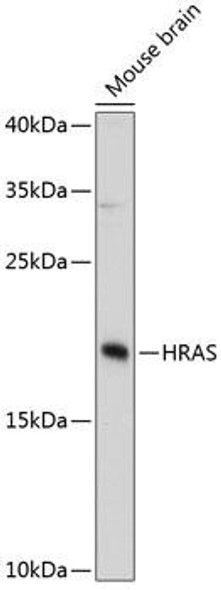
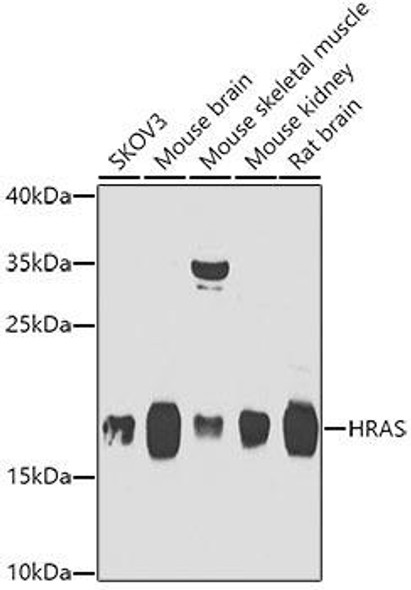
| Observed MW: | 21kDa |
This gene belongs to the Ras oncogene family, whose members are related to the transforming genes of mammalian sarcoma retroviruses. The products encoded by these genes function in signal transduction pathways. These proteins can bind GTP and GDP, and they have intrinsic GTPase activity. This protein undergoes a continuous cycle of de- and re-palmitoylation, which regulates its rapid exchange between the plasma membrane and the Golgi apparatus. Mutations in this gene cause Costello syndrome, a disease characterized by increased growth at the prenatal stage, growth deficiency at the postnatal stage, predisposition to tumor formation, cognitive disability, skin and musculoskeletal abnormalities, distinctive facial appearance and cardiovascular abnormalities. Defects in this gene are implicated in a variety of cancers, including bladder cancer, follicular thyroid cancer, and oral squamous cell carcinoma. Multiple transcript variants, which encode different isoforms, have been identified for this gene.
| Purification Method | Affinity purification |
| Gene ID | 3265 |
| RRID | AB_2862701 |
| Buffer Information | Store at -20℃. Avoid freeze / thaw cycles. Buffer: PBS containing 50% glycerol and 0.05% BSA, preserved with proclin300 or sodium azide, pH 7.3. |
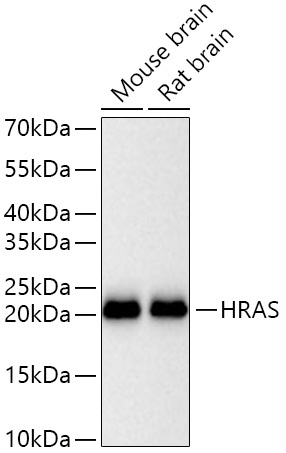 | Western blot analysis of various lysates using HRAS Rabbit mAb (CAB19619) at 1:1000 dilution incubated overnight at 4℃. Secondary antibody: HRP-conjugated Goat anti-Rabbit IgG (H+L) (CABS014) at 1:10000 dilution. Lysates/proteins: 25 μg per lane. Blocking buffer: 3% nonfat dry milk in TBST. Detection: ECL Basic Kit (AbGn00020). Exposure time: 10s. |