The Human TLR3 Polyclonal Antibody (CAB24885) is a high-quality antibody developed for reliable detection and analysis of target proteins. This antibody, produced in rabbits, is highly specific to human TLR3 and is validated for use in various applications, including Western blotting and immunohistochemistry.TLR3 is known for recognizing double-stranded RNA and initiating a signaling cascade that leads to the production of pro-inflammatory cytokines and type I interferons. This antibody binds specifically to TLR3, allowing researchers to detect and quantify TLR3 expression in different cell types and tissues.
This antibody is validated for use in WB, IF/ICC, ELISA applications and has demonstrated reactivity against Human samples.
Product Name:
Human TLR3 Polyclonal Antibody
SKU:
CAB24885
Size:
20μL, 100μL
Reactivity:
Human
Conjugate:
Unconjugated
Immunogen:
Recombinant protein (or fragment).This information is considered to be commercially sensitive.
Recommended starting concentration is 1 μg/mL. Please optimize the concentration based on your specific assay requirements.
Synonyms:
TLR3, CD283, IIAE2, toll-like receptor 3, Human TLR3
Positive Sample:
293T transfected with TLR3
Cellular Localization:
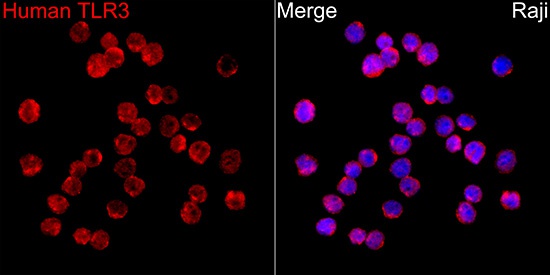
Early Endosome, Endoplasmic Reticulum Membrane, Endosome Membrane, Single-Pass Type I Membrane Protein.
Calculated MW:
72kDa/103kDa
Observed MW:
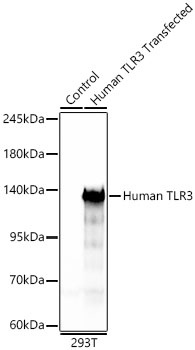
130kDa
The protein encoded by this gene is a member of the Toll-like receptor (TLR) family which plays a fundamental role in pathogen recognition and activation of innate immunity. TLRs are highly conserved from Drosophila to humans and share structural and functional similarities. They recognize pathogen-associated molecular patterns (PAMPs) that are expressed on infectious agents, and mediate the production of cytokines necessary for the development of effective immunity. The various TLRs exhibit different patterns of expression. This receptor is most abundantly expressed in placenta and pancreas, and is restricted to the dendritic subpopulation of the leukocytes. It recognizes dsRNA associated with viral infection, and induces the activation of NF-kappaB and the production of type I interferons. It may thus play a role in host defense against viruses. Use of alternative polyadenylation sites to generate different length transcripts has been noted for this gene.
Purification Method
Affinity purification
Gene ID
7098
Buffer Information
Store at -20℃. Avoid freeze / thaw cycles. Buffer: PBS containing 50% glycerol, preserved with proclin300 or sodium azide, pH 7.3.
Western blot analysis of lysates from wild type (WT) and 293T cells transfected with TLR3 using Human TLR3 Rabbit pAb (CAB24885) at 1:800 dilution. Secondary antibody: HRP-conjugated Goat anti-Rabbit IgG (H+L) (CABS014) at 1:10000 dilution. Lysates/proteins: 25 μg per lane. Blocking buffer: 3% nonfat dry milk in TBST. Detection: ECL Basic Kit (AbGn00020). Exposure time: 10s.
Immunofluorescence analysis of Raji cells using Human TLR3 Rabbit pAb(CAB24885) at a dilution of 1:100 (40x lens). Secondary antibody:Cy3 Goat Anti-Rabbit IgG (H+L)(CABS007) at 1:500 dilution. Blue: DAPI for nuclear staining.