The Cation-independent M6PR (IGF2R) Antibody (CAB13022) is a high-quality antibody developed for reliable detection and analysis of target proteins. This gene encodes a receptor for both insulin-like growth factor 2 and mannose 6-phosphate. The binding sites for each ligand are located on different segments of the protein. This receptor has various functions, including in the intracellular trafficking of lysosomal enzymes, the activation of transforming growth factor beta, and the degradation of insulin-like growth factor 2. Mutation or loss of heterozygosity of this gene has been association with risk of hepatocellular carcinoma. The orthologous mouse gene is imprinted and shows exclusive expression from the maternal allele; however, imprinting of the human gene may be polymorphic, as only a minority of individuals showed biased expression from the maternal allele (PMID:8267611). RRID AB_2759869 Gene ID 3482 Swiss Prot Synonym MPR1; MPRI; CD222; CIMPR; M6P-R; MPR300; CI-M6PR; MPR 300; M6P/IGF2R; Cation-independent M6PR (IGF2R)
This antibody is validated for use in WB, IF/ICC, ELISA applications and has demonstrated reactivity against Human, Mouse, Rat samples.
Product Name:
Cation-independent M6PR (IGF2R) Antibody
SKU:
CAB13022
Size:
100μL, 20μL
Reactivity:
Human, Mouse, Rat
Clone Number:
-
Conjugate:
Unconjugated
Immunogen:
Recombinant protein (or fragment).This information is considered to be commercially sensitive.
Tested Applications:
WBIF/ICCELISA
Recommended Dilution:
WB
1:500 - 1:1000
IF
/
ICC
1:50 - 1:200
ELISA
Recommended starting concentration is 1 μg/mL. Please optimize the concentration based on your specific assay requirements.
Lysosome Membrane, Single-Pass Type I Membrane Protein.
Calculated MW:
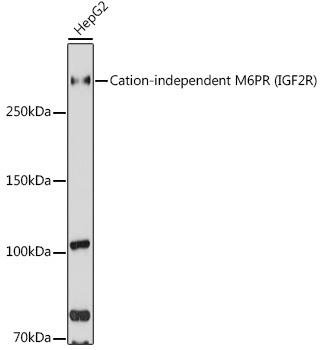
274kDa
Observed MW:
274kDa
This gene encodes a receptor for both insulin-like growth factor 2 and mannose 6-phosphate. The binding sites for each ligand are located on different segments of the protein. This receptor has various functions, including in the intracellular trafficking of lysosomal enzymes, the activation of transforming growth factor beta, and the degradation of insulin-like growth factor 2. Mutation or loss of heterozygosity of this gene has been association with risk of hepatocellular carcinoma. The orthologous mouse gene is imprinted and shows exclusive expression from the maternal allele; however, imprinting of the human gene may be polymorphic, as only a minority of individuals showed biased expression from the maternal allele (PMID:8267611). RRID AB_2759869 Gene ID 3482 Swiss Prot Synonym MPR1; MPRI; CD222; CIMPR; M6P-R; MPR300; CI-M6PR; MPR 300; M6P/IGF2R; Cation-independent M6PR (IGF2R)
Purification Method:
Affinity purification
Gene ID:
3482
RRID:
AB_2759869
Buffer Information:
Store at -20℃. Avoid freeze / thaw cycles. Buffer: PBS containing 50% glycerol, preserved with proclin300 or sodium azide, pH 7.3.
Western blot analysis of lysates from HepG2 cells, using Cation-independent M6PR (IGF2R) Rabbit pAb (CAB13022) at 1:1000 dilution. Secondary antibody: HRP-conjugated Goat anti-Rabbit IgG (H+L) (AS014) at 1:10000 dilution. Lysates/proteins: 25μg per lane. Blocking buffer: 3% nonfat dry milk in TBST. Detection: ECL Basic Kit (AbGn00020). Exposure time: 60s.
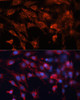
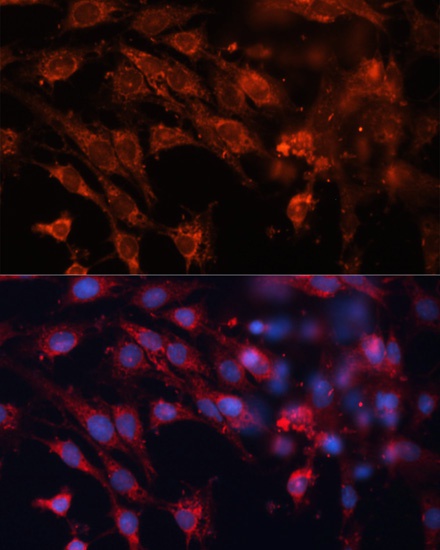
Immunofluorescence analysis of C6 cells using Cation-independent M6PR (IGF2R) Rabbit pAb (CAB13022) at dilution of 1:100. Secondary antibody: Cy3-conjugated Goat anti-Rabbit IgG (H+L) (AS007) at 1:500 dilution. Blue: DAPI for nuclear staining.
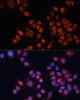
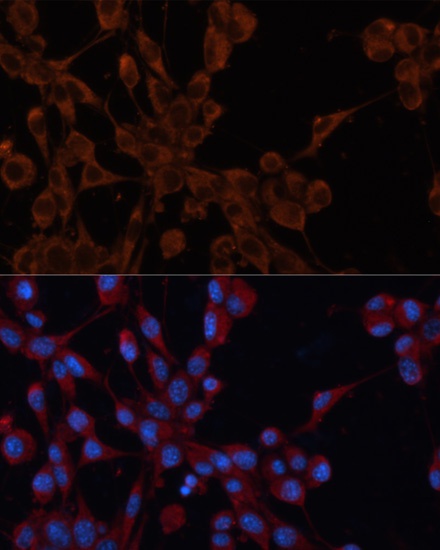
Immunofluorescence analysis of NIH/3T3 cells using Cation-independent M6PR (IGF2R) Rabbit pAb (CAB13022) at dilution of 1:100. Secondary antibody: Cy3-conjugated Goat anti-Rabbit IgG (H+L) (AS007) at 1:500 dilution. Blue: DAPI for nuclear staining.