The KLK3 Antibody (CAB2052) is a high-quality antibody developed for reliable detection and analysis of target proteins. This antibody is produced in rabbits and is highly reactive with human samples, making it ideal for use in Western blot applications. By binding specifically to the KLK3 protein, this antibody enables the detection and analysis of KLK3 in various cell types.The KLK3 protein is primarily known for its role as a biomarker for prostate cancer, where elevated levels of PSA in the blood can indicate the presence of the disease.
This antibody is validated for use in WB, IHC-P, IF/ICC, IP, ELISA applications and has demonstrated reactivity against Human, Mouse samples.
Product Name:
KLK3 Antibody
SKU:
CAB2052
Size:
20μL, 100μL
Reactivity:
Human, Mouse
Conjugate:
Unconjugated
Immunogen:
Recombinant protein (or fragment).This information is considered to be commercially sensitive.
0.5μg-4μg antibody for 200μg-400μg extracts of whole cells
ELISA
Recommended starting concentration is 1 μg/mL. Please optimize the concentration based on your specific assay requirements.
Synonyms:
APS, PSA, hK3, KLK2A1, KLK3
Positive Sample:
LNCaP
Cellular Localization:
Secreted.
Calculated MW:
29kDa
Observed MW:
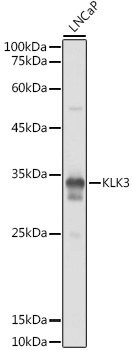
34kDa
Kallikreins are a subgroup of serine proteases having diverse physiological functions. Growing evidence suggests that many kallikreins are implicated in carcinogenesis and some have potential as novel cancer and other disease biomarkers. The gene is one of the fifteen kallikrein subfamily members located in a cluster on chromosome 19. It encodes a single-chain glycoprotein, a protease which is synthesized in the epithelial cells of the prostate gland, and is present in seminal plasma. It is thought to function normally in the liquefaction of seminal coagulum, presumably by hydrolysis of the high molecular mass seminal vesicle protein. The serum level of this protein, called PSA in the clinical setting, is useful in the diagnosis and monitoring of prostatic carcinoma. Alternate splicing of this gene generates several transcript variants encoding different isoforms.
Purification Method
Affinity purification
Gene ID
354
RRID
AB_2764075
Buffer Information
Store at -20℃. Avoid freeze / thaw cycles. Buffer: PBS containing 50% glycerol, preserved with proclin300 or sodium azide, pH 7.3.
Western blot analysis of lysates from LNCaP cells, using KLK3 Rabbit pAb (CAB2052) at 1:1000 dilution. Secondary antibody: HRP-conjugated Goat anti-Rabbit IgG (H+L) (CABS014) at 1:10000 dilution. Lysates/proteins: 25μg per lane. Blocking buffer: 3% nonfat dry milk in TBST. Detection: ECL Basic Kit (AbGn00020). Exposure time: 1s.
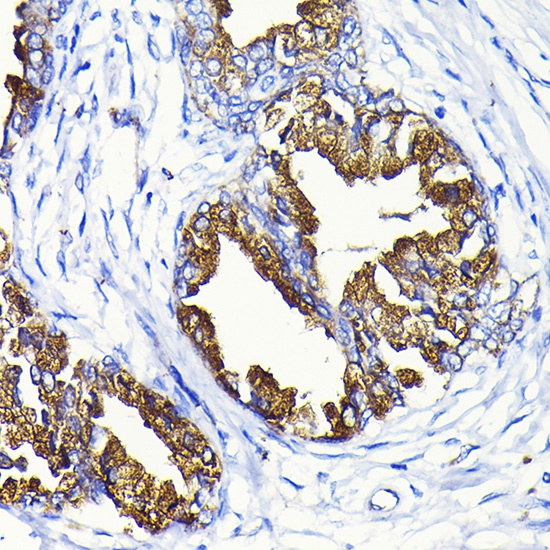
Immunohistochemistry analysis of paraffin-embedded Human prostate cancer using KLK3 Rabbit pAb (CAB2052) at dilution of 1:100 (40x lens). High pressure antigen retrieval performed with 0.01M Citrate buffer (pH 6.0) prior to IHC staining.
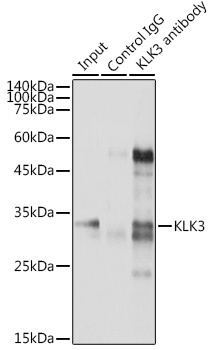
Immunoprecipitation analysis of 300 μg extracts of LNCaP cells using 3 μg KLK3 antibody (CAB2052). Western blot was performed from the immunoprecipitate using KLK3 antibody (CAB2052) at a dilution of 1:2000.