Description
LAMC1 Antibody (CAB16020)
The LAMC1 Antibody (CAB16020) is a high-quality antibody developed for reliable detection and analysis of target proteins. This antibody, raised in rabbits, demonstrates high reactivity with human samples and has been validated for use in Western blot applications. By binding specifically to the LAMC1 protein, researchers can accurately detect and analyze its expression in a variety of cell types.LAMC1, also known as laminin subunit gamma-1, plays a crucial role in maintaining tissue architecture and function. Dysregulation of LAMC1 has been associated with various diseases, including cancer, muscular dystrophy, and kidney disorders.
This antibody is validated for use in WB, IHC-P, ELISA applications and has demonstrated reactivity against Human, Mouse, Rat samples.
| Product Name: | LAMC1 Antibody |
| SKU: | CAB16020 |
| Size: | 20μL, 100μL |
| Reactivity: | Human, Mouse, Rat |
| Conjugate: | Unconjugated |
| Immunogen: | Recombinant protein (or fragment).This information is considered to be commercially sensitive. | ||||||
| Sequence: | ECPA CYRL VKDK VADH RVKL QELE SLIA NLGT GDEM VTDQ AFED RLKE AERE VMDL LREA QDVK DVDQ NLMD RLQR VNNT LSSQ ISRL QNIR NTIE ETGN LAEQ ARAH VENT ERLI EIAS RELE KAKV AAAN VSVT QPES TGDP NNMT LLAE EARK LAER HKQE ADDI VRVA KTAN DTST EAYN LLLR TLAG ENQT AFEI EELN RKYE QAKN ISQD LEKQ AARV HEEA KRAG DKAV EIYA SVAQ LS | ||||||
| Tested Applications: | WB IHC-P ELISA | ||||||
| Recommended Dilution: |
| ||||||
| Synonyms: | LAMB2, LAMC1 |
| Positive Sample: | LO2, Mouse heart, Mouse kidney, Rat heart |
| Cellular Localization: | Basement Membrane, Endoplasmic Reticulum Lumen, Extracellular Exosome, Extracellular Region, Extracellular Space. |
| Calculated MW: | 178kDa |
| Observed MW: | 220kDa |
Laminins, a family of extracellular matrix glycoproteins, are the major noncollagenous constituent of basement membranes. They have been implicated in a wide variety of biological processes including cell adhesion, differentiation, migration, signaling, neurite outgrowth and metastasis. Laminins, composed of 3 non identical chains: laminin alpha, beta and gamma (formerly A, B1, and B2, respectively), have a cruciform structure consisting of 3 short arms, each formed by a different chain, and a long arm composed of all 3 chains. Each laminin chain is a multidomain protein encoded by a distinct gene. Several isoforms of each chain have been described. Different alpha, beta and gamma chain isomers combine to give rise to different heterotrimeric laminin isoforms which are designated by Arabic numerals in the order of their discovery, i.e. alpha1beta1gamma1 heterotrimer is laminin 1. The biological functions of the different chains and trimer molecules are largely unknown, but some of the chains have been shown to differ with respect to their tissue distribution, presumably reflecting diverse functions in vivo. This gene encodes the gamma chain isoform laminin, gamma 1. The gamma 1 chain, formerly thought to be a beta chain, contains structural domains similar to beta chains, however, lacks the short alpha region separating domains I and II. The structural organization of this gene also suggested that it had diverged considerably from the beta chain genes. Embryos of transgenic mice in which both alleles of the gamma 1 chain gene were inactivated by homologous recombination, lacked basement membranes, indicating that laminin, gamma 1 chain is necessary for laminin heterotrimer assembly. It has been inferred by analogy with the strikingly similar 3' UTR sequence in mouse laminin gamma 1 cDNA, that multiple polyadenylation sites are utilized in human to generate the 2 different sized mRNAs (5.5 and 7.5 kb) seen on Northern analysis.
| Purification Method | Affinity purification |
| Gene ID | 3915 |
| RRID | AB_2763457 |
| Buffer Information | Store at -20℃. Avoid freeze / thaw cycles. Buffer: PBS containing 50% glycerol, preserved with proclin300 or sodium azide, pH 7.3. |
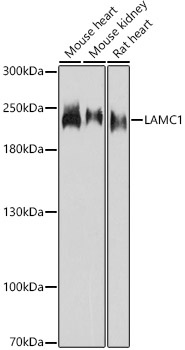 | Western blot analysis of various lysates using LAMC1 Rabbit pAb (CAB16020) at 1:3000 dilution. Secondary antibody: HRP-conjugated Goat anti-Rabbit IgG (H+L) (CABS014) at 1:10000 dilution. Lysates/proteins: 25μg per lane. Blocking buffer: 3% nonfat dry milk in TBST. Detection: ECL Basic Kit (AbGn00020). Exposure time: 90s. |
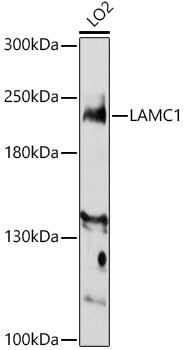 | Western blot analysis of lysates from LO2 cells, using LAMC1 Rabbit pAb (CAB16020) at 1:3000 dilution. Secondary antibody: HRP-conjugated Goat anti-Rabbit IgG (H+L) (CABS014) at 1:10000 dilution. Lysates/proteins: 25μg per lane. Blocking buffer: 3% nonfat dry milk in TBST. Detection: ECL Enhanced Kit (AbGn00021). Exposure time: 30s. |
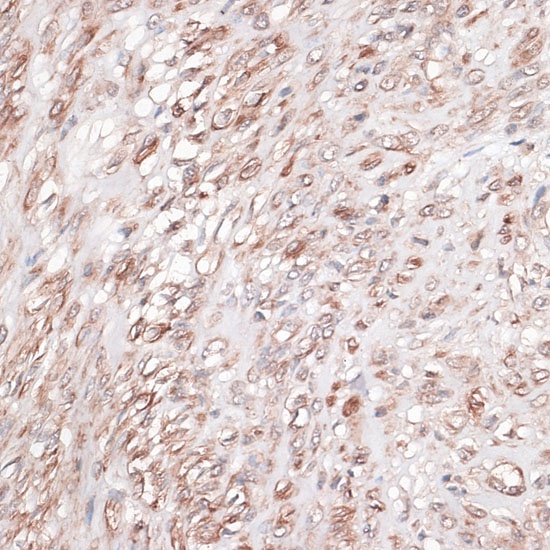 | Immunohistochemistry analysis of paraffin-embedded Human uterus using LAMC1 Rabbit pAb (CAB16020) at dilution of 1:100 (40x lens). Microwave antigen retrieval performed with 0.01M PBS Buffer (pH 7.2) prior to IHC staining. |
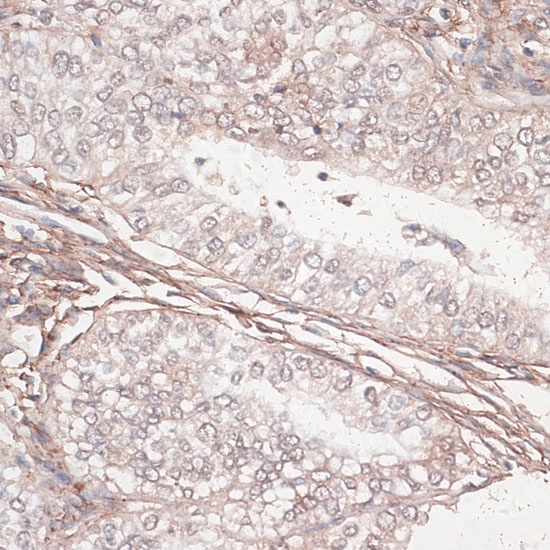 | Immunohistochemistry analysis of paraffin-embedded Human uterine cancer using LAMC1 Rabbit pAb (CAB16020) at dilution of 1:100 (40x lens). Microwave antigen retrieval performed with 0.01M PBS Buffer (pH 7.2) prior to IHC staining. |