The phospho-LATS1-S909/LATS2-S872 Antibody (CABP0904) is a high-quality antibody developed for reliable detection and analysis of target proteins. This antibody, raised in rabbits, specifically detects phosphorylation of LATS1 at Serine 909 and LATS2 at Serine 872, key regulatory sites in the pathway. The Hippo pathway plays a crucial role in controlling organ size, tissue homeostasis, and tumor suppression. Phosphorylation of LATS1 and LATS2 is essential for their activation and downstream signaling, ultimately leading to regulation of cell proliferation and apoptosis.
This antibody is validated for use in WB, ELISA applications and has demonstrated reactivity against Human samples.
Product Name:
phospho-LATS1-S909/LATS2-S872 Antibody
SKU:
CABP0904
Size:
20μL, 100μL
Reactivity:
Human
Conjugate:
Unconjugated
Immunogen:
Synthetic peptide. This information is considered to be commercially sensitive.
Sequence:
AHSL V
Tested Applications:
WBELISA
Recommended Dilution:
WB
1:500 - 1:2000
ELISA
Recommended starting concentration is 1 μg/mL. Please optimize the concentration based on your specific assay requirements.
The protein encoded by this gene is a putative serine/threonine kinase that localizes to the mitotic apparatus and complexes with cell cycle controller CDC2 kinase in early mitosis. The protein is phosphorylated in a cell-cycle dependent manner, with late prophase phosphorylation remaining through metaphase. The N-terminal region of the protein binds CDC2 to form a complex showing reduced H1 histone kinase activity, indicating a role as a negative regulator of CDC2/cyclin A. In addition, the C-terminal kinase domain binds to its own N-terminal region, suggesting potential negative regulation through interference with complex formation via intramolecular binding. Biochemical and genetic data suggest a role as a tumor suppressor. This is supported by studies in knockout mice showing development of soft-tissue sarcomas, ovarian stromal cell tumors and a high sensitivity to carcinogenic treatments.
Purification Method
Affinity purification
Gene ID
9113 26524
RRID
AB_2771258
Buffer Information
Store at -20℃. Avoid freeze / thaw cycles. Buffer: PBS containing 50% glycerol, preserved with proclin300 or sodium azide, pH 7.3.
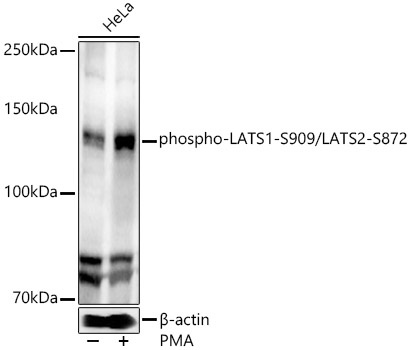
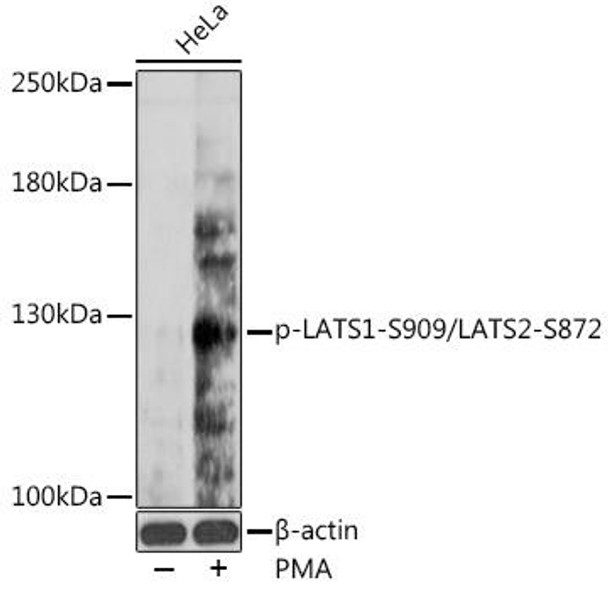
Western blot analysis of lysates from HeLa cells, using phospho-LATS1-S909/LATS2-S872 Rabbit pAb (CABP0904) at 1:500 dilution. HeLa cells were treated with PMA/TPA (200 nM) at 37℃ for 15 minutes after serum-starvation overnight. Secondary antibody: HRP-conjugated Goat anti-Rabbit IgG (H+L) (CABS014) at 1:10000 dilution. Lysates/proteins: 25μg per lane. Blocking buffer: 3% nonfat dry milk in TBST. Detection: ECL Enhanced Kit (AbGn00021). Exposure time: 30s.