Description
LDH Cytotoxicity Assay Kit (BA0001) (BA0001)
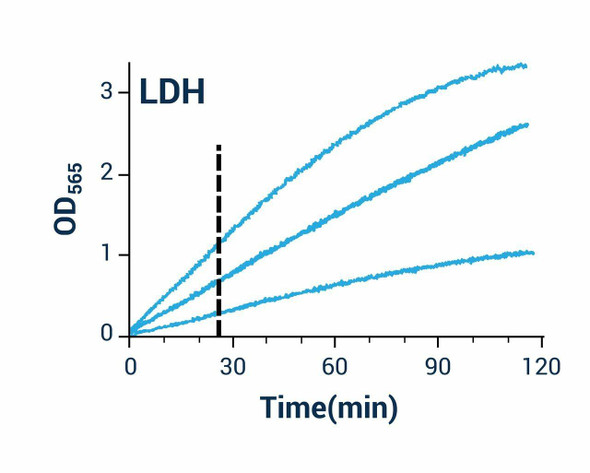
The LDH Cytotoxicity Assay Kit (SKU: BA0001) provides a simple and robust colorimetric method for assessing cytotoxic effects on cultured cells. Lactate dehydrogenase (LDH) is a stable cytosolic enzyme that is released into the surrounding medium when the cell membrane is compromised, making it an excellent marker of tissue and cell damage. This kit measures LDH activity in cell culture supernatant through the reduction of a tetrazolium salt to a coloured formazan dye. The assay is non-radioactive, rapid and readily amenable to high-throughput screening in 96-well plates. It is ideally suited to the evaluation of toxic compounds, toxins, detergents and environmental pollutants, as well as high-throughput drug toxicity screening.
| Product Name: | LDH Cytotoxicity Assay Kit (BA0001) |
| SKU: | BA0001 |
| Detection Method: | Colorimetric (OD 500 nm) |
| Sample Type: | ['Cell culture supernatant', 'Adherent cells', 'Suspension cells'] |
| Species Reactivity: | All |
| Assay Time: | 10 minutes |
| Kit Size: | 100 Assays |
| Equipment Required: | Microplate reader |
| Storage: | -20°C |
| Shelf Life: | 12 months after receipt |
| Shipping: | Room Temperature |
Lactate dehydrogenase (LDH) is an oxidoreductase that catalyses the interconversion of lactate and pyruvate. Cytotoxic compounds often compromise cell membrane integrity by inducing apoptosis or necrosis, and the stable cytosolic LDH is released into the cellular environment upon membrane damage. LDH is therefore frequently measured to evaluate the presence of tissue or cell damage. This colorimetric LDH release assay is a simple and robust method to assess cytotoxic effects on cells by measuring the activity of LDH in cell culture supernatant. The assay is based on the reduction of a tetrazolium salt to a formazan dye.
- Safe. Non-radioactive assay.
- Fast. A 10 min, single reagent, mix-incubate-measure type assay. High-throughput assay using 96-well plates allows simultaneous processing of tens of thousands of samples per day.
- Robust and amenable to HTS. Can be readily automated with HTS liquid handling systems.
- Cytotoxicity and Apoptosis: evaluation of toxic compounds, toxins, detergents, environmental pollutants etc.
- Drug Discovery: high-throughput screen for drug toxicity.
Note: The below protocol is a sample protocol. Protocols are specific to each batch/lot. For the correct instructions please follow the protocol included in your kit.
| Step | Procedure |
| 1 | Sample Preparation: Ensure cells are in logarithmic growth phase and subculture cells two days before the experiment. Medium containing 10% FBS is compatible with the assay, so it is not necessary to subculture cells in FBS-free medium. Plate and culture cells (100 µL per well) in a 96-well tissue culture plate, running assays in duplicate or triplicate. A range between 10,000 and 40,000 cells per well for adherent cells and between 40,000 and 160,000 suspension cells is appropriate for most mammalian cell types. |
| 2 | In addition to the test samples, include extra wells of untreated cells (Control) and wells of cells treated with Tergitol (Total Lysis). Add 10 µL test compounds to sample wells, 10 µL dH2O to Control wells, and 10 µL provided Tergitol to the Total Lysis control wells, then incubate cells for 10 min to overnight at 37°C. |
| 3 | Equilibrate the Reagent to room temperature, add 160 µL of Reagent per well and incubate at room temperature for 10 minutes. |
| 4 | Measure OD500nm for each well in an absorbance plate reader. The suitable absorbance range for the formazan dye is between 490 and 510 nm, and reading at 500 nm is recommended. |
Cytotoxicity is calculated as the percentage of the maximum LDH release in the Total Lysis wells: Cytotoxicity (%) = [(ODSample - ODControl) / (ODTotal Lysis - ODControl)] x 100, where ODSample, ODControl and ODTotal Lysis are the absorbance values of the sample, the no-treatment control and the Tergitol-treated cells respectively.
| Component | Quantity | Storage |
| Reagent | 20 mL | -20°C |
| Tergitol | 1 mL | -20°C |
| Gálvez et al. | Cross-talk between NLRP3 and AIM2 inflammasomes in macrophage activation by LPS and titanium ions | Molecular Medicine 2025 | PubMed ID: 40490723 |