The LIPA Antibody (CAB6385) is a high-quality antibody developed for reliable detection and analysis of target proteins. This antibody, produced in rabbits, is highly specific for detecting LIPA in human samples and is validated for use in Western blot applications. By targeting the LIPA protein, researchers can gain insights into lipid processing, storage, and utilization within cells, with potential implications in metabolic disorders and lipid-related diseases.
This antibody is validated for use in WB, ELISA applications and has demonstrated reactivity against Human, Rat samples.
Product Name:
LIPA Antibody
SKU:
CAB6385
Size:
20μL, 100μL
Reactivity:
Human, Rat
Conjugate:
Unconjugated
Immunogen:
Recombinant protein (or fragment).This information is considered to be commercially sensitive.
Recommended starting concentration is 1 μg/mL. Please optimize the concentration based on your specific assay requirements.
Synonyms:
LAL, CESD, LIPA
Positive Sample:
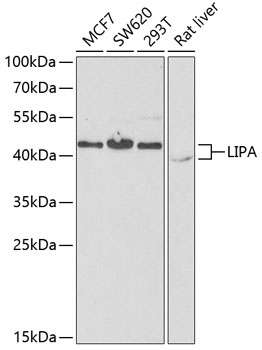
MCF7, SW620, 293T, Rat liver
Cellular Localization:
Lysosome.
Calculated MW:
45kDa
Observed MW:
40-45kDa
This gene encodes lipase A, the lysosomal acid lipase (also known as cholesterol ester hydrolase). This enzyme functions in the lysosome to catalyze the hydrolysis of cholesteryl esters and triglycerides. Mutations in this gene can result in Wolman disease and cholesteryl ester storage disease. Alternatively spliced transcript variants have been found for this gene.
Purification Method
Affinity purification
Gene ID
3988
RRID
AB_2766987
Buffer Information
Store at -20℃. Avoid freeze / thaw cycles. Buffer: PBS containing 50% glycerol, preserved with proclin300 or sodium azide, pH 7.3.
Western blot analysis of various lysates using LIPA Rabbit pAb (CAB6385) at 1:1000 dilution. Secondary antibody: HRP-conjugated Goat anti-Rabbit IgG (H+L) (CABS014) at 1:10000 dilution. Lysates/proteins: 25μg per lane. Blocking buffer: 3% nonfat dry milk in TBST. Detection: ECL Enhanced Kit (AbGn00021). Exposure time: 90s.