The N6-methyladenosine/m6A Monoclonal Antibody (CAB19841) is a high-quality antibody developed for reliable detection and analysis of target proteins. Discovered in the 1970s, m6A is the most prevalent internal modification in polyadenylated mRNAs and long non-coding RNAs (lncRNAs) in higher eukaryotes. m6A is widely conserved among eukaryotic species that range from yeast, plants, flies to mammals, as well as among viral RNAs with a nuclear phase. The m6A-based modification is associated with a well-defined RNA motif, RRACH (R: A/G, H: A/C/U). As a representative of the epitranscriptome, m6A mRNA modifications participate in many vital activities in the cell, including stem cell self-renewal and differentiation, mRNA transcription, alternative splicing, nuclear export, translation, degradation, and microRNA processing. These processes determine the expression or inactivation of specific genes, which is vital for growth and development.(PMID: 30416848; PMID: 24662220; PMID: 30429466)
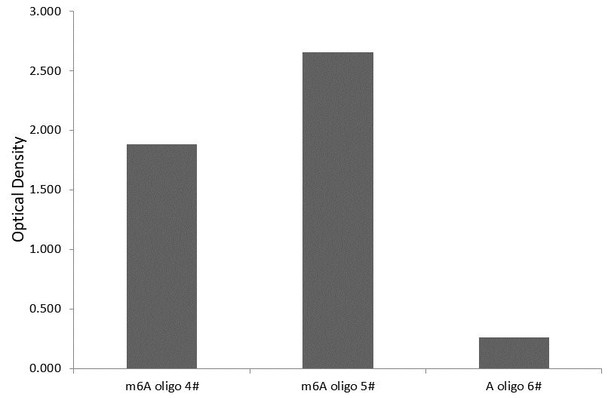
This antibody is validated for use in IF/ICC, ELISA, Nucleotide Array, DB, meRIP applications and has demonstrated reactivity against Species independent samples.
Product Name:
N6-methyladenosine/m6A Monoclonal Antibody
SKU:
CAB19841
Size:
100μL, 20μL
Reactivity:
Species independent
Clone Number:
ARC5003-10
Immunogen:
Chemical compounds corresponding to N6-methyladenosine / m6A.
Tested Applications:
IF/ICCELISANucleotide ArrayDBmeRIP
Recommended Dilution:
DB
1:500 - 1:2000
IF/ICC
1:50 - 1:200
ELISA
Recommended starting concentration is 1 μg/mL. Please optimize the concentration based on your specific assay requirements.
meRIP
1:50 - 1:200
Synonyms:
N6-methyladenosine, m6A, N6-methyladenosine / m6A
Observed MW:
Refer to figures
Discovered in the 1970s, m6A is the most prevalent internal modification in polyadenylated mRNAs and long non-coding RNAs (lncRNAs) in higher eukaryotes. m6A is widely conserved among eukaryotic species that range from yeast, plants, flies to mammals, as well as among viral RNAs with a nuclear phase. The m6A-based modification is associated with a well-defined RNA motif, RRACH (R: A/G, H: A/C/U). As a representative of the epitranscriptome, m6A mRNA modifications participate in many vital activities in the cell, including stem cell self-renewal and differentiation, mRNA transcription, alternative splicing, nuclear export, translation, degradation, and microRNA processing. These processes determine the expression or inactivation of specific genes, which is vital for growth and development.(PMID: 30416848; PMID: 24662220; PMID: 30429466)
Purification Method
Protein A
RRID
AB_2862753
Buffer Information
Store at -20℃. Avoid freeze / thaw cycles. Buffer: PBS containing 50% glycerol and 0.05% BSA, preserved with proclin300 or sodium azide, pH 7.3.
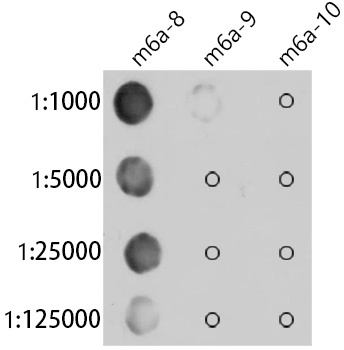
The m6A rabbit monoclonal antibody (CAB19841) are tested in Dot Blot against N6-methyladenosine (m6A) and unmodified adenosine. Oligomer 8 - ATAACTGG-m6A-CCGAATGG Oligomer 9 - ATAACTGGACCGAATGG Oligomer 10 - AAAAAAAAAAAAAAAA-biotin.
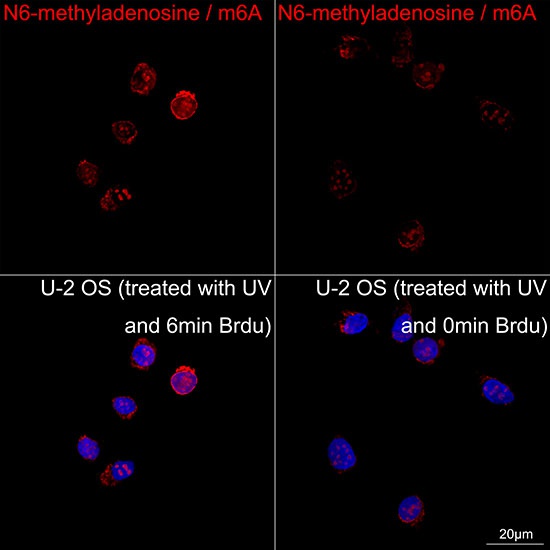
Confocal imaging of U-2 OS cells (treated with UV and 6min Brdu) and U-2 OS cells (treated with UV and 0min Brdu) using N6-methyladenosine / m6A Rabbit mAb (CAB19841, dilution 1:200) followed by a further incubation with Cy3 Goat Anti-Rabbit IgG (H+L) (AS007, dilution 1:500) (Red). DAPI was used for nuclear staining (Blue). Objective: 100x.