The NKX28 Monoclonal Antibody (PAC022719) is a valuable tool for researchers studying NKX28, a transcription factor involved in regulating gene expression in various biological processes. This antibody, produced in mice, is specifically designed for use in immunohistochemistry and immunofluorescence applications. It recognizes the NKX28 protein, allowing for precise detection and visualization in a variety of tissues and cell types.NKX28 is known for its role in embryonic development, particularly in the formation of the heart and other organs.
Its aberrant expression has been linked to cardiovascular diseases and developmental disorders, making it a target of interest for researchers in the field. By using the NKX28 Monoclonal Antibody, investigators can explore the functions and mechanisms of NKX28 in different physiological and pathological contexts, furthering our understanding of its contributions to human health and disease.
Antibody Name:
NKX28 Antibody (PACO22719)
Antibody SKU:
PACO22719
Size:
100ul
Host Species:
Rabbit
Tested Applications:
ELISA, WB
Recommended Dilutions:
ELISA:1:2000-1:10000, WB:1:500-1:3000
Species Reactivity:
Human
Immunogen:
Synthesized peptide derived from N-terminal of human NKX28.
Form:
Liquid
Storage Buffer:
Rabbit IgG in phosphate buffered saline (without Mg2+ and Ca2+), pH 7.4, 150mM NaCl, 0.02% sodium azide and 50% glycerol.
Purification Method:
The antibody was affinity-purified from rabbit antiserum by affinity-chromatography using epitope-specific immunogen.
Clonality:
Polyclonal
Isotype:
IgG
Conjugate:
Non-conjugated
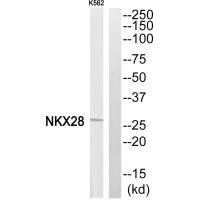
Western blot analysis of extracts from K562 cells, using NKX28 antibody.
Synonyms:
NK2 homeobox 8; NKX2-8;
UniProt Protein Function:
NKX2-8: Belongs to the NK-2 homeobox family.Protein type: Transcription factor; Cell development/differentiation; DNA-bindingChromosomal Location of Human Ortholog: 14q13.3Cellular Component: nucleusMolecular Function: sequence-specific DNA binding; double-stranded DNA binding; transcription factor activityBiological Process: transcription from RNA polymerase II promoter; transcription, DNA-dependent; axonogenesis; positive regulation of transcription from RNA polymerase II promoter; liver development; lung development; negative regulation of epithelial cell proliferation