The NLRP3 Monoclonal Antibody (CAB24294) is a high-quality antibody developed for reliable detection and analysis of target proteins. Enables DNA-binding transcription factor binding activity and sequence-specific DNA binding activity. Involved in several processes, including positive regulation of T-helper cell differentiation; positive regulation of cytokine production; and response to bacterium. Acts upstream of or within several processes, including NLRP3 inflammasome complex assembly; activation of cysteine-type endopeptidase activity involved in apoptotic process; and defense response to virus. Located in cytoplasm and nucleus. Part of NLRP3 inflammasome complex. Is expressed in central nervous system and retina. Used to study CINCA Syndrome; familial cold autoinflammatory syndrome 1; and non-alcoholic fatty liver disease. Human ortholog(s) of this gene implicated in CINCA Syndrome; Muckle-Wells syndrome; autosomal dominant nonsyndromic deafness 34; familial cold autoinflammatory syndrome 1; and urticaria. Orthologous to human NLRP3 (NLR family pyrin domain containing 3).
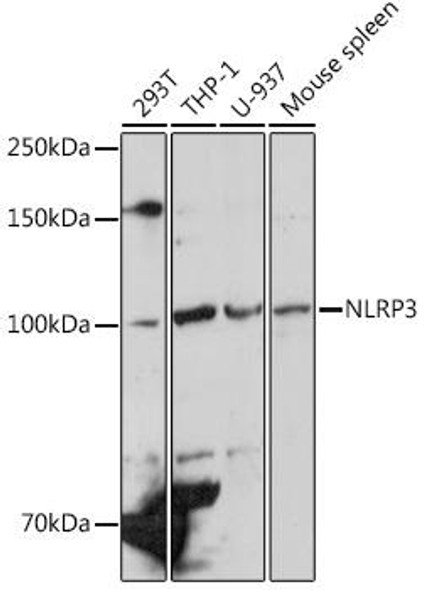
This antibody is validated for use in WB, IF/ICC, IP, ELISA applications and has demonstrated reactivity against Mouse samples.
Product Name:
NLRP3 Monoclonal Antibody
SKU:
CAB24294
Size:
100μL, 20μL
Reactivity:
Mouse
Clone Number:
ARC62768
Conjugate:
Unconjugated
Immunogen:
Recombinant protein (or fragment).This information is considered to be commercially sensitive.
Tested Applications:
WBIF/ICCIPELISA
Recommended Dilution:
WB
1:1000 - 1:6000
IF/ICC
1:100 - 1:500
IP
0.5μg-4μg antibody for 200μg-400μg extracts of whole cells
ELISA
Recommended starting concentration is 1 μg/mL. Please optimize the concentration based on your specific assay requirements.
Enables DNA-binding transcription factor binding activity and sequence-specific DNA binding activity. Involved in several processes, including positive regulation of T-helper cell differentiation; positive regulation of cytokine production; and response to bacterium. Acts upstream of or within several processes, including NLRP3 inflammasome complex assembly; activation of cysteine-type endopeptidase activity involved in apoptotic process; and defense response to virus. Located in cytoplasm and nucleus. Part of NLRP3 inflammasome complex. Is expressed in central nervous system and retina. Used to study CINCA Syndrome; familial cold autoinflammatory syndrome 1; and non-alcoholic fatty liver disease. Human ortholog(s) of this gene implicated in CINCA Syndrome; Muckle-Wells syndrome; autosomal dominant nonsyndromic deafness 34; familial cold autoinflammatory syndrome 1; and urticaria. Orthologous to human NLRP3 (NLR family pyrin domain containing 3).
Purification Method
Affinity purification
Gene ID
216799
Buffer Information
Store at -20℃. Avoid freeze / thaw cycles. Buffer: PBS with 0.09% Sodium azide,0.05% BSA,50% glycerol,pH7.3.
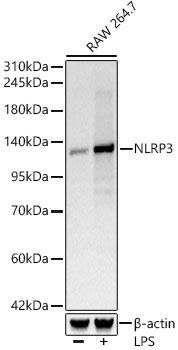
Western blot analysis of lysates from RAW 264.7 cells, using NLRP3 Rabbit mAb (CAB24294) at 1:1000 dilution. Raw264. 7 cells were treated with LPS (1 μg/ml) at 37℃ for 8 hours. Secondary antibody: HRP-conjugated Goat anti-Rabbit IgG (H+L) (AS014) at 1:10000 dilution. Lysates/proteins: 25μg per lane. Blocking buffer: 3% nonfat dry milk in TBST. Detection: ECL Basic Kit (AbGn00020). Exposure time: 10s.
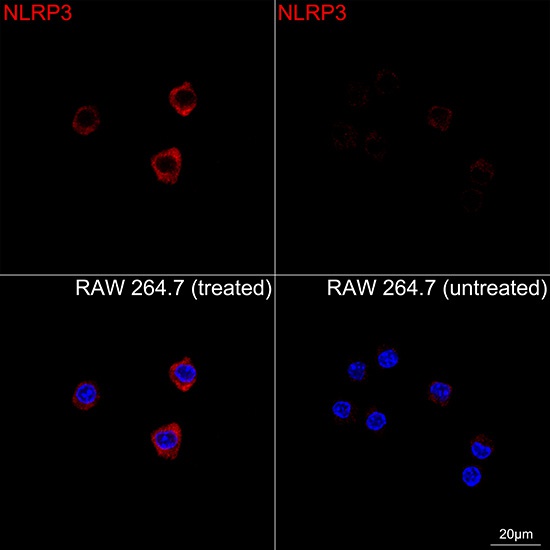
Confocal imaging of RAW 264.7 cells (treated with LPS) and RAW 264.7 cells (untreated) using NLRP3 Rabbit mAb (CAB24294, dilution 1:200) followed by a further incubation with Cy3 Goat Anti-Rabbit IgG (H+L) (AS007, dilution 1:500) (Red). DAPI was used for nuclear staining (Blue). Objective: 100x.