OFCC1 Antibody is a premium polyclonal that offers outstanding performance and reliability for demanding research applications. Rigorously validated for ELISA, WB, this antibody ensures consistent, reproducible results across multiple experimental platforms. Demonstrates excellent reactivity with Human, Mouse samples, providing researchers with confidence in cross-species compatibility. Conveniently packaged in 50ug format to meet your experimental needs. For optimal performance, store at -20°C or -80°C and maintains stability for 12 months. Backed by rigorous quality control testing to ensure superior performance in your critical research applications.
Product Name:
OFCC1 Antibody
SKU:
PACO37642
Size:
50μg
Isotype:
IgG
Host Species:
Rabbit
Reactivity:
Human, Mouse
Immunogen:
Recombinant Human Orofacial cleft 1 candidate gene 1 protein (3-231AA)
Immunogen Species:
Homo sapiens (Human)
Uniprot No:
Q8IZS5
Form:
Liquid
Tested Applications:
ELISAWB
Recommended Dilution:
Application
Recommended Dilution
WB
1:1000-1:5000
Synonyms:
OFCC1 antibody, MRDS1 antibody, Orofacial cleft 1 candidate gene 1 protein antibody, Orofacial clefting chromosomal breakpoint region candidate 1 protein antibody
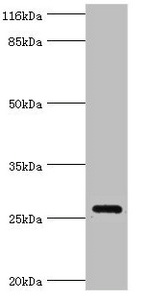
Western blot All lanes: OFCC1 antibody at 2µg/ml + Mouse gonadal tissue Secondary Goat polyclonal to rabbit IgG at 1/10000 dilution Predicted band size: 27, 32, 21, 14, 16 kDa Observed band size: 27 kDa