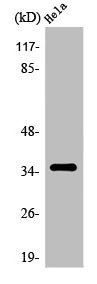
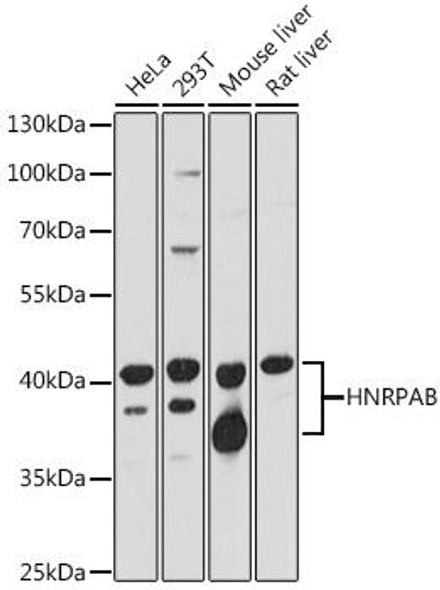
The OR6K2 Polyclonal Antibody (PACO01256) is a valuable tool for researchers studying the OR6K2 protein, a member of the olfactory receptor family involved in odor detection and perception. This antibody, produced in rabbits, exhibits high reactivity with human samples and has been validated for use in various experimental applications, including Western blotting.OR6K2 is a key player in the olfactory system, where it helps detect specific odors and transduce signals to the brain for processing. Understanding the function and regulation of OR6K2 is essential for unraveling the complexities of olfaction and sensory perception.
The OR6K2 Polyclonal Antibody enables the detection and analysis of the OR6K2 protein in different cell types, providing researchers with a powerful tool for investigating olfactory signaling pathways and sensory processing mechanisms. By targeting OR6K2, researchers can gain insights into how the olfactory system functions and how it contributes to overall human health and behavior. Studies involving OR6K2 may have implications for various fields, including neuroscience, sensory biology, and pharmaceutical research aimed at developing novel therapeutics for olfactory-related disorders.
Antibody Name:
OR6K2 Antibody
Antibody SKU:
PACO01256
Size:
50ug
Host Species:
Rabbit
Tested Applications:
ELISA, WB
Recommended Dilutions:
WB:1:500-1:2000
Species Reactivity:
Human
Immunogen:
synthesized peptide derived from the C-terminal region of human Olfactory receptor 6K2.
Form:
Liquid
Storage Buffer:
Liquid in PBS containing 50% glycerol, 0.5% BSA and 0.02% sodium azide.
Purification Method:
The antibody was affinity-purified from rabbit antiserum by affinity-chromatography using epitope-specific immunogen.
OR6K2: Odorant receptor (Potential). Belongs to the G-protein coupled receptor 1 family.Protein type: GPCR, family 1; Membrane protein, integral; Membrane protein, multi-pass; Receptor, GPCRChromosomal Location of Human Ortholog: 1q23.1Cellular Component: integral to membrane; plasma membraneMolecular Function: transmembrane receptor activityBiological Process: detection of chemical stimulus involved in sensory perception; G-protein coupled receptor protein signaling pathway
UniProt Protein Details:
NCBI Summary:
Olfactory receptors interact with odorant molecules in the nose, to initiate a neuronal response that triggers the perception of a smell. The olfactory receptor proteins are members of a large family of G-protein-coupled receptors (GPCR) arising from single coding-exon genes. Olfactory receptors share a 7-transmembrane domain structure with many neurotransmitter and hormone receptors and are responsible for the recognition and G protein-mediated transduction of odorant signals. The olfactory receptor gene family is the largest in the genome. The nomenclature assigned to the olfactory receptor genes and proteins for this organism is independent of other organisms. [provided by RefSeq, Jul 2008]