The Pan Cadherin Monoclonal Antibody (CAB4903) is a high-quality antibody developed for reliable detection and analysis of target proteins. This antibody, generated in rabbits, is highly specific for human samples and has been validated for use in various applications, including immunohistochemistry and flow cytometry.Cadherins are a family of calcium-dependent cell adhesion molecules that are essential for maintaining tissue structure and organization. Aberrant expression of cadherins has been implicated in various diseases, including cancer and developmental disorders. The Pan-Cadherin Rabbit Monoclonal Antibody specifically targets all types of cadherin proteins, allowing for comprehensive analysis and detection in different cell types and tissue samples.
This antibody is validated for use in WB, IHC-P, ELISA applications and has demonstrated reactivity against Human, Mouse samples.
Product Name:
Pan Cadherin Monoclonal Antibody
SKU:
CAB4903
Size:
20μL, 100μL
Reactivity:
Human, Mouse
Clone Number:
ARC1135
Conjugate:
Unconjugated
Immunogen:
Synthetic peptide. This information is considered to be commercially sensitive.
Recommended starting concentration is 1 μg/mL. Please optimize the concentration based on your specific assay requirements.
Synonyms:
Arc-1, CD324, CDHE, ECAD, LCAM, UVO, Pan Cadherin
Positive Sample:
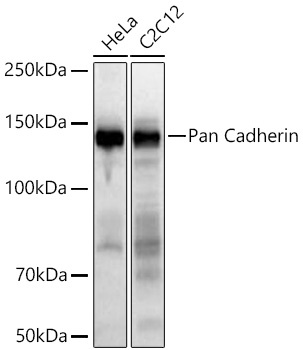
HeLa, C2C12
Cellular Localization:
Actin Cytoskeleton, Adherens Junction, Apical Junction Complex, Cell Junction, Cytoplasm, Cytoplasmic Side Of Plasma Membrane, Endosome, Extracellular Exosome, Extracellular Region, Flotillin Complex, Glutamatergic Synapse, Lateral Plasma Membrane, Perinuclear Region Of Cytoplasm, Plasma Membrane, Trans-Golgi Network.
Calculated MW:
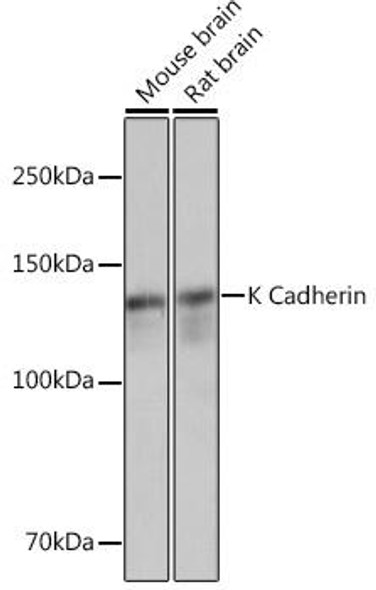
140kDa
Observed MW:
130-150kDa
This gene encodes a classical cadherin of the cadherin superfamily. Alternative splicing results in multiple transcript variants, at least one of which encodes a preproprotein that is proteolytically processed to generate the mature glycoprotein. This calcium-dependent cell-cell adhesion protein is comprised of five extracellular cadherin repeats, a transmembrane region and a highly conserved cytoplasmic tail. Mutations in this gene are correlated with gastric, breast, colorectal, thyroid and ovarian cancer. Loss of function of this gene is thought to contribute to cancer progression by increasing proliferation, invasion, and/or metastasis. The ectodomain of this protein mediates bacterial adhesion to mammalian cells and the cytoplasmic domain is required for internalization. This gene is present in a gene cluster with other members of the cadherin family on chromosome 16. [provided by RefSeq, Nov 2015]
Purification Method
Affinity purification
Gene ID
999 1000 1001 1001 1002 12561
RRID
AB_2863384
Buffer Information
Store at -20℃. Avoid freeze / thaw cycles. Buffer: PBS containing 50% glycerol and 0.05% BSA, preserved with proclin300 or sodium azide, pH 7.3.
Western blot analysis of various lysates using Pan Cadherin Rabbit mAb (CAB4903) at 1:1000 dilution incubated at room temperature for 1.5 hours. Secondary antibody: HRP-conjugated Goat anti-Rabbit IgG (H+L) (CABS014) at 1:10000 dilution. Lysates/proteins: 25 μg per lane. Blocking buffer: 3% nonfat dry milk in TBST. Detection: ECL Basic Kit (AbGn00020). Exposure time: 20 s.
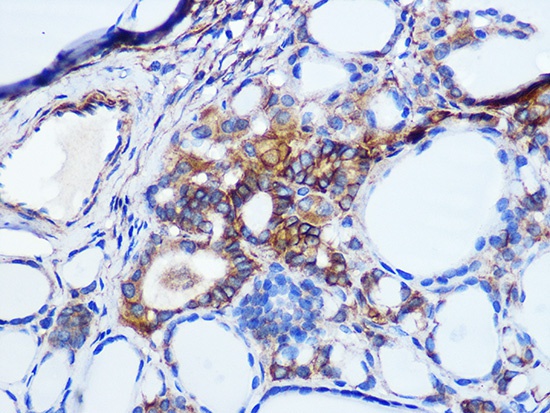
Immunohistochemistry analysis of paraffin-embedded Human thyroid cancer using Pan Cadherin Rabbit mAb (CAB4903) at dilution of 1:100 (40x lens). Microwave antigen retrieval performed with 0.01M PBS Buffer (pH 7.2) prior to IHC staining.