Description
Phospho-AKT1-S473 Monoclonal Antibody (CABP0637)
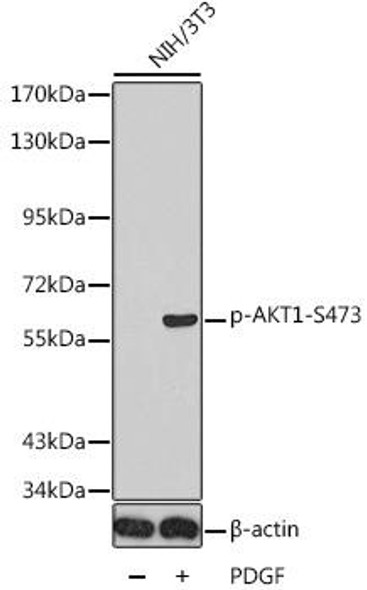
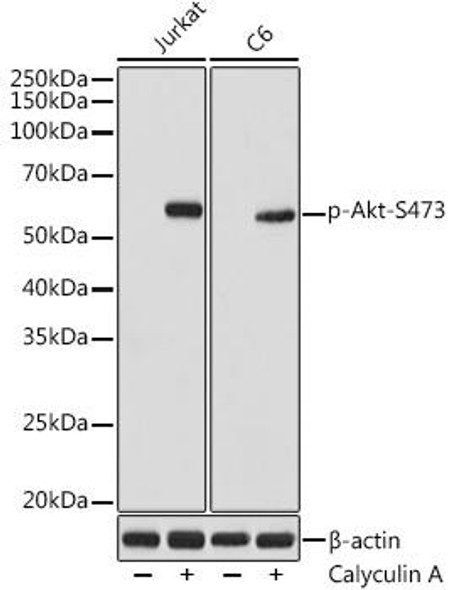
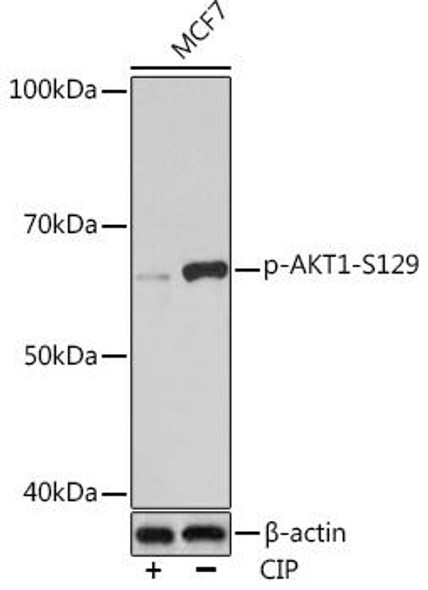
The Phospho-AKT1-S473 Monoclonal Antibody (CABP0637) is a high-quality antibody developed for reliable detection and analysis of target proteins. This antibody specifically targets the phosphorylated form of Akt1 at Ser473, which plays a crucial role in Akt1 activation and downstream signaling.Raised in mice, this monoclonal antibody is highly specific to human samples and has been validated for use in Western blot applications, enabling researchers to detect and analyze phosphorylated Akt1 in various cell types. By targeting the phosphorylated form of Akt1, researchers can gain insights into the activation status of this critical signaling molecule and its role in cell growth, survival, and metabolism.
This antibody is validated for use in WB, IHC-P, ELISA applications and has demonstrated reactivity against Human, Mouse, Rat samples.
| Product Name: | Phospho-AKT1-S473 Monoclonal Antibody |
| SKU: | CABP0637 |
| Size: | 20μL, 100μL |
| Reactivity: | Human, Mouse, Rat |
| Clone Number: | ARC0169 |
| Conjugate: | Unconjugated |
| Immunogen: | Synthetic peptide. This information is considered to be commercially sensitive. | ||||||
| Sequence: | QFSY S | ||||||
| Tested Applications: | WB IHC-P ELISA | ||||||
| Recommended Dilution: |
| ||||||
| Synonyms: | AKT, PKB, RAC, PRKBA, PKB-ALPHA, RAC-ALPHA, Phospho-AKT1-S473 |
| Positive Sample: | Jurkat treated with Calyculin A, NIH/3T3 treated with Calyculin A, C6 treated with Calyculin A |
| Cellular Localization: | Cell Membrane, Cytoplasm, Nucleus. |
| Calculated MW: | 56kDa |
| Observed MW: | 60kDa |
This gene encodes one of the three members of the human AKT serine-threonine protein kinase family which are often referred to as protein kinase B alpha, beta, and gamma. These highly similar AKT proteins all have an N-terminal pleckstrin homology domain, a serine/threonine-specific kinase domain and a C-terminal regulatory domain. These proteins are phosphorylated by phosphoinositide 3-kinase (PI3K). AKT/PI3K forms a key component of many signalling pathways that involve the binding of membrane-bound ligands such as receptor tyrosine kinases, G-protein coupled receptors, and integrin-linked kinase. These AKT proteins therefore regulate a wide variety of cellular functions including cell proliferation, survival, metabolism, and angiogenesis in both normal and malignant cells. AKT proteins are recruited to the cell membrane by phosphatidylinositol 3,4,5-trisphosphate (PIP3) after phosphorylation of phosphatidylinositol 4,5-bisphosphate (PIP2) by PI3K. Subsequent phosphorylation of both threonine residue 308 and serine residue 473 is required for full activation of the AKT1 protein encoded by this gene. Phosphorylation of additional residues also occurs, for example, in response to insulin growth factor-1 and epidermal growth factor. Protein phosphatases act as negative regulators of AKT proteins by dephosphorylating AKT or PIP3. The PI3K/AKT signalling pathway is crucial for tumor cell survival. Survival factors can suppress apoptosis in a transcription-independent manner by activating AKT1 which then phosphorylates and inactivates components of the apoptotic machinery. AKT proteins also participate in the mammalian target of rapamycin (mTOR) signalling pathway which controls the assembly of the eukaryotic translation initiation factor 4F (eIF4E) complex and this pathway, in addition to responding to extracellular signals from growth factors and cytokines, is disregulated in many cancers. Mutations in this gene are associated with multiple types of cancer and excessive tissue growth including Proteus syndrome and Cowden syndrome 6, and breast, colorectal, and ovarian cancers. Multiple alternatively spliced transcript variants have been found for this gene.
| Purification Method | Affinity purification |
| Gene ID | 207 |
| RRID | AB_2770898 |
| Buffer Information | Store at -20℃. Avoid freeze / thaw cycles. Buffer: PBS containing 50% glycerol and 0.05% BSA, preserved with proclin300 or sodium azide, pH 7.3. |
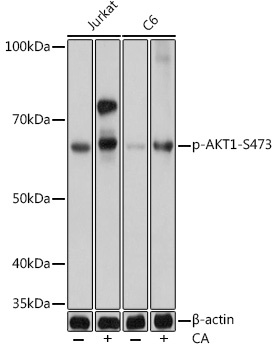 | Western blot analysis of various lysates using Phospho-AKT1-S473 mAb (CABP0637) at 1:1000 dilution. Both Jurkat cells and C6 cells were treated with Calyculin A (100 nM) at 37℃ for 30 minutes. Secondary antibody: HRP-conjugated Goat anti-Rabbit IgG (H+L) (CABS014) at 1:10000 dilution. Lysates/proteins: 25μg per lane. Blocking buffer: 3% nonfat dry milk in TBST. Detection: ECL Basic Kit (AbGn00020). Exposure time: 1s. |
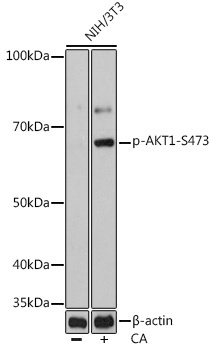 | Western blot analysis of lysates from NIH/3T3 cells, using Phospho-AKT1-S473 mAb (CABP0637) at 1:1000 dilution. NIH/3T3 cells were treated with Calyculin A (100 nM) at 37℃ for 30 minutes. Secondary antibody: HRP-conjugated Goat anti-Rabbit IgG (H+L) (CABS014) at 1:10000 dilution. Lysates/proteins: 25μg per lane. Blocking buffer: 3% nonfat dry milk in TBST. Detection: ECL Basic Kit (AbGn00020). Exposure time: 10s. |
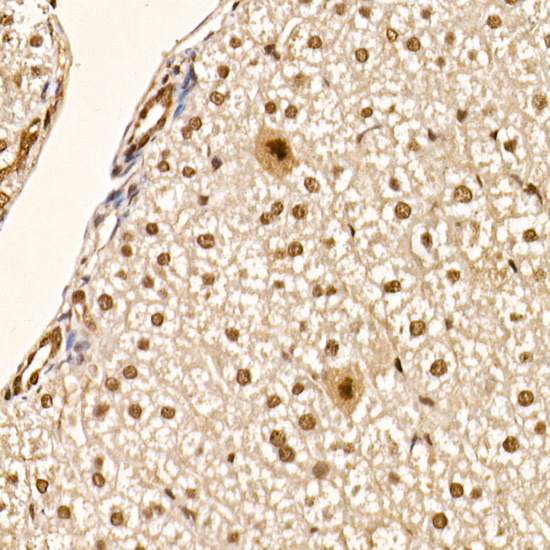 | Immunohistochemistry analysis of paraffin-embedded Mouse liver using Phospho-AKT1-S473 Rabbit mAb (CABP0637) at dilution of 1:100 (40x lens). High pressure antigen retrieval performed with 0.01M Citrate buffer (pH 6.0) prior to IHC staining. |
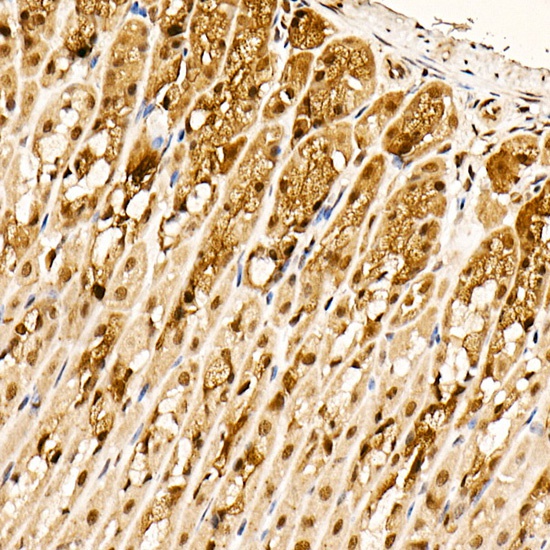 | Immunohistochemistry analysis of paraffin-embedded Mouse stomach using Phospho-AKT1-S473 Rabbit mAb (CABP0637) at dilution of 1:100 (40x lens). High pressure antigen retrieval performed with 0.01M Citrate buffer (pH 6.0) prior to IHC staining. |