Description
Phospho-ALK-Y1096 Antibody (CABP0503)
The Phospho-ALK-Y1096 Antibody (CABP0503) is a high-quality antibody developed for reliable detection and analysis of target proteins. This antibody, produced in rabbits, is highly specific to phosphorylated ALK at the Y1096 residue and is validated for use in applications such as Western blot and immunohistochemistry.Phosphorylation of ALK at the Y1096 site is known to activate downstream signaling pathways involved in cell proliferation and survival, making it a crucial marker for identifying ALK-driven tumors and monitoring response to targeted therapies. The antibody's high reactivity with human samples enables precise detection and quantification of phosphorylated ALK in tumor tissues, making it an invaluable resource in cancer research.
This antibody is validated for use in WB, ELISA applications and has demonstrated reactivity against Human samples.
| Product Name: | Phospho-ALK-Y1096 Antibody |
| SKU: | CABP0503 |
| Size: | 20μL, 100μL |
| Reactivity: | Human |
| Conjugate: | Unconjugated |
| Immunogen: | Synthetic peptide. This information is considered to be commercially sensitive. | ||||
| Sequence: | PNYC F | ||||
| Tested Applications: | WB ELISA | ||||
| Recommended Dilution: |
| ||||
| Synonyms: | ALK1, CD246, NBLST3, Phospho-ALK-Y1096 |
| Positive Sample: | HL-60 treated with 10% FBS |
| Cellular Localization: | Cell Membrane, Single-Pass Type I Membrane Protein. |
| Calculated MW: | 176kDa |
| Observed MW: | 168kDa |
This gene encodes a receptor tyrosine kinase, which belongs to the insulin receptor superfamily. This protein comprises an extracellular domain, an hydrophobic stretch corresponding to a single pass transmembrane region, and an intracellular kinase domain. It plays an important role in the development of the brain and exerts its effects on specific neurons in the nervous system. This gene has been found to be rearranged, mutated, or amplified in a series of tumours including anaplastic large cell lymphomas, neuroblastoma, and non-small cell lung cancer. The chromosomal rearrangements are the most common genetic alterations in this gene, which result in creation of multiple fusion genes in tumourigenesis, including ALK (chromosome 2)/EML4 (chromosome 2), ALK/RANBP2 (chromosome 2), ALK/ATIC (chromosome 2), ALK/TFG (chromosome 3), ALK/NPM1 (chromosome 5), ALK/SQSTM1 (chromosome 5), ALK/KIF5B (chromosome 10), ALK/CLTC (chromosome 17), ALK/TPM4 (chromosome 19), and ALK/MSN (chromosome X).
| Purification Method | Affinity purification |
| Gene ID | 238 |
| RRID | AB_2770908 |
| Buffer Information | Store at -20℃. Avoid freeze / thaw cycles. Buffer: PBS containing 50% glycerol, preserved with proclin300 or sodium azide, pH 7.3. |
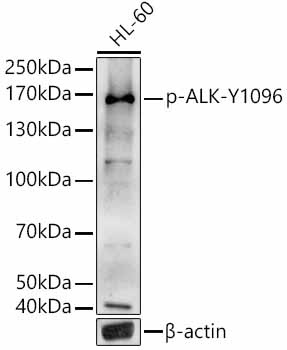 | Western blot analysis of lysates from HL-60 and HL-60 cells, using Phospho-ALK-Y1096 Rabbit pAb (CABP0503) at 1:1000 dilution. HL-60 cells were treated with 10% FBS after serum-starvation overnight. HL-60 cells were treated with UV for 15-30 minutes. Secondary antibody: HRP-conjugated Goat anti-Rabbit IgG (H+L) (CABS014) at 1:10000 dilution. Lysates/proteins: 25μg per lane. Blocking buffer: 3% BSA. |