The Phospho-ATF-2 (Thr69/71)/ATF-7 (Thr51/53) Polyclonal Antibody (CABP1429) is a high-quality antibody developed for reliable detection and analysis of target proteins. This antibody, raised in rabbits, is highly specific and reacts with human samples, making it suitable for a variety of research applications including Western blotting.By targeting specific phosphorylation sites on ATF-2 and ATF-7, this antibody allows for the detection and analysis of these proteins in different cellular contexts. Researchers interested in signal transduction pathways, gene expression regulation, and cellular stress responses will find this antibody particularly useful in their studies.
This antibody is validated for use in WB, ELISA applications and has demonstrated reactivity against Human samples.
This gene encodes a transcription factor that is a member of the leucine zipper family of DNA binding proteins. The encoded protein has been identified as a moonlighting protein based on its ability to perform mechanistically distinct functions This protein binds to the cAMP-responsive element (CRE), an octameric palindrome. It forms a homodimer or a heterodimer with c-Jun and stimulates CRE-dependent transcription. This protein is also a histone acetyltransferase (HAT) that specifically acetylates histones H2B and H4 in vitro; thus it may represent a class of sequence-specific factors that activate transcription by direct effects on chromatin components. The encoded protein may also be involved in cell's DNA damage response independent of its role in transcriptional regulation. Several alternatively spliced transcript variants have been found for this gene,Enables several functions, including DNA-binding transcription repressor activity, RNA polymerase II-specific; mitogen-activated protein kinase binding activity; and transcription coactivator binding activity. Involved in negative regulation of transcription by RNA polymerase II and positive regulation of transcription by RNA polymerase II. Located in nucleoplasm. Biomarker of colorectal cancer.
Purification Method
Affinity purification
Gene ID
1386 11016
Buffer Information
Store at -20℃. Avoid freeze / thaw cycles. Buffer: PBS containing 50% glycerol, preserved with proclin300 or sodium azide, pH 7.3.
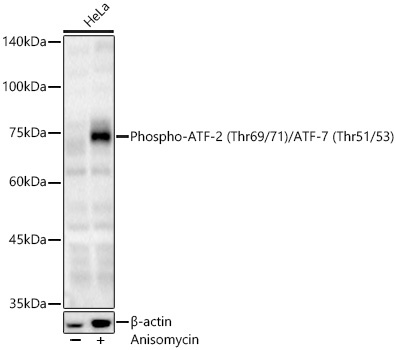
Western blot analysis of lysates from HeLa cells, using Phospho-ATF-2 (Thr69/71)/ATF-7 (Thr51/53) Rabbit pAb (CABP1429) at 1:600 dilution. HeLa cells were treated by Anisomycin (25 μg/mL) at 37℃ for 30 minutes after serum-starvation overnight. Secondary antibody: HRP-conjugated Goat anti-Rabbit IgG (H+L) (CABS014) at 1:10000 dilution. Lysates/proteins: 25μg per lane. Blocking buffer: 3% nonfat dry milk in TBST. Detection: ECL Basic Kit (AbGn00020). Exposure time: 90s.