The Phospho-CSF1R-Y708 Antibody (CABP0609) is a high-quality antibody developed for reliable detection and analysis of target proteins. This antibody, generated in rabbits, specifically targets the phosphorylated Y708 site on the CSF1R protein, allowing for accurate detection and analysis in various experimental settings, particularly Western blot applications.CSF1R plays a crucial role in regulating the development and function of macrophages, immune cells that play a key role in various physiological and pathological processes. Phosphorylation of the Y708 residue of CSF1R is associated with its activation and downstream signaling pathways, making this antibody an important resource for investigating the functions and mechanisms of CSF1R in cellular processes.
This antibody is validated for use in WB, ELISA applications and has demonstrated reactivity against Human samples.
Product Name:
Phospho-CSF1R-Y708 Antibody
SKU:
CABP0609
Size:
20μL, 100μL
Reactivity:
Human
Conjugate:
Unconjugated
Immunogen:
Synthetic peptide. This information is considered to be commercially sensitive.
Sequence:
KKYV R
Tested Applications:
WBELISA
Recommended Dilution:
WB
1:500 - 1:1000
ELISA
Recommended starting concentration is 1 μg/mL. Please optimize the concentration based on your specific assay requirements.
Cell Membrane, Single-Pass Type I Membrane Protein.
Calculated MW:
108kDa
Observed MW:
175kDa
The protein encoded by this gene is the receptor for colony stimulating factor 1, a cytokine which controls the production, differentiation, and function of macrophages. This receptor mediates most if not all of the biological effects of this cytokine. Ligand binding activates the receptor kinase through a process of oligomerization and transphosphorylation. The encoded protein is a tyrosine kinase transmembrane receptor and member of the CSF1/PDGF receptor family of tyrosine-protein kinases. Mutations in this gene have been associated with a predisposition to myeloid malignancy. The first intron of this gene contains a transcriptionally inactive ribosomal protein L7 processed pseudogene oriented in the opposite direction. Alternative splicing results in multiple transcript variants. Expression of a splice variant from an LTR promoter has been found in Hodgkin lymphoma (HL), HL cell lines and anaplastic large cell lymphoma.
Purification Method
Affinity purification
Gene ID
1436
RRID
AB_2771014
Buffer Information
Store at -20℃. Avoid freeze / thaw cycles. Buffer: PBS with 0.01% thimerosal,50% glycerol,pH7.3.
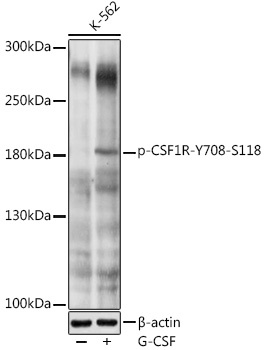
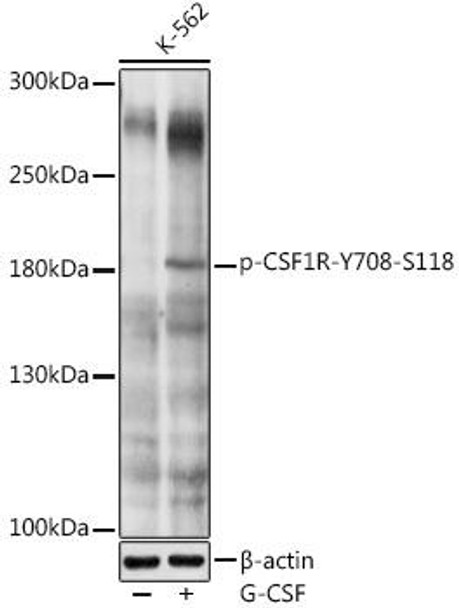
Western blot analysis of lysates from K-562 cells, using Phospho-CD115/CSF-1R-Y708 Rabbit pAb (CABP0609) at 1:1000 dilution. K-562 cells were treated with G-CSF (25 ng/ml) at 37℃ for 30 minutes after serum-starvation overnight. Secondary antibody: HRP-conjugated Goat anti-Rabbit IgG (H+L) (CABS014) at 1:10000 dilution. Lysates/proteins: 25μg per lane. Blocking buffer: 3% nonfat dry milk in TBST. Detection: ECL Basic Kit (AbGn00020). Exposure time: 1s.