The Phospho-eIF4E-S209 Monoclonal Antibody (CABP1024) is a high-quality antibody developed for reliable detection and analysis of target proteins. This antibody, produced in rabbits, is highly specific for the phosphorylated form of eIF4E at serine 209 and is validated for use in Western blot applications. By targeting this specific phosphorylation site, researchers can investigate the regulation of eIF4E activity in various cellular processes, such as protein synthesis, cell growth, and proliferation.The phosphorylation of eIF4E at serine 209 is known to regulate its function in cap-dependent translation, a process essential for the synthesis of proteins involved in cell proliferation and survival. Aberrant regulation of eIF4E phosphorylation has been implicated in various diseases, including cancer, where dysregulated protein synthesis can promote tumor growth and progression.
This antibody is validated for use in WB, ELISA applications and has demonstrated reactivity against Human, Rat samples.
Product Name:
Phospho-eIF4E-S209 Monoclonal Antibody
SKU:
CABP1024
Size:
20μL, 100μL
Reactivity:
Human, Rat
Clone Number:
ARC1569
Conjugate:
Unconjugated
Immunogen:
Synthetic peptide. This information is considered to be commercially sensitive.
Tested Applications:
WBELISA
Recommended Dilution:
WB
1:1000 - 1:5000
ELISA
Recommended starting concentration is 1 μg/mL. Please optimize the concentration based on your specific assay requirements.
The protein encoded by this gene is a component of the eukaryotic translation initiation factor 4F complex, which recognizes the 7-methylguanosine cap structure at the 5' end of messenger RNAs. The encoded protein aids in translation initiation by recruiting ribosomes to the 5'-cap structure. Association of this protein with the 4F complex is the rate-limiting step in translation initiation. This gene acts as a proto-oncogene, and its expression and activation is associated with transformation and tumorigenesis. Several pseudogenes of this gene are found on other chromosomes. Alternative splicing results in multiple transcript variants.
Purification Method
Affinity purification
Gene ID
1977
Buffer Information
Store at -20℃. Avoid freeze / thaw cycles. Buffer: PBS containing 50% glycerol and 0.05% BSA, preserved with proclin300 or sodium azide, pH 7.3.
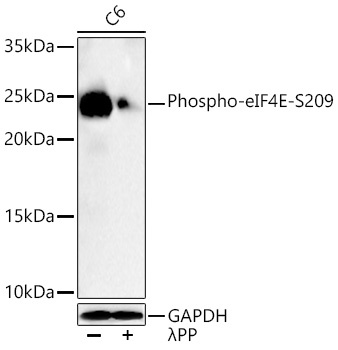
Western blot analysis of lysates from C6 cells using Phospho-eIF4E-S209 Rabbit mAb (CABP1024) at 1:1000 dilution incubated overnight at 4℃. C6 treated with λpp (125 U) at 37℃ for 1 hour. Secondary antibody: HRP-conjugated Goat anti-Rabbit IgG (H+L) (CABS014) at 1:10000 dilution. Lysates/proteins: 30 μg per lane. Blocking buffer: 3% nonfat dry milk in TBST. Detection: ECL Basic Kit (AbGn00020). Exposure time: 30 s.
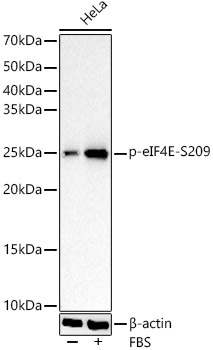
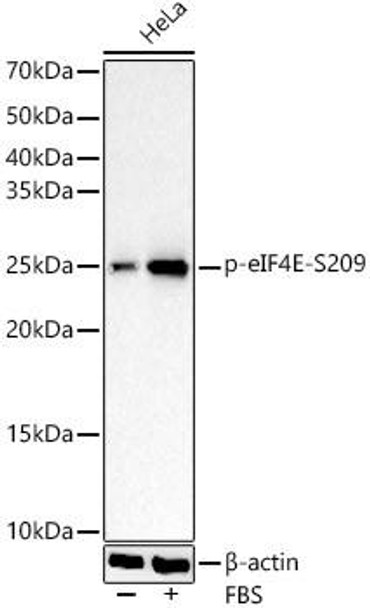
Western blot analysis of lysates from HeLa cells, using Phospho-eIF4E-S209 Rabbit mAb (CABP1024) at 1:1000 dilution. HeLa cells were treated with 20% FBS at 37℃ for 30 minutes after serum-starvation overnight. Secondary antibody: HRP-conjugated Goat anti-Rabbit IgG (H+L) (CABS014) at 1:10000 dilution. Lysates/proteins: 25 μg per lane. Blocking buffer: 3% nonfat dry milk in TBST. Detection: ECL Basic Kit (AbGn00020). Exposure time: 3 s.