The Phospho-mTOR-S2448 Monoclonal Antibody (CABP0115) is a high-quality antibody developed for reliable detection and analysis of target proteins. This antibody, generated from rabbit monoclonal cells, is highly specific to the phosphorylated form of mTOR at serine 2448 in human samples. It has been validated for use in Western blot applications, allowing for the detection and analysis of phospho-mTOR in various cell types.mTOR, a key regulator of cell growth and metabolism, is involved in various cellular processes such as protein synthesis, autophagy, and cell proliferation. Phosphorylation of mTOR at serine 2448 is known to activate its kinase activity, leading to downstream signaling that influences cell survival and growth.
This antibody is validated for use in WB, ELISA applications and has demonstrated reactivity against Human, Mouse samples.
Product Name:
Phospho-mTOR-S2448 Monoclonal Antibody
SKU:
CABP0115
Size:
20μL, 100μL
Reactivity:
Human, Mouse
Clone Number:
ARC0094
Conjugate:
Unconjugated
Immunogen:
Synthetic peptide. This information is considered to be commercially sensitive.
Sequence:
TDSY S
Tested Applications:
WBELISA
Recommended Dilution:
WB
1:500 - 1:1000
ELISA
Recommended starting concentration is 1 μg/mL. Please optimize the concentration based on your specific assay requirements.
The protein encoded by this gene belongs to a family of phosphatidylinositol kinase-related kinases. These kinases mediate cellular responses to stresses such as DNA damage and nutrient deprivation. This kinase is a component of two distinct complexes, mTORC1, which controls protein synthesis, cell growth and proliferation, and mTORC2, which is a regulator of the actin cytoskeleton, and promotes cell survival and cell cycle progression. This protein acts as the target for the cell-cycle arrest and immunosuppressive effects of the FKBP12-rapamycin complex. Inhibitors of mTOR are used in organ transplants as immunosuppressants, and are being evaluated for their therapeutic potential in SARS-CoV-2 infections. Mutations in this gene are associated with Smith-Kingsmore syndrome and somatic focal cortical dysplasia type II. The ANGPTL7 gene is located in an intron of this gene.
Purification Method
Affinity purification
Gene ID
2475
RRID
AB_2832985
Buffer Information
Store at -20℃. Avoid freeze / thaw cycles. Buffer: PBS with 0.09% Sodium azide,0.05% BSA,50% glycerol,pH7.3.
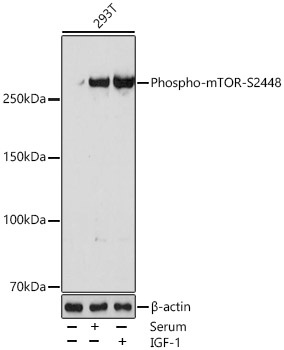
Western blot analysis of lysates from 293T cells, using Phospho-mTOR-S2448 Rabbit mAb (CABP0115) at 1:1000 dilution. 293T cells were treated with 10% FBS at 37℃ for 30 minutes after serum-starvation overnight or treated with IGF-1 (50 ng/mL) at 37℃ for 5 minutes after serum-starvation overnight. Secondary antibody: HRP-conjugated Goat anti-Rabbit IgG (H+L) (CABS014) at 1:10000 dilution. Lysates/proteins: 25μg per lane. Blocking buffer: 3% nonfat dry milk in TBST. Detection: ECL Basic Kit (AbGn00020). Exposure time: 1s.
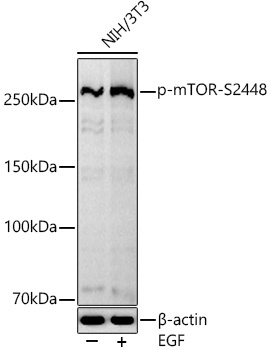
Western blot analysis of lysates from NIH/3T3 cells, using Phospho-mTOR-S2448 Rabbit mAb (CABP0115) at 1:1000 dilution. NIH/3T3 cells were treated with EGF (100 ng/ml) at 37℃ for 30 minutes after serum-starvation overnight. Secondary antibody: HRP-conjugated Goat anti-Rabbit IgG (H+L) (CABS014) at 1:10000 dilution. Lysates/proteins: 25μg per lane. Blocking buffer: 3% nonfat dry milk in TBST. Detection: ECL Basic Kit (AbGn00020). Exposure time: 90s.