The Phospho-Smad2-S465/S467 Antibody (CABP0925) is a high-quality antibody developed for reliable detection and analysis of target proteins. This antibody is raised in rabbits and is highly specific to the phosphorylated form of Smad2 at serine residues 465 and 467 in human samples. Validated for use in Western blot applications, this antibody allows for the detection and analysis of phospho-Smad2 in various cell types.Smad2 is a crucial mediator of TGF-β signaling, playing a pivotal role in cell growth, differentiation, and apoptosis. Phosphorylation at serine residues 465 and 467 is known to regulate Smad2 activity, making this antibody an essential tool for researchers investigating the TGF-β signaling pathway in immunology, cancer research, and developmental biology.
This antibody is validated for use in WB, ELISA applications and has demonstrated reactivity against Human, Mouse samples.
Product Name:
Phospho-Smad2-S465/S467 Antibody
SKU:
CABP0925
Size:
20μL, 100μL
Reactivity:
Human, Mouse
Immunogen:
Synthetic peptide. This information is considered to be commercially sensitive.
Sequence:
SSMS
Tested Applications:
WBELISA
Recommended Dilution:
WB
1:500 - 1:5000
ELISA
Recommended starting concentration is 1 μg/mL. Please optimize the concentration based on your specific assay requirements.
The protein encoded by this gene belongs to the SMAD, a family of proteins similar to the gene products of the Drosophila gene 'mothers against decapentaplegic' (Mad) and the C. elegans gene Sma. SMAD proteins are signal transducers and transcriptional modulators that mediate multiple signaling pathways. This protein mediates the signal of the transforming growth factor (TGF)-beta, and thus regulates multiple cellular processes, such as cell proliferation, apoptosis, and differentiation. This protein is recruited to the TGF-beta receptors through its interaction with the SMAD anchor for receptor activation (SARA) protein. In response to TGF-beta signal, this protein is phosphorylated by the TGF-beta receptors. The phosphorylation induces the dissociation of this protein with SARA and the association with the family member SMAD4. The association with SMAD4 is important for the translocation of this protein into the nucleus, where it binds to target promoters and forms a transcription repressor complex with other cofactors. This protein can also be phosphorylated by activin type 1 receptor kinase, and mediates the signal from the activin. Alternatively spliced transcript variants have been observed for this gene.
Purification Method
Affinity purification
Gene ID
4087
RRID
AB_2863837
Buffer Information
Store at -20℃. Avoid freeze / thaw cycles. Buffer: PBS containing 50% glycerol, preserved with proclin300 or sodium azide, pH 7.3.
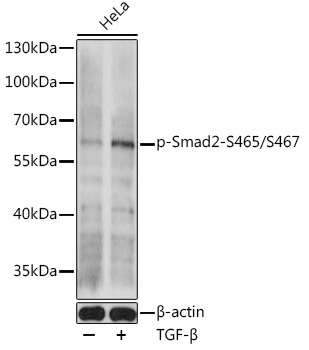
Western blot analysis of lysates from HeLa cells, using Phospho-Smad2-S465/S467 Rabbit pAb (CABP0925) at 1:1000 dilution. HeLa cells were treated with TGF-β (10ng/mL) for 30 minutes after serum-starvation overnight. Secondary antibody: HRP-conjugated Goat anti-Rabbit IgG (H+L) (CABS014) at 1:10000 dilution. Lysates/proteins: 25μg per lane. Blocking buffer: 3% BSA. Detection: ECL Basic Kit (AbGn00020). Exposure time: 10s.