The PIN1 Polyclonal Antibody (CAB20718) is a high-quality antibody developed for reliable detection and analysis of target proteins. This antibody, raised in rabbits, is validated for use in various applications, including Western blot and immunohistochemistry.Pin1 is a unique enzyme that catalyzes the isomerization of specific phosphorylated Ser/Thr-Pro motifs in target proteins, allowing for precise regulation of protein function and stability. Dysfunction of Pin1 has been implicated in various diseases, including cancer, Alzheimer's disease, and heart disease.
This antibody is validated for use in WB, ELISA applications and has demonstrated reactivity against Arabidopsis thaliana samples.
Product Name:
PIN1 Polyclonal Antibody
SKU:
CAB20718
Size:
20μL, 100μL
Reactivity:
Arabidopsis thaliana
Conjugate:
Unconjugated
Immunogen:
Recombinant protein (or fragment).This information is considered to be commercially sensitive.
Encodes an auxin efflux carrier involved in shoot and root development. It is involved in the maintenance of embryonic auxin gradients. Loss of function severely affects organ initiation, pin1 mutants are characterised by an inflorescence meristem that does not initiate any flowers, resulting in the formation of a naked inflorescence stem. PIN1 is involved in the determination of leaf shape by actively promoting development of leaf margin serrations. In roots, the protein mainly resides at the basal end of the vascular cells, but weak signals can be detected in the epidermis and the cortex. Expression levels and polarity of this auxin efflux carrier change during primordium development suggesting that cycles of auxin build-up and depletion accompany, and may direct, different stages of primordium development. PIN1 action on plant development does not strictly require function of PGP1 and PGP19 proteins.
Purification Method
Affinity purification
Gene ID
843693
Buffer Information
Store at -20℃. Avoid freeze / thaw cycles. Buffer: PBS containing 50% glycerol, preserved with proclin300 or sodium azide, pH 7.3.
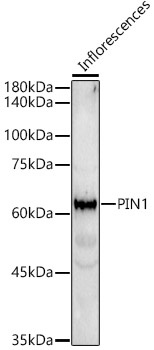
Western blot analysis of lysates from Inflorescences, using PIN1 Rabbit pAb (CAB20718) at 1:1000 dilution. Secondary antibody: HRP-conjugated Goat anti-Rabbit IgG (H+L) (CABS014) at 1:10000 dilution. Lysates/proteins: 25μg per lane. Blocking buffer: 3% nonfat dry milk in TBST. Detection: ECL Basic Kit (AbGn00020). Exposure time: 180s.