Description
PSME2 Antibody (CAB13631)
The PSME2 Antibody (CAB13631) is a high-quality antibody developed for reliable detection and analysis of target proteins. This antibody, produced in rabbits, is highly specific to human samples and has been validated for use in Western blot applications.PSME2, also known as the proteasome activator complex subunit 2, is involved in the activation of the 20S proteasome, which is responsible for degrading unwanted or damaged proteins in the cell. Dysregulation of PSME2 has been linked to various diseases, including cancer and autoimmune disorders.
This antibody is validated for use in WB, ELISA applications and has demonstrated reactivity against Human, Mouse samples.
| Product Name: | PSME2 Antibody |
| SKU: | CAB13631 |
| Size: | 20μL, 100μL |
| Reactivity: | Human, Mouse |
| Conjugate: | Unconjugated |
| Immunogen: | Recombinant protein (or fragment).This information is considered to be commercially sensitive. | ||||
| Sequence: | MAKP CGVR LSGE ARKQ VEVF RQNL FQEA EEFL YRFL PQKI IYLN QLLQ EDSL NVAD LTSL RAPL DIPI PDPP PKDD EMET DKQE KKEV HKCG FLPG NEKV LSLL ALVK PEVW TLKE KCIL VITW IQHL IPKI EDGN DFGV AIQE KVLE RVNA VKTK VEAF QTTI SKYF SERG DAVA KASK ETHV MDYR ALVH ERDE AAYG ELRA MVLD LRAF YAEL YHII SSNL EKIV NPKG EEKP SMY | ||||
| Tested Applications: | WB ELISA | ||||
| Recommended Dilution: |
| ||||
| Synonyms: | PA28B, REGbeta, PA28beta, E2 |
| Positive Sample: | 293T |
| Cellular Localization: | Cytoplasm, Cytosol, Extracellular Exosome, Nucleoplasm. |
| Calculated MW: | 27kDa |
| Observed MW: | 27kDa |
The 26S proteasome is a multicatalytic proteinase complex with a highly ordered structure composed of 2 complexes, a 20S core and a 19S regulator. The 20S core is composed of 4 rings of 28 non-identical subunits; 2 rings are composed of 7 alpha subunits and 2 rings are composed of 7 beta subunits. The 19S regulator is composed of a base, which contains 6 ATPase subunits and 2 non-ATPase subunits, and a lid, which contains up to 10 non-ATPase subunits. Proteasomes are distributed throughout eukaryotic cells at a high concentration and cleave peptides in an ATP/ubiquitin-dependent process in a non-lysosomal pathway. An essential function of a modified proteasome, the immunoproteasome, is the processing of class I MHC peptides. The immunoproteasome contains an alternate regulator, referred to as the 11S regulator or PA28, that replaces the 19S regulator. Three subunits (alpha, beta and gamma) of the 11S regulator have been identified. This gene encodes the beta subunit of the 11S regulator, one of the two 11S subunits that is induced by gamma-interferon. Three beta and three alpha subunits combine to form a heterohexameric ring. Six pseudogenes have been identified on chromosomes 4, 5, 8, 10 and 13.
| Purification Method | Affinity purification |
| Gene ID | 5721 |
| RRID | AB_2760493 |
| Buffer Information | Store at -20℃. Avoid freeze / thaw cycles. Buffer: PBS containing 50% glycerol, preserved with proclin300 or sodium azide, pH 7.3. |
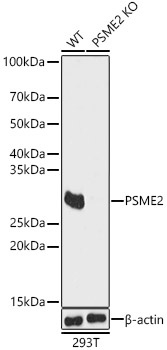 | Western blot analysis of lysates from wild type(WT) and PSME2 knockout (KO) 293T(KO) cells, using [KO Validated] PSME2 Rabbit pAb (CAB13631) at 1:1000 dilution. Secondary antibody: HRP-conjugated Goat anti-Rabbit IgG (H+L) (CABS014) at 1:10000 dilution. Lysates/proteins: 25μg per lane. Blocking buffer: 3% nonfat dry milk in TBST. Detection: ECL Basic Kit (AbGn00020). Exposure time: 1s. |