Description
PTRH2 Antibody (CAB6466)
The PTRH2 Antibody (CAB6466) is a high-quality antibody developed for reliable detection and analysis of target proteins. This antibody, generated in rabbits, is highly specific to human PTRH2 samples and has been validated for use in Western blot applications.PTRH2 plays a critical role in maintaining mitochondrial function and energy production, making it a key player in cellular metabolism and overall health. Dysregulation of PTRH2 has been linked to various metabolic disorders and diseases, highlighting the importance of studying its function and regulation.
This antibody is validated for use in WB, IHC-P, IF/ICC, ELISA applications and has demonstrated reactivity against Human, Mouse, Rat samples.
| Product Name: | PTRH2 Antibody |
| SKU: | CAB6466 |
| Size: | 20μL, 100μL |
| Reactivity: | Human, Mouse, Rat |
| Conjugate: | Unconjugated |
| Immunogen: | Recombinant protein (or fragment).This information is considered to be commercially sensitive. | ||||||||
| Sequence: | LPKS KTSK THTD TESE ASIL GDSG EYKM ILVV RNDL KMGK GKVA AQCS HAAV SAYK QIQR RNPE MLKQ WEYC GQPK VVVK APDE ETLI ALLA HAKM LGLT VSLI QDAG RTQI APGS QTVL GIGP GPAD LIDK VTGH LKLY | ||||||||
| Tested Applications: | WB IHC-P IF/ICC ELISA | ||||||||
| Recommended Dilution: |
| ||||||||
| Synonyms: | PTH, BIT1, PTH2, PTH 2, CFAP37, IMNEPD, CGI-147, PTRH2 |
| Positive Sample: | MCF7, BT-474, SW480, Mouse liver, Mouse spleen, Mouse thymus, Rat brain |
| Cellular Localization: | Mitochondrion. |
| Calculated MW: | 19kDa |
| Observed MW: | 19kDa |
The protein encoded by this gene is a mitochondrial protein with two putative domains, an N-terminal mitochondrial localization sequence, and a UPF0099 domain. In vitro assays suggest that this protein possesses peptidyl-tRNA hydrolase activity, to release the peptidyl moiety from tRNA, thereby preventing the accumulation of dissociated peptidyl-tRNA that could reduce the efficiency of translation. This protein also plays a role regulating cell survival and death. It promotes survival as part of an integrin-signaling pathway for cells attached to the extracellular matrix (ECM), but also promotes apoptosis in cells that have lost their attachment to the ECM, a process called anoikos. After loss of cell attachment to the ECM, this protein is phosphorylated, is released from the mitochondria into the cytosol, and promotes caspase-independent apoptosis through interactions with transcriptional regulators. This gene has been implicated in the development and progression of tumors, and mutations in this gene have been associated with an infantile multisystem neurologic, endocrine, and pancreatic disease (INMEPD) characterized by intellectual disability, postnatal microcephaly, progressive cerebellar atrophy, hearing impairment, polyneuropathy, failure to thrive, and organ fibrosis with exocrine pancreas insufficiency (PMID: 25574476). Alternative splicing results in multiple transcript variants encoding different isoforms.
| Purification Method | Affinity purification |
| Gene ID | 51651 |
| RRID | AB_2767068 |
| Buffer Information | Store at -20℃. Avoid freeze / thaw cycles. Buffer: PBS containing 50% glycerol, preserved with proclin300 or sodium azide, pH 7.3. |
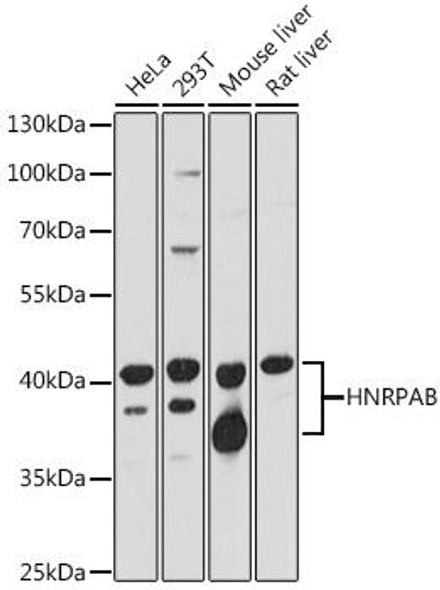
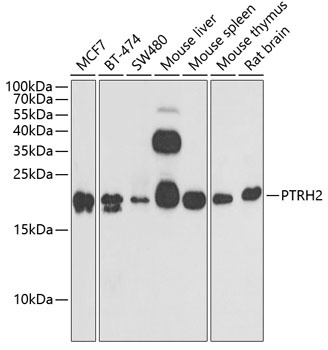 | Western blot analysis of various lysates using PTRH2 Rabbit pAb (CAB6466) at 1:1000 dilution. Secondary antibody: HRP-conjugated Goat anti-Rabbit IgG (H+L) (CABS014) at 1:10000 dilution. Lysates/proteins: 25μg per lane. Blocking buffer: 3% nonfat dry milk in TBST. Detection: ECL Basic Kit (AbGn00020). Exposure time: 90s. |
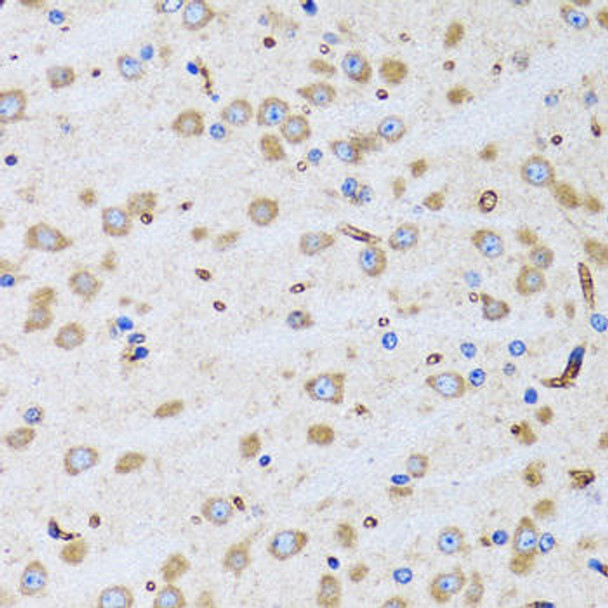
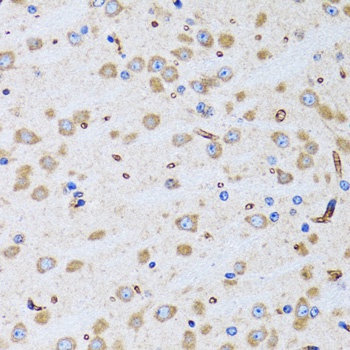 | Immunohistochemistry analysis of paraffin-embedded Rat brain using PTRH2 Rabbit pAb (CAB6466) at dilution of 1:100 (40x lens). Microwave antigen retrieval performed with 0.01M PBS Buffer (pH 7.2) prior to IHC staining. |
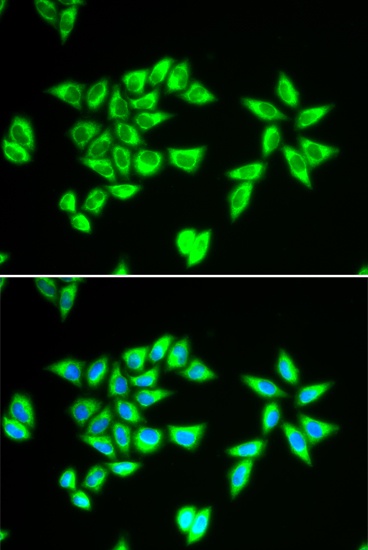 | Immunofluorescence analysis of MCF-7 cells using PTRH2 Rabbit pAb (CAB6466). Secondary antibody: Cy3-conjugated Goat anti-Rabbit IgG (H+L) (CABS007) at 1:500 dilution. Blue: DAPI for nuclear staining. |