The RBP3 Antibody (CAB6403) is a high-quality antibody developed for reliable detection and analysis of target proteins. Interphotoreceptor retinol-binding protein is a large glycoprotein known to bind retinoids and found primarily in the interphotoreceptor matrix of the retina between the retinal pigment epithelium and the photoreceptor cells. It is thought to transport retinoids between the retinal pigment epithelium and the photoreceptors, a critical role in the visual process.The human IRBP gene is approximately 9.5 kbp in length and consists of four exons separated by three introns. The introns are 1.6-1.9 kbp long. The gene is transcribed by photoreceptor and retinoblastoma cells into an approximately 4.3-kilobase mRNA that is translated and processed into a glycosylated protein of 135,000 Da. The amino acid sequence of human IRBP can be divided into four contiguous homology domains with 33-38% identity, suggesting a series of gene duplication events. In the gene, the boundaries of these domains are not defined by exon-intron junctions, as might have been expected. The first three homology domains and part of the fourth are all encoded by the first large exon, which is 3,180 base pairs long. The remainder of the fourth domain is encoded in the last three exons, which are 191, 143, and approximately 740 base pairs long, respectively.
This antibody is validated for use in WB, ELISA applications and has demonstrated reactivity against Human, Mouse, Rat samples.
Product Name:
RBP3 Antibody
SKU:
CAB6403
Size:
100μL, 20μL
Reactivity:
Human, Mouse, Rat
Conjugate:
Unconjugated
Immunogen:
Recombinant protein (or fragment).This information is considered to be commercially sensitive.
Tested Applications:
WBELISA
Recommended Dilution:
WB
1:500 - 1:2000
ELISA
Recommended starting concentration is 1 μg/mL. Please optimize the concentration based on your specific assay requirements.
Interphotoreceptor retinol-binding protein is a large glycoprotein known to bind retinoids and found primarily in the interphotoreceptor matrix of the retina between the retinal pigment epithelium and the photoreceptor cells. It is thought to transport retinoids between the retinal pigment epithelium and the photoreceptors, a critical role in the visual process.The human IRBP gene is approximately 9.5 kbp in length and consists of four exons separated by three introns. The introns are 1.6-1.9 kbp long. The gene is transcribed by photoreceptor and retinoblastoma cells into an approximately 4.3-kilobase mRNA that is translated and processed into a glycosylated protein of 135,000 Da. The amino acid sequence of human IRBP can be divided into four contiguous homology domains with 33-38% identity, suggesting a series of gene duplication events. In the gene, the boundaries of these domains are not defined by exon-intron junctions, as might have been expected. The first three homology domains and part of the fourth are all encoded by the first large exon, which is 3,180 base pairs long. The remainder of the fourth domain is encoded in the last three exons, which are 191, 143, and approximately 740 base pairs long, respectively.
Purification Method
Affinity purification
Gene ID
5949
RRID
AB_2767005
Buffer Information
Store at -20℃. Avoid freeze / thaw cycles. Buffer: PBS containing 50% glycerol, preserved with proclin300 or sodium azide, pH 7.3.
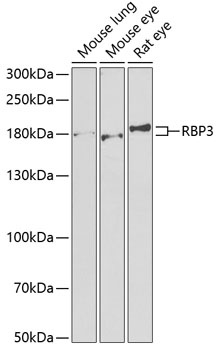
Western blot analysis of various lysates using RBP3 Rabbit pAb (CAB6403) at 1:1000 dilution. Secondary antibody: HRP-conjugated Goat anti-Rabbit IgG (H+L) (AS014) at 1:10000 dilution. Lysates/proteins: 25μg per lane. Blocking buffer: 3% nonfat dry milk in TBST. Detection: ECL Basic Kit (AbGn00020). Exposure time: 90s.