Description
Recombinant Human HMGB1 Protein
The Recombinant Human HMGB1 Protein is a biologically active recombinant protein that plays a significant role in various cellular processes and signaling pathways in human biology. This protein is widely employed in immunological research, cell biology studies, protein-protein interaction analyses, and therapeutic development, providing researchers with a reliable tool for investigating HMGB1 function and its implications in health and disease.
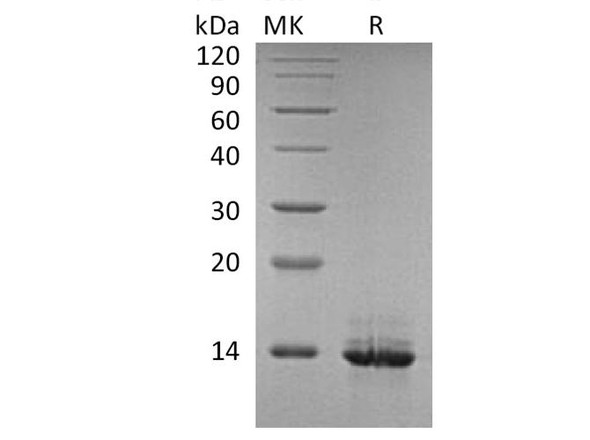
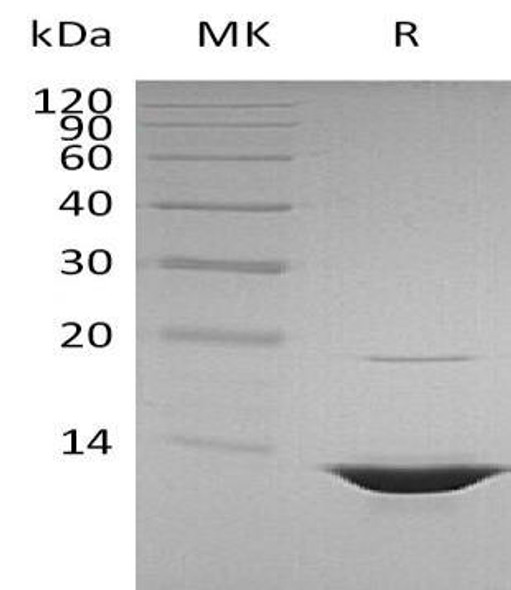
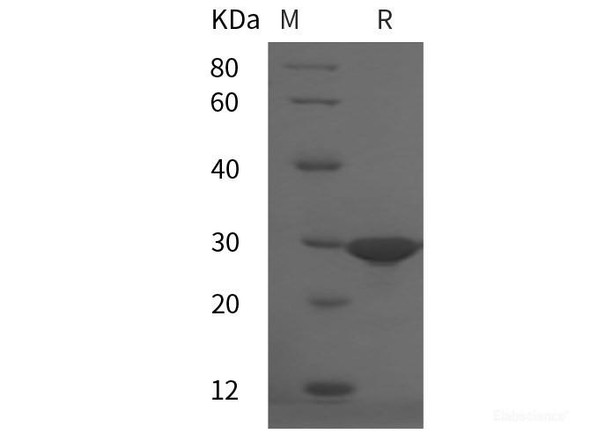
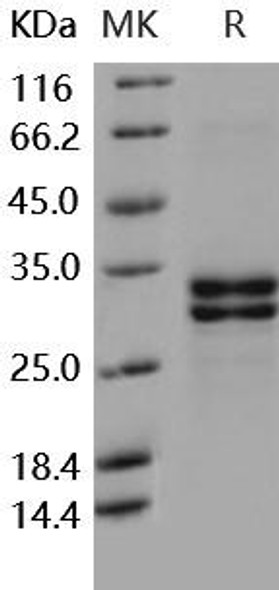
This product (SKU: RPCB0177) is produced using HEK293 cells and features a C-His tag for convenient detection and purification. The protein exhibits a calculated molecular weight of 25.74 kDa with an observed molecular weight of 30 kDa under denaturing conditions, achieving ≥ 95 % as determined by SDS-PAGE.. Functional bioactivity has been validated through rigorous quality control assays, confirming its suitability for demanding research applications.
Key Features
| High Purity by Affinity Chromatography | |
| Mammalian & Bacterial Expression Systems | |
| High lot-to-lot consistency via strict QC |
| Product Name: | Recombinant Human HMGB1 Protein |
| SKU: | RPCB0177 |
| Size: | 10 μg , 20 μg , 50 μg , 100 μg |
| Reactivity: | Human |
| Synonyms: | HMG-1, HMG1, HMG3, SBP-1, HMGB1 |
| Tag: | C-His |
| Expression Host: | HEK293 cells |
| Calculated MW: | 25.74 kDa |
| Observed MW: | 30 kDa |
| Gene ID: | 3146 |
| Protein Description: | High quality, high purity and low endotoxin recombinant Recombinant Human HMGB1 Protein (RPCB0177), tested reactivity in HEK293 cells and has been validated in SDS-PAGE.100% guaranteed. |
| Endotoxin: | < 1 EU/μg of the protein by LAL method. |
| Purity: | ≥ 95 % as determined by SDS-PAGE. |
| Formulation: | Lyophilized from a 0.22 μm filtered solution of PBS, pH 7.4.Contact us for customized product form or formulation. |
| Bio-Activity: | Measured by its binding ability in a functional ELISA. Immobilized Human HMGB1 (Cat: RP) at 2μg/mL (100 μL/well) can bind Human AGER/RAGE (Cat: RPCB0249) with a linear range of 0.1-42.8 ng/mL. |
| Reconstitution: | Centrifuge the vial before opening. Reconstitute to a concentration of 0.1-0.5 mg/mL in sterile distilled water. Avoid vortex or vigorously pipetting the protein. For long term storage, it is recommended to add a carrier protein or stablizer (e.g. 0.1% BSA, 5% HSA, 10% FBS or 5% Trehalose), and aliquot the reconstituted protein solution to minimize free-thaw cycles. |
| Storage: | Store at -20℃.Store the lyophilized protein at -20℃ to -80 ℃ up to 1 year from the date of receipt. After reconstitution, the protein solution is stable at -20℃ for 3 months, at 2-8℃ for up to 1 week. |
High-mobility group box 1 protein (HMGB1), also known as HMG-1 or amphoterin previously, is a member of the HMGB family consisting of three members, HMGB1, HMGB2 and HMGB3. Posttranslational modification of HMGB1, including acetylation, phosphorylation, and methylation, affects HMGB1 localization, receptor interactions, and bioactivity. HMGB1 can be localized to the nucleus or cytoplasm and can also be secreted despite its lack of a signal peptide. HMGB1 binds DNA in a non-sequence specific manner and may act as a structural cofactor during gene transcription.Acetylation of HMGB1 results in its cytoplasmic localization and eventual secretion. HMGB1 can be secreted by multiple cell types, and it is also released upon cell necrosis, apoptosis, and pyroptosis.
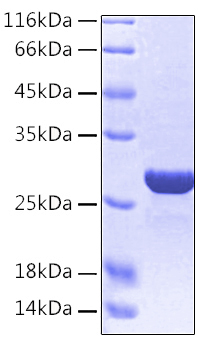 | Recombinant Human HMGB1 Protein was determined by SDS-PAGE under reducing conditions with Coomassie Blue. |
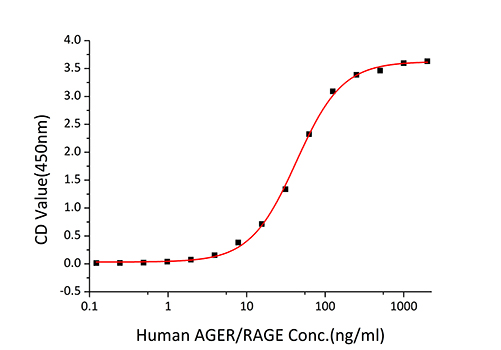 | Immobilized Human HMGB1 (Cat: RPCB0177) at 2μg/mL (100 μL/well) can bind Human AGER/RAGE (Cat: RPCB0249) with a linear range of 0.1-42.8 ng/mL. |