Description
Recombinant Human Mature TGF-beta 1 Protein
The Recombinant Human Mature TGF-beta 1 Protein is a biologically active recombinant protein that plays a significant role in various cellular processes and signaling pathways in human biology. This protein is widely employed in immunological research, cell biology studies, protein-protein interaction analyses, and therapeutic development, providing researchers with a reliable tool for investigating Mature TGF-beta 1 function and its implications in health and disease.
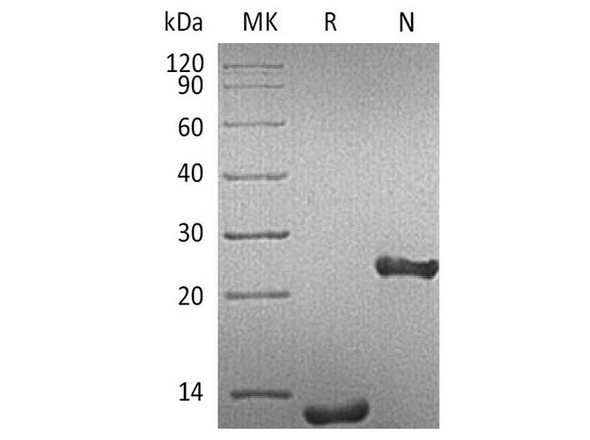
This product (SKU: RPCB0931) is produced using HEK293 cells and features a No tag tag for convenient detection and purification. The protein exhibits a calculated molecular weight of 12.79 kDa with an observed molecular weight of 15 kDa under denaturing conditions, achieving ≥ 95 % as determined by SDS-PAGE.. Functional bioactivity has been validated through rigorous quality control assays, confirming its suitability for demanding research applications.
Key Features
| High Purity by Affinity Chromatography | |
| Mammalian & Bacterial Expression Systems | |
| High lot-to-lot consistency via strict QC |
| Product Name: | Recombinant Human Mature TGF-beta 1 Protein |
| SKU: | RPCB0931 |
| Size: | 10 μg , 20 μg , 50 μg , 100 μg |
| Reactivity: | Human |
| Synonyms: | TGFB1, CED, DPD1, LAP, TGFB, TGFbeta, transforming growth factor beta-1, TGF-beta 1, CED, DPD1, LAP, TGFB, TGFbeta, TGF-β |
| Tag: | No tag |
| Expression Host: | HEK293 cells |
| Calculated MW: | 12.79 kDa |
| Observed MW: | 15 kDa |
| Gene ID: | 7040 |
| Protein Description: | High quality, high purity and low endotoxin recombinant Recombinant Human Mature TGF-beta 1 Protein (RPCB0931), tested reactivity in HEK293 cells and has been validated in SDS-PAGE.100% guaranteed. |
| Endotoxin: | < 0.01 EU/μg of the protein by LAL method. |
| Purity: | ≥ 95 % as determined by SDS-PAGE. |
| Formulation: | Lyophilized from a 0.22 μm filtered solution of 50 mM Glycine,150 mM NaCl,pH3.5. |
| Bio-Activity: |
|
| Reconstitution: | Centrifuge the vial before opening. Reconstitute to a concentration of 0.1-0.5 mg/mL in sterile distilled water. Avoid vortex or vigorously pipetting the protein. For long term storage, it is recommended to add a carrier protein or stablizer (e.g. 0.1% BSA, 5% HSA, 10% FBS or 5% Trehalose), and aliquot the reconstituted protein solution to minimize free-thaw cycles. |
| Storage: | Store at -20℃.Store the lyophilized protein at -20℃ to -80 ℃ up to 1 year from the date of receipt. After reconstitution, the protein solution is stable at -20℃ for 3 months, at 2-8℃ for up to 1 week. |
TGF-beta 1 is a member of the transforming growth factor beta (TGF-beta) family. The transforming growth factor-beta family of polypeptides are involved in the regulation of cellular processes, including cell division, differentiation, motility, adhesion and death. TGF-beta 1 positively and negatively regulates many other growth factors. It inhibits the secretion and activity of many other cytokines including interferon-γ, tumor necrosis factor-alpha and various interleukins. It can also decrease the expression levels of cytokine receptors. Meanwhile, TGF-beta 1 also increases the expression of certain cytokines in T cells and promotes their proliferation, particularly if the cells are immature. TGF-beta 1 also inhibits proliferation and stimulates apoptosis of B cells, and plays a role in controlling the expression of antibody, transferrin and MHC class II proteins on immature and mature B cells. As for myeloid cells, TGF-beta 1can inhibit their proliferation and prevent their production of reactive oxygen and nitrogen intermediates. However, as with other cell types, TGF-beta 1 also has the opposite effect on cells of myeloid origin. TGF-beta 1 is a multifunctional protein that controls proliferation, differentiation and other functions in many cell types. It plays an important role in bone remodeling as it is a potent stimulator of osteoblastic bone formation, causing chemotaxis, proliferation and differentiation in committed osteoblasts. Once cells lose their sensitivity to TGF-beta1-mediated growth inhibition, autocrine TGF-beta signaling can promote tumorigenesis. Elevated levels of TGF-beta1 are often observed in advanced carcinomas, and have been correlated with increased tumor invasiveness and disease progression.
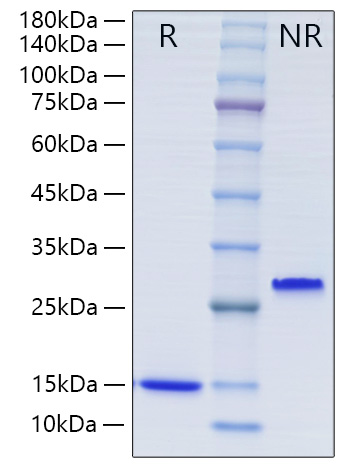 | Recombinant Human Mature TGF-beta 1 Protein was determined by SDS-PAGE under reducing (R) and non-reducing (NR) conditions. |
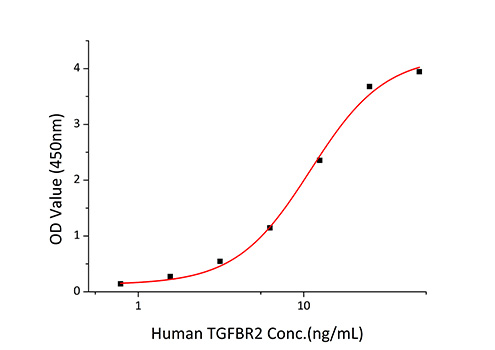 | Immobilized Human TGF-beta 1 at 2 μg/mL (100 μL/well) can bind Human TGFBR2 with a linear range of 0.78-11 ng/mL. |