Description
Recombinant Human Sonic hedgehog protein N-product/SHH (C24IVI) Protein
The Recombinant Human Sonic hedgehog protein N-product/SHH (C24IVI) Protein is a biologically active recombinant protein that plays a significant role in various cellular processes and signaling pathways in human biology. This protein is widely employed in immunological research, cell biology studies, protein-protein interaction analyses, and therapeutic development, providing researchers with a reliable tool for investigating Sonic hedgehog protein N-product/SHH (C24IVI) function and its implications in health and disease.
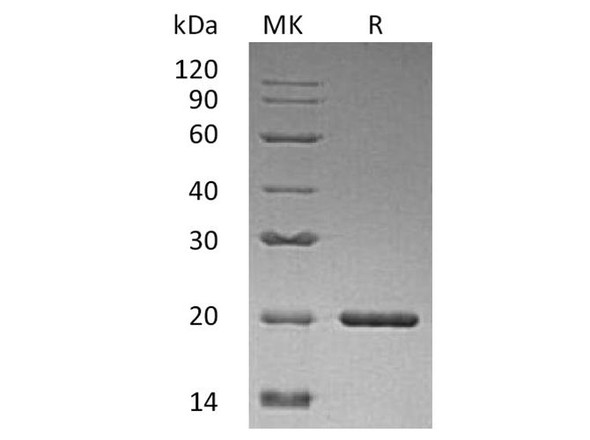
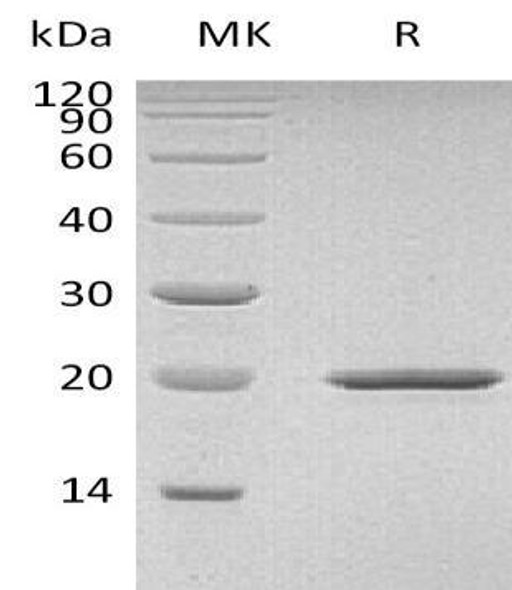
This product (SKU: RPCB0220) is produced using E. coli and features a No tag tag for convenient detection and purification. The protein exhibits a calculated molecular weight of 19.78 kDa with an observed molecular weight of 22 kDa under denaturing conditions, achieving ≥ 95 % as determined by SDS-PAGE;≥95 % as determined by HPLC.. Functional bioactivity has been validated through rigorous quality control assays, confirming its suitability for demanding research applications.
Key Features
| High Purity by Affinity Chromatography | |
| Mammalian & Bacterial Expression Systems | |
| High lot-to-lot consistency via strict QC |
| Product Name: | Recombinant Human Sonic hedgehog protein N-product/SHH (C24IVI) Protein |
| SKU: | RPCB0220 |
| Size: | 10 μg , 20 μg , 50 μg , 100 μg |
| Reactivity: | Human |
| Synonyms: | HHG1, HLP3, HPE3, MCOPCB5, SMMCI, TPT, TPTPS, SHH, HHG1, sonic hedgehog, HLP3, HPE3, MCOPCB5, SMMCI, TPT, TPTPS |
| Tag: | No tag |
| Expression Host: | E. coli |
| Calculated MW: | 19.78 kDa |
| Observed MW: | 22 kDa |
| Gene ID: | 6469 |
| Protein Description: | High quality, high purity and low endotoxin recombinant Recombinant Human Sonic hedgehog protein N-product/SHH(C24IVI) Protein (RPCB0220), tested reactivity in E. coli and has been validated in SDS-PAGE.100% guaranteed. |
| Endotoxin: | < 1 EU/μg of the protein by LAL method. |
| Purity: | ≥ 95 % as determined by SDS-PAGE;≥95 % as determined by HPLC. |
| Formulation: | Lyophilized from a 0.22 μm filtered solution of 20mM Tris, 300mM NaCl, pH 7.4.Contact us for customized product form or formulation. |
| Bio-Activity: | Measured by its ability to inhibit p53 expression in C3H10T1/2 mouse embryonic fibroblast cells. 1.25-2.5 μg/mL of Recombinant Human Sonic hedgehog can effectively decrease p53 expression. |
| Reconstitution: | Centrifuge the vial before opening. Reconstitute to a concentration of 0.1-0.5 mg/mL in sterile distilled water. Avoid vortex or vigorously pipetting the protein. For long term storage, it is recommended to add a carrier protein or stablizer (e.g. 0.1% BSA, 5% HSA, 10% FBS or 5% Trehalose), and aliquot the reconstituted protein solution to minimize free-thaw cycles. |
| Storage: | Store at -20℃.Store the lyophilized protein at -20℃ to -80 ℃ up to 1 year from the date of receipt. After reconstitution, the protein solution is stable at -20℃ for 3 months, at 2-8℃ for up to 1 week. |
This protein is instrumental in patterning the early embryo. It has been implicated as the key inductive signal in patterning of the ventral neural tube, the anterior-posterior limb axis, and the ventral somites. Of three human proteins showing sequence and functional similarity to the sonic hedgehog protein of Drosophila, this protein is the most similar. The protein is made as a precursor that is autocatalytically cleaved; the N-terminal portion is soluble and contains the signalling activity while the C-terminal portion is involved in precursor processing. More importantly, the C-terminal product covalently attaches a cholesterol moiety to the N-terminal product, restricting the N-terminal product to the cell surface and preventing it from freely diffusing throughout the developing embryo. Defects in this protein or in its signalling pathway are a cause of holoprosencephaly (HPE), a disorder in which the developing forebrain fails to correctly separate into right and left hemispheres. HPE is manifested by facial deformities. It is also thought that mutations in this gene or in its signalling pathway may be responsible for VACTERL syndrome, which is characterized by vertebral defects, anal atresia, tracheoesophageal fistula with esophageal atresia, radial and renal dysplasia, cardiac anomalies, and limb abnormalities.
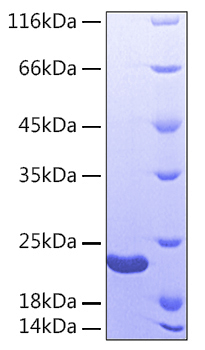 | Recombinant Human Sonic hedgehog protein N-product/SHH(C24IVI) Protein was determined by SDS-PAGE under reducing conditions with Coomassie Blue. |
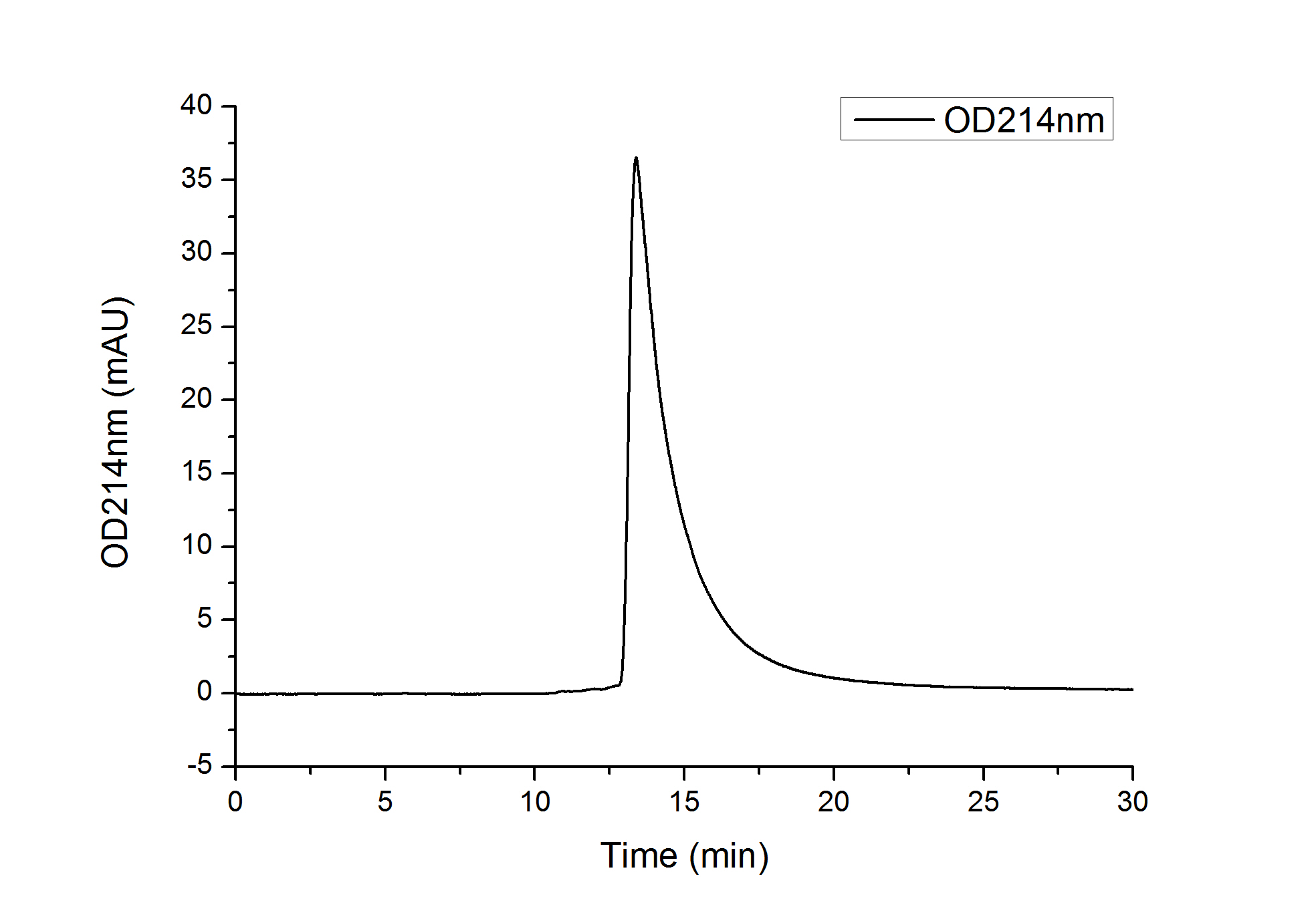 | The purity of Human Sonic hedgehog N-product Protein (RPCB0220) was greater than 95% as determined by SEC-HPLC. |