Tissue-type plasminogen activator (PLAT) is a protein that secreted into extracellular space. PLAT contains five domains: EGF-like domain, fibronectin type-I domain, 2 kringle domains and peptidase S1 domain. It belongs to the peptidase S1 family. The main function of this protein is to convert plasminogen into biologically active plasmin. As a protease, PLAT plays a crucial role in regulating blood fibrinolysis, maintaining the homeostasis of extracellular matrix and in modulating the post-translational activation of growth factors. PLAT is found not only in the blood, where its primary function is as a thrombolytic enzyme, but also in the central nervous system (CNS). It participates in a number of physiological and pathological events in the CNS, as well as the role of neuroserpin as the natural regulator of PLAT's activity in these processes. Increased or decreased activity of PLAT leads to hyperfibrinolysis or hypofibrinolysis, respectively. In addition, as a cytokine, PLAT plays a pivotal role in the pathogenesis of renal interstitial fibrosis through diverse mechanisms. Thus, as a fibrogenic cytokine, it promotes the progression of kidney diseases.
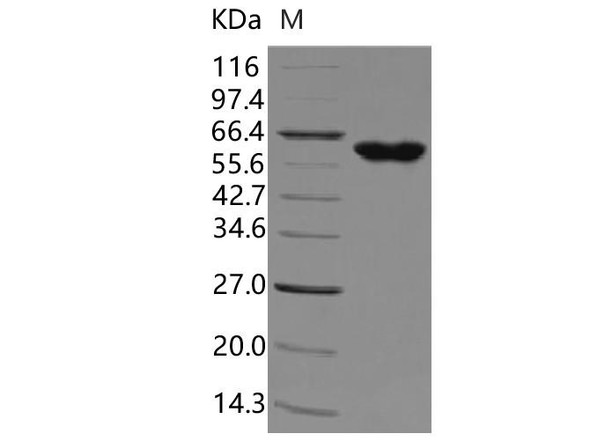
Recombinant Human Tissue-type plasminogen activator is produced by our Mammalian expression system and the target gene encoding Ser36-Pro562 is expressed with a 6His tag at the C-terminus.
Purity:
> 95 % as determined by reducing SDS-PAGE.
Mol Mass:
61.7 kDa
AP Mol Mass:
60 kDa
Formulation:
Lyophilized from a 0.2 µm filtered solution of 20mM MES,150mM NaCl,0.2mM GaCl2,pH5.5.
Shipping:
This product is provided as lyophilized powder which is shipped with ice packs.
Stability and Storage:
Lyophilized proteins are stable for up to 12 months when stored at -20 to -80°C. Reconstituted protein solution can be stored at 4-8°C for 2-7 days. Aliquots of reconstituted samples are stable at < -20°C for 3 months.