Description
Recombinant Mouse Hepatocyte growth factor/HGF Protein
The Recombinant Mouse Hepatocyte growth factor/HGF Protein is a high-quality recombinant protein designed for murine biological research applications. This protein serves as an essential reagent in mouse model studies, comparative immunology research, and preclinical therapeutic evaluations, enabling scientists to investigate Hepatocyte growth factor/HGF biology and its relevance to human disease mechanisms through translational research approaches.
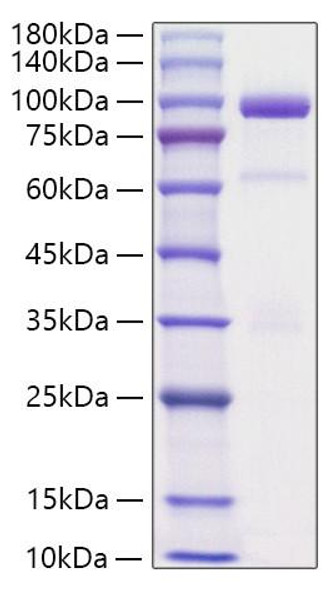
This product (SKU: RPCB1466) is produced using HEK293 cells and features a C-His tag for convenient detection and purification. The protein exhibits a calculated molecular weight of 80.18 kDa with an observed molecular weight of 35 kDa, 65 kDa, 90-100 kDa under denaturing conditions, achieving ≥ 95 % as determined by SDS-PAGE;≥ 95 % as determined by HPLC.. Functional bioactivity has been validated through rigorous quality control assays, confirming its suitability for demanding research applications.
Key Features
| High Purity by Affinity Chromatography | |
| Mammalian & Bacterial Expression Systems | |
| High lot-to-lot consistency via strict QC |
| Product Name: | Recombinant Mouse Hepatocyte growth factor/HGF Protein |
| SKU: | RPCB1466 |
| Size: | 10 μg , 20 μg , 50 μg , 100 μg |
| Reactivity: | Mouse |
| Synonyms: | SF, NK1, NK2, HGF/SF, SF/HGF, C230052L06Rik, HGF |
| Tag: | C-His |
| Expression Host: | HEK293 cells |
| Calculated MW: | 80.18 kDa |
| Observed MW: | 35 kDa, 65 kDa, 90-100 kDa |
| Gene ID: | 15234 |
| Protein Description: | High quality, high purity and low endotoxin recombinant Recombinant Mouse Hepatocyte growth factor/HGF Protein (RPCB1466), tested reactivity in HEK293 cells and has been validated in SDS-PAGE.100% guaranteed. |
| Endotoxin: | < 1 EU/μg of the protein by LAL method. |
| Purity: | ≥ 95 % as determined by SDS-PAGE;≥ 95 % as determined by HPLC. |
| Formulation: | Lyophilized from a 0.22 μm filtered solution of PBS, pH 7.4. |
| Bio-Activity: | Measured in a cell proliferation assay using Mv.1.lu cells. The ED 50 for this effect is 1.2-5.0 ng/mL, corresponding to a specific activity of 2×10 5 ~ 8.3×10 5 units/mg. |
| Reconstitution: | Centrifuge the vial before opening. Reconstitute to a concentration of 0.1-0.5 mg/mL in sterile distilled water. Avoid vortex or vigorously pipetting the protein. For long term storage, it is recommended to add a carrier protein or stablizer (e.g. 0.1% BSA, 5% HSA, 10% FBS or 5% Trehalose), and aliquot the reconstituted protein solution to minimize free-thaw cycles. |
| Storage: | Store at -20℃.Store the lyophilized protein at -20℃ to -80 ℃ up to 1 year from the date of receipt. After reconstitution, the protein solution is stable at -20℃ for 3 months, at 2-8℃ for up to 1 week. |
HGF, also known as Scatter Factor and Hepatopoietin A, is a pleiotropic protein in the Plasminogen subfamily of S1 peptidases. It is a multidomain molecule that includes an N-terminal PAN/APPLE-like domain, four Kringle domains, and a serine proteinase-like domain that has no detectable protease activity. Mouse HGF is secreted as an inactive 728 amino acid (aa) single chain propeptide. It is cleaved after the fourth Kringle domain by a serine protease to form bioactive disulfide-linked HGF with a 60kDa alpha and 30 kDa beta chain. Alternate splicing generates an isoform that lacks the peptidase and the second, third, and fourth Kringle domains. Mouse HGF shares 91%-95%aa sequence identity with bovine, canine, feline, human, and rat HGF. HGF binds heparan-sulfate proteoglycans and the widely expressed receptor tyrosine kinase, HGF R/c-MET. HGF dependent c-MET activation is implicated in the development of many human cancers. HGF regulates epithelial morphogenesis by inducing cell scattering and branching tubulogenesis. HGF induces the up regulation of integrin alpha 2 beta 1 in epithelial cells by a selective increase in alpha 2 gene transcription. This integrin serves as a collagen I receptor, and its blockade disrupts epithelial cell branching tubulogenesis. HGF can also alter epithelium morphology by the induction of nectin-1 alpha ectodomain shedding, an adhesion protein component of adherens junctions. In the thyroid, HGF induces the proliferation, motility, and loss of differentiation markers of thyrocytes and inhibits TSH-stimulated iodine uptake. HGF promotes the motility of cardiac stem cells in damaged myocardium.
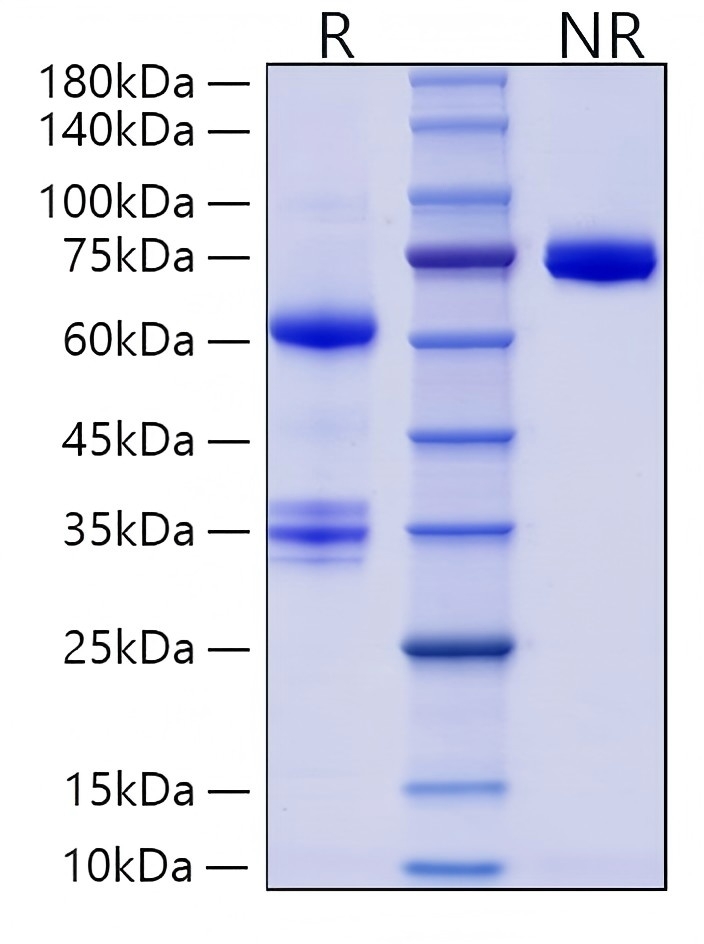 | Recombinant Mouse Hepatocyte growth factor/HGF Protein was determined by SDS-PAGE under reducing (R) and non-reducing (NR) conditions. |
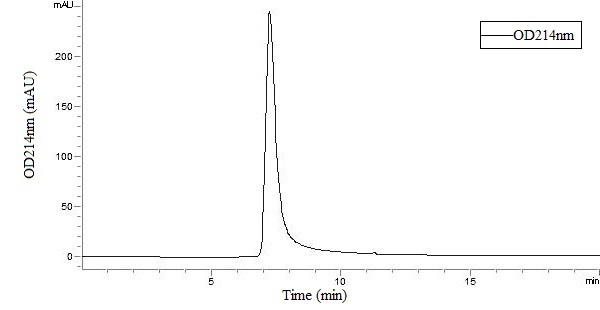 | The purity of Recombinant Mouse Hepatocyte growth factor/HGF Protein is greater than 95% as determined by SEC-HPLC. |