The Recombinant Mouse Hepcidin/HAMP Protein is a high-quality recombinant protein designed for murine biological research applications. This protein serves as an essential reagent in mouse model studies, comparative immunology research, and preclinical therapeutic evaluations, enabling scientists to investigate Hepcidin/HAMP biology and its relevance to human disease mechanisms through translational research approaches.
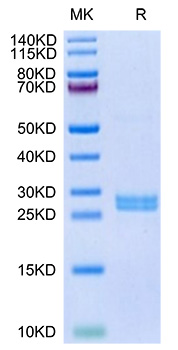
This product (SKU: RPCB1998) is produced using E. coli and features a N-GST tag for convenient detection and purification. The protein exhibits a calculated molecular weight of 29.05 kDa with an observed molecular weight of 29 kDa under denaturing conditions, achieving ≥ 95 % as determined by SDS-PAGE., ensuring exceptional quality and consistency for research applications.
High quality, high purity and low endotoxin recombinant Recombinant Mouse Hepcidin/HAMP Protein (RP02870LQ), tested reactivity in E. coli and has been validated in SDS-PAGE.100% guaranteed.
Endotoxin:
< 1 EU/μg of the protein by LAL method.
Purity:
≥ 95 % as determined by SDS-PAGE.
Formulation:
Supplied as a 0.22 μm filtered solution in 50 mM Tris-HCl, 150 mM NaCl, 2 mM DTT, pH 7.5.
Storage:
Store at -70℃. This product is stable at ≤ -70℃ for up to 1 year from the date of receipt. For optimal storage, aliquot into smaller quantities after centrifugation and store at recommended temperature. Avoid repeated freeze-thaw cycles.
Hepcidin, the main regulator of iron metabolism, is synthesized and released by hepatocytes in response to increased body iron concentration and inflammation. Deregulation of hepcidin expression is a common feature of genetic and acquired iron disorders: in Hereditary Hemochromatosis (HH) and iron-loading anemias low hepcidin causes iron overload, while in Iron Refractory Iron Deficiency Anemia (IRIDA) and anemia of inflammation (AI), high hepcidin levels induce iron-restricted erythropoiesis.
Recombinant Mouse Hepcidin/HAMP Protein was determined by SDS-PAGE under reducing conditions with Coomassie Blue.