Description
Recombinant Mouse IL-10 Protein
The Recombinant Mouse IL-10 Protein is a high-quality recombinant protein designed for murine biological research applications. This protein serves as an essential reagent in mouse model studies, comparative immunology research, and preclinical therapeutic evaluations, enabling scientists to investigate IL-10 biology and its relevance to human disease mechanisms through translational research approaches.
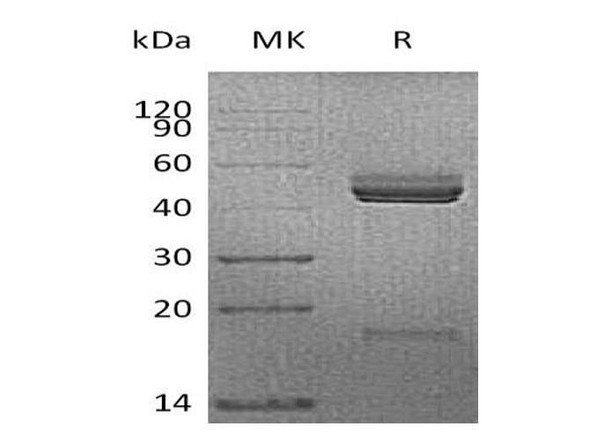
This product (SKU: RPCB0946) is produced using HEK293 cells and features a C-His tag for convenient detection and purification. The protein exhibits a calculated molecular weight of 19.59 kDa with an observed molecular weight of 20-24 kDa under denaturing conditions, achieving ≥ 90 % as determined by SDS-PAGE.. Functional bioactivity has been validated through rigorous quality control assays, confirming its suitability for demanding research applications.
Key Features
| High Purity by Affinity Chromatography | |
| Mammalian & Bacterial Expression Systems | |
| High lot-to-lot consistency via strict QC |
| Product Name: | Recombinant Mouse IL-10 Protein |
| SKU: | RPCB0946 |
| Size: | 10 μg , 20 μg , 50 μg , 100 μg |
| Reactivity: | Mouse |
| Synonyms: | IL-, CSIF, If2a, Il-10, IL10 |
| Tag: | C-His |
| Expression Host: | HEK293 cells |
| Calculated MW: | 19.59 kDa |
| Observed MW: | 20-24 kDa |
| Gene ID: | 16153 |
| Protein Description: | High quality, high purity and low endotoxin recombinant Recombinant Mouse IL-10 Protein (RPCB0946), tested reactivity in HEK293 cells and has been validated in SDS-PAGE.100% guaranteed. |
| Endotoxin: | < 0.1 EU/μg of the protein by LAL method. |
| Purity: | ≥ 90 % as determined by SDS-PAGE. |
| Formulation: | Lyophilized from a 0.22 μm filtered solution of PBS, pH 7.4. |
| Bio-Activity: | Measured in a cell proliferation assay using MC/9-2 mouse mast cells. The ED 50 for this effect is 0.2-0.8 ng/mL, corresponding to a specific activity of 1.25×10 6 -5×10 6 units/mg. |
| Reconstitution: | Centrifuge the vial before opening. Reconstitute to a concentration of 0.1-0.5 mg/mL in sterile distilled water. Avoid vortex or vigorously pipetting the protein. For long term storage, it is recommended to add a carrier protein or stablizer (e.g. 0.1% BSA, 5% HSA, 10% FBS or 5% Trehalose), and aliquot the reconstituted protein solution to minimize free-thaw cycles. |
| Storage: | Store at -20℃.Store the lyophilized protein at -20℃ to -80 ℃ up to 1 year from the date of receipt. After reconstitution, the protein solution is stable at -20℃ for 3 months, at 2-8℃ for up to 1 week. |
IL-10 is an anti-inflammatory cytokine that belongs to the IL-10 family. It is produced by a variety of cell lines, including T-cells, macrophages, mast cells, and other cell types, while it is produced primarily by monocytes and to a lesser extent by lymphocytes. IL-10 is mainly expressed in monocytes and Type 2 T helper cells (TH2), mast cells, CD4+CD25+Foxp3+ regulatory T cells, and also in a certain subset of activated T cells and B cells. IL-10 has pleiotropic effects in immunoregulation and inflammation. It down-regulates the expression of Th1 cytokines, MHC class II Ags, and costimulatory molecules on macrophages. It also enhances B cell survival, proliferation, and antibody production. IL-10 can block NF-kappa B activity and is involved in the regulation of the JAK-STAT signaling pathway. Knockout studies in mice suggested the function of this cytokine as an essential immunoregulator in the intestinal tract. The importance of interleukin 10 for counteracting excessive immunity in the human body is revealed by the fact that patients with Crohn‘s disease react favorably towards treatment with bacteria producing recombinant IL-10. IL-10 inhibits the synthesis of some cytokines, including IFN-gamma, IL-2, IL-3, TNF, and GM-CSF produced by activated macrophages and by helper T-cells. It also displays a potent ability to suppress the antigen-presentation capacity of antigen-presenting cells. However, it is also stimulatory towards certain T cells and mast cells and stimulates B cell maturation and antibody production.
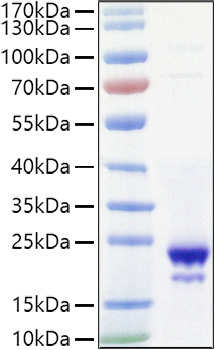 | Recombinant Mouse IL-10 Protein was determined by SDS-PAGE under reducing conditions with Coomassie Blue. |
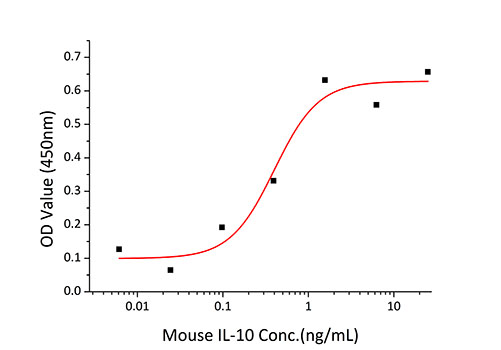 | Recombinant Mouse IL-10 promotes proliferation of MC/9 2 mouse mast cells. The ED50 for this effect is 0.2-0.8 ng/mL, corresponding to a specific activity of 1.25×10⁶-5×10⁶ units/mg. |