Description
Recombinant Mouse NCAM-1/CD56 Protein
The Recombinant Mouse NCAM-1/CD56 Protein is a high-quality recombinant protein designed for murine biological research applications. This protein serves as an essential reagent in mouse model studies, comparative immunology research, and preclinical therapeutic evaluations, enabling scientists to investigate NCAM-1/CD56 biology and its relevance to human disease mechanisms through translational research approaches.
This product (SKU: RPCB0015) is produced using advanced expression systems and features a C-Avi&His tag for convenient detection and purification. The protein exhibits a calculated molecular weight of 79.31 kDa with an observed molecular weight of 100-130 under denaturing conditions, achieving ≥ 95 % as determined by SDS-PAGE., ensuring exceptional quality and consistency for research applications.
Key Features
| High Purity by Affinity Chromatography | |
| Mammalian & Bacterial Expression Systems | |
| High lot-to-lot consistency via strict QC |
| Product Name: | Recombinant Mouse NCAM-1/CD56 Protein |
| SKU: | RPCB0015 |
| Size: | 10 μg , 20 μg , 50 μg , 100 μg |
| Reactivity: | Mouse |
| Synonyms: | Ncam1, Ncam, Neural cell adhesion molecule 1, N-CAM-1, NCAM-1, CD56 |
| Tag: | C-Avi&His |
| Calculated MW: | 79.31 kDa |
| Observed MW: | 100-130 |
| Gene ID: | 17967 |
| Protein Description: | High quality, high purity and low endotoxin recombinant Recombinant Mouse NCAM-1/CD56 Protein (RPCB0015), tested reactivity in HEK293 cells and has been validated in SDS-PAGE.100% guaranteed. |
| Endotoxin: | < 0.01 EU/μg of the protein by LAL method |
| Purity: | ≥ 95 % as determined by SDS-PAGE. |
| Formulation: | Lyophilized from a 0.22 μm filtered solution of PBS, pH 7.4. |
| Reconstitution: | Centrifμge the vial before opening. Reconstitute to a concentration of 0.1-0.5 mg/mL in sterile distilled water. Avoid vortex or vigorously pipetting the protein. For long term storage, it is recommended to add a carrier protein or stablizer (e.g. 0.1% BSA, 5% HSA, 10% FBS or 5% Trehalose), and aliquot the reconstituted protein solution to minimize free-thaw cycles. |
| Storage: | Store at -20℃. Store the lyophilized protein at -20℃ to -80℃ up to 1 year from the date of receipt. After reconstitution, the protein solution is stable at -20℃ for 3 months, at 2-8℃ for up to 1 week. |
Neural cell adhesion molecule 1 (NCAM-1; also CD56) is a membrane-bound glycoprotein that plays an important role in nervous system development and function. Mature mouse NCAM-1 consists of a 692 amino acid (aa) extracellular domain (ECD) with five tandem Ig-like domains and two fibronectin type III domains, an 18 aa transmembrane segment, and a 386 aa cytoplasmic domain. Three major splice variants of NCAM-1 are expressed: the 180 kDa full length NCAM-180 isoform, the 140 kDa NCAM-140 isoform which lacks most of the cytoplasmic domain, and the 120 kDa GPI-anchored NCAM-120 isoform that includes the ECD only. Splicing is tissue specific and developmentally regulated. Within the ECD, mouse NCAM-1 shares 94% and 95% aa sequence identity with human and rat NCAM-1, respectively. It is expressed on neurons and glial cells, skeletal muscle, and immune NK cells. NCAM-1 is extensively modified with polysialic acid (PSA) during development, but this addition is decreased in adult tissues. Polysialylation of NCAM-1 is retained in the adult hippocampus where it is important for synaptic plasticity and memory formation. The PSA moiety also participates in the binding of NCAM-1 to heparan sulfate proteoglycans and NCAM-1 mediated migration of olfactory neurons. Proteolytic shedding of NCAM-1 liberates a soluble ECD fragment that can inhibit cortical neurite branching and growth. The NCAM-140 isoform is preferentially expressed on NK cells that robustly secrete cytokines upon activation. Selective up‑regulation of the NCAM-140 isoform in a variety of tumors initiates epithelial-mesenchymal transition (EMT) and promotes tumor cell invasion. Finally, NCAM-1 is known to interact with a number of transmembrane and extracellular molecules. NK cell NCAM-1 binds to T cell FGF R1, co-stimulating IL-2 production by T cells. NCAM-1 also forms a noncovalent membrane complex with GFR alpha 1, 2 and 4, generating a receptor for GDNF, NTN and PSP, respectively. And NCAM-1 is reported to form homophilic trans-interactions, and to interact with L1 CAM in cis, and with HSPGs (agrin and collagen XVIII) in trans. In general, these interactions are involved in cell adhesion, migration, and/or process extension.
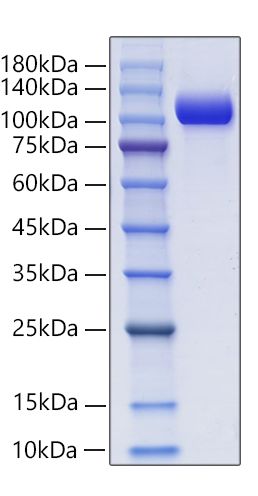 | Recombinant Mouse NCAM-1/CD56 Protein was determined by SDS-PAGE under reducing conditions with Coomassie Blue. |