Description
Recombinant Mouse/Rat Mature TGF-beta 1 Protein
The Recombinant Mouse/Rat Mature TGF-beta 1 Protein is a high-quality recombinant protein designed for murine biological research applications. This protein serves as an essential reagent in mouse model studies, comparative immunology research, and preclinical therapeutic evaluations, enabling scientists to investigate Recombinant Mouse/Rat Mature TGF-beta 1 biology and its relevance to human disease mechanisms through translational research approaches.
This product (SKU: RPCB0738) is produced using HEK293 cells and features a No tag tag for convenient detection and purification. The protein exhibits a calculated molecular weight of 12.81 kDa with an observed molecular weight of 15 kDa under denaturing conditions, achieving ≥ 95 % as determined by SDS-PAGE.. Functional bioactivity has been validated through rigorous quality control assays, confirming its suitability for demanding research applications.
Key Features
| High Purity by Affinity Chromatography | |
| Mammalian & Bacterial Expression Systems | |
| High lot-to-lot consistency via strict QC |
| Product Name: | Recombinant Mouse/Rat Mature TGF-beta 1 Protein |
| SKU: | RPCB0738 |
| Size: | 10 μg , 20 μg , 50 μg , 100 μg |
| Reactivity: | Mouse |
| Synonyms: | TGF-beta1, Tgfb, Tgfb-1, TGFbeta1, CED, DPD1, LAP, TGFB, TGFbeta, TGFB1 |
| Tag: | No tag |
| Expression Host: | HEK293 cells |
| Calculated MW: | 12.81 kDa |
| Observed MW: | 15 kDa |
| Gene ID: | 21803 |
| Protein Description: | High quality, high purity and low endotoxin recombinant Recombinant Mouse/Rat Mature TGF-beta 1 Protein (RPCB0738), tested reactivity in HEK293 cells and has been validated in SDS-PAGE.100% guaranteed. |
| Endotoxin: | < 0.01 EU/μg of the protein by LAL method |
| Purity: | ≥ 95 % as determined by SDS-PAGE. |
| Formulation: | Lyophilized from a 0.2 μm filtered solution of 50 mM Glycine,150 mM NaCl, pH3.5. Contact us for customized product form or formulation. |
| Bio-Activity: | Measured by its ability to inhibit the IL-4-dependent proliferation of HT-2 Mouse T cells. The ED 50 for this effect is 0.054-0.214 ng/mL, corresponding to a specific activity of 4.7×10 6 ~1.85×10 7 units/mg. |
| Reconstitution: | Centrifuge the vial before opening. Reconstitute to a concentration of 0.1-0.5 mg/mL in sterile distilled water. Avoid vortex or vigorously pipetting the protein. For long term storage, it is recommended to add a carrier protein or stablizer (e.g. 0.1% BSA, 5% HSA, 10% FBS or 5% Trehalose), and aliquot the reconstituted protein solution to minimize free-thaw cycles. |
| Storage: | Store at -20℃.Store the lyophilized protein at -20℃ to -80 ℃ up to 1 year from the date of receipt. After reconstitution, the protein solution is stable at -20℃ for 3 months, at 2-8℃ for up to 1 week. |
Transforming growth factor beta 1 (TGFβ1) is the prototype of a growing superfamily of peptide growth factorsand plays a prominent role in a variety of cellular processes, including cell-cycle progression, celldifferentiation,reproductivefunction,development,motility,adhesion,neuronalgrowth,bonemorphogenesis, wound healing, and immune surveillance. TGF- β 1, TGF- β 2 and TGF- β 3 signal via the sameheteromeric receptor complex, consisting of a ligand binding TGF- β receptor type II (T β R-II), and a TGF- βreceptor type I (T β R-I). Signal transduction from the receptor to the nucleus is mediated via SMADs. TGF- βexpression is found in cartilage, bone, teeth, muscle, heart, blood vessels, haematopoitic cells, lung, kidney,gut, liver, eye, ear, skin, and the nervous system.
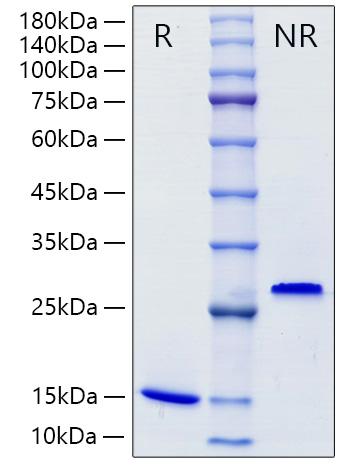 | Recombinant Mouse/Rat Mature TGF-beta 1 Protein was determined by SDS-PAGE under reducing (R) and non-reducing (NR) conditions. |
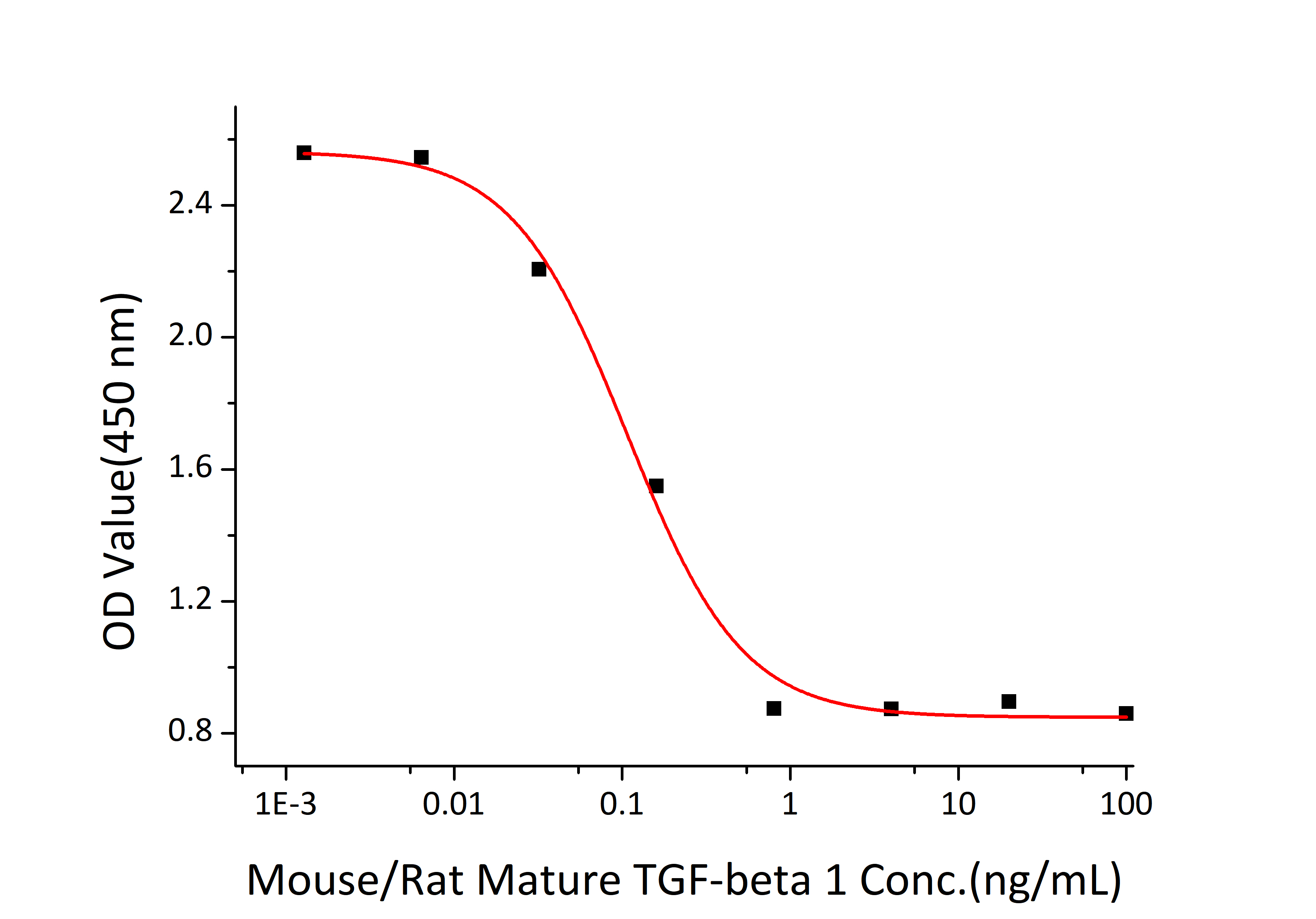 | Recombinant Mouse/Rat Mature TGF-beta 1 inhibit the IL-4-dependent proliferation of HT-2 mouse T cells. The ED50 for this effect is 0.054-0.214 ng/mL, corresponding to a specific activity of 4.7×10⁶~1.85×10⁷ units/mg. |