The SAA1 Antibody (CAB14553) is a high-quality antibody developed for reliable detection and analysis of target proteins. This antibody, produced in rabbits, shows high reactivity with human samples and is validated for use in Western blot applications. By binding to the SAA1 protein, it enables accurate detection and analysis in different cell types, making it a valuable tool for studies in immunology, inflammation, and disease research.SAA1, a member of the SAA family of proteins, is known for its role in the acute-phase response to inflammation and infection.
This antibody is validated for use in WB, ELISA applications and has demonstrated reactivity against Human, Mouse, Rat samples.
Product Name:
SAA1 Antibody
SKU:
CAB14553
Size:
20μL, 100μL
Reactivity:
Human, Mouse, Rat
Conjugate:
Unconjugated
Immunogen:
Synthetic peptide. This information is considered to be commercially sensitive.
Sequence:
MKLL TGLV FCSL VLGV SSRS FFSF LGEA FDGA RDMW RAYS DMRE ANYI GSDK YFHA RGNY DAAK RGPG GAWA AEVI SDAR ENIQ RFFG HGAE DSLA DQAA
Tested Applications:
WBELISA
Recommended Dilution:
WB
1:500 - 1:2000
ELISA
Recommended starting concentration is 1 μg/mL. Please optimize the concentration based on your specific assay requirements. For high-ratio antibody dilutions (≥1:10000),a sequential dilution method is strongly recommended to ensure measurement accuracy.
Synonyms:
SAA, PIG4, SAA2, TP53I4, SAA1
Positive Sample:
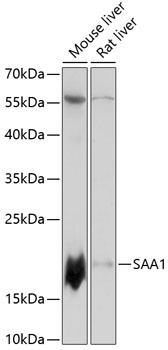
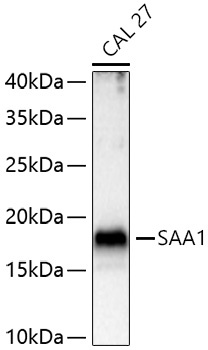
Mouse liver, Rat liver, CAL 27
Cellular Localization:
Secreted.
Calculated MW:
12kDa
Observed MW:
16kDa
This gene encodes a member of the serum amyloid A family of apolipoproteins. The encoded preproprotein is proteolytically processed to generate the mature protein. This protein is a major acute phase protein that is highly expressed in response to inflammation and tissue injury. This protein also plays an important role in HDL metabolism and cholesterol homeostasis. High levels of this protein are associated with chronic inflammatory diseases including atherosclerosis, rheumatoid arthritis, Alzheimer's disease and Crohn's disease. This protein may also be a potential biomarker for certain tumors. Finally, antimicrobial activity against S. aureus and E. coli resides in the N-terminal portion of the mature protein. Alternate splicing results in multiple transcript variants that encode the same protein. A pseudogene of this gene is found on chromosome 11.
Purification Method
Affinity purification
Gene ID
6288
RRID
AB_2761429
Buffer Information
Store at -20℃. Avoid freeze / thaw cycles. Buffer: PBS with 0.09% Sodium azide,50% glycerol,pH7.3.
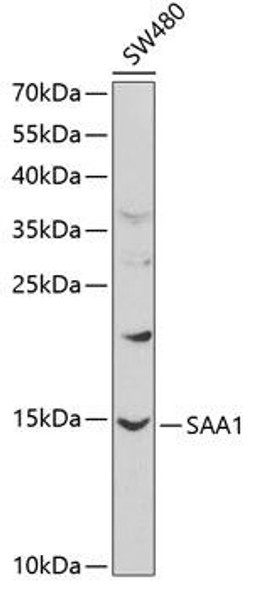
Western blot analysis of various lysates using SAA1 Rabbit pAb (CAB14553) at 1:3000 dilution. Secondary antibody: HRP-conjugated Goat anti-Rabbit IgG (H+L) (CABS014) at 1:10000 dilution. Lysates/proteins: 25μg per lane. Blocking buffer: 3% nonfat dry milk in TBST. Detection: ECL Basic Kit (AbGn00020). Exposure time: 30s.
Western blot analysis of lysates from CAL 27 cells using SAA1 Rabbit pAb (CAB14553) at 1:1000 dilution incubated overnight at 4℃. Secondary antibody: HRP-conjugated Goat anti-Rabbit IgG (H+L) (CABS014) at 1:10000 dilution. Lysates/proteins: 25 μg per lane. Blocking buffer: 3% nonfat dry milk in TBST. Detection: ECL Basic Kit (AbGn00020). Exposure time: 60 s.